Key Takeaways
- Colour night vision cameras typically cost $250–$600+ each installed, versus $150–$350 for infrared equivalents.
- NSW installers need a Class 2C security licence; SA requires its own security installer licence under the Security and Investigation Industry Act.
- Colour night vision pays off where identification matters — driveways, shopfronts, entrances — but IR suits perimeter coverage on a budget.
- You can mix colour and infrared cameras on one NVR, letting you spend the premium only where it counts.
How Do You Decide Where You Need Identification Before Buying CCTV?
The short answer: colour night vision CCTV costs between $250 and $600+ per camera professionally installed in Australia, while infrared-only units typically run $150 to $350. For Newcastle and Adelaide homeowners and business owners, the right choice depends less on the price gap and more on whether you need identification-grade footage after dark. This guide compares both technologies across equipment, installation, storage and running costs so you can budget with confidence.
That distinction drives every cost decision in this article. If you only need detection — knowing something moved near a fence line or inside a storeroom — infrared does the job for less money. If you need identification — working out who approached your front door or what vehicle entered your yard after hours — colour night vision is worth its premium, but you don't need it everywhere.
There's also a middle category: Starlight or low-light sensors, which hold colour in dim ambient conditions before switching to black-and-white infrared once light drops too far. True colour night vision models keep colour much deeper into darkness.
What Does Colour Night Vision Cost Compared With Infrared in Australia?
For professional-grade equipment fitted by a licensed installer, colour night vision cameras typically run between $250 and $600+ each, against $150 to $400 for an equivalent infrared turret or bullet model — a [[budget-vs-premium-cctv-is-it-worth-spending-more-on-security-cameras|premium]] of roughly 30-60% depending on resolution, brand and features.
On a standard four-camera Sydney home [[dahua-cctv-cost-breakdown-from-entry-level-to-enterprise-in-australia|installation]], going colour across the board adds around $400 to $800 to the total system price. Scale that to a 16-camera commercial site and the gap reaches several thousand dollars — which is exactly why most businesses we work with don't buy colour everywhere.
One warning about bargain-bin retail kits: many consumer 'colour night vision' cameras are really spotlight cameras that only switch on when motion triggers them. By the time the light fires, whoever's there is already well onto your property. Professional ColorVu and Full-Colour cameras hold continuous colour all night — a fundamentally different level of performance, and the reason they cost more.
Where Does the Extra Money Actually Go in Colour Night Vision Cameras?
The premium isn't marketing — it's physics and optics. Colour night vision cameras need larger, more sensitive image sensors, commonly 1/1.8 inch or bigger versus the 1/2.8 inch chips in budget IR cameras. They pair those sensors with wide-aperture F1.0 lenses that admit four times more light than a standard F2.0 lens, and precision glass like that isn't cheap to manufacture.
Many models also add built-in warm white LED lighting, heavier-duty housings built to survive Australian heat, and stronger onboard processing. Add AI detection such as Hikvision AcuSense — which filters out false triggers from animals, rain and swaying branches — and you're paying for a genuinely more capable device.
Installation labour barely differs between the two types. Both typically run over Power over Ethernet (PoE) cabling back to an NVR, so the cost difference sits almost entirely in the camera hardware itself.
- Larger, more sensitive image sensors (often 1/1.8 inch or bigger)
- Wide-aperture F1.0 lenses gathering far more light than standard F2.0 optics
- Built-in warm white supplemental lighting on many models
- More powerful onboard processing for AI features like AcuSense
- Ruggedised housings suited to harsh Australian conditions
Should You Budget Beyond the Sticker Price for Power, Storage and Ambient Light?
The upfront figure isn't the whole story. Cameras with supplemental lighting draw slightly more power than IR-only units, though on a PoE [[how-much-does-a-4-camera-cctv-system-cost-in-australia|system]] the impact on your electricity bill is small — usually just a few dollars per camera per year.
Storage deserves more attention. Full-colour night footage carries more visual information than monochrome IR video, so continuous high-resolution recording fills drives faster. We generally recommend pairing colour cameras with smart motion or AI-triggered recording and sizing the NVR drive accordingly. For most homes, a 4TB to 8TB surveillance-grade drive comfortably handles a four-to-eight-camera colour system with 14 to 30 days of retention.
The cost that catches people out is ambient light. Colour night vision performs best with at least some light — a streetlight, porch light or the camera's own warm LEDs. On a rural property or unlit commercial yard with zero ambient light, you may need extra lighting infrastructure, or better results from quality infrared or thermal cameras in those zones.
When Does the Colour Night Vision Premium Pay Off — and When Doesn't It?
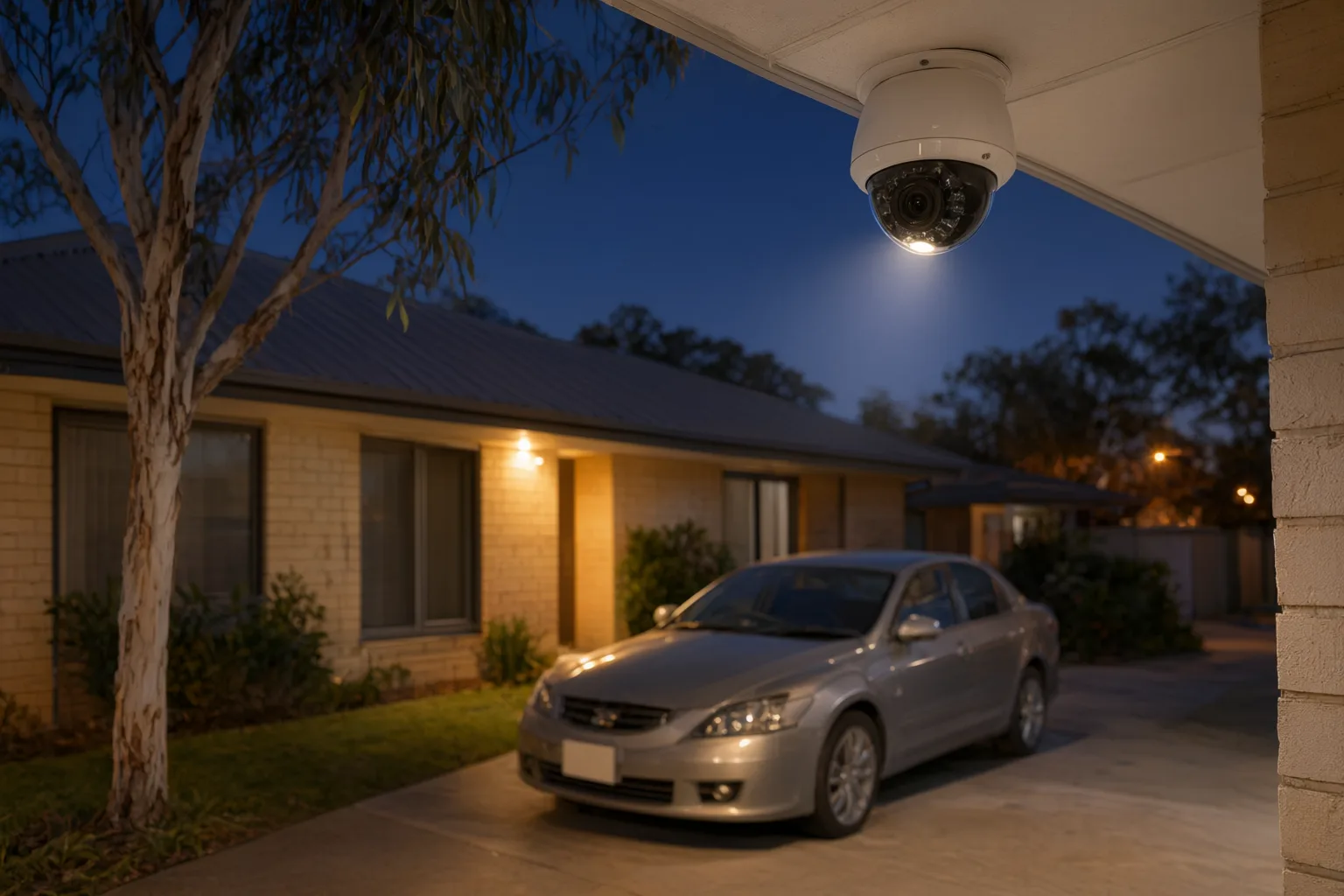
Colour night vision earns its keep wherever identification matters. Someone approaching your front door, crossing your driveway or entering your shop after hours should be captured in colour: clothing, hair, vehicles and bags all become usable evidence for police and insurers. Black-and-white IR can confirm a person was there; colour footage helps establish who it was.
For homes, we typically place colour cameras at the front entrance, driveway and side access points — the routes an intruder would actually take. For commercial clients, colour covers entrances, loading docks, tills and car parks, while standard infrared handles internal corridors, storage areas and fence lines where simple detection suffices.
This hybrid approach is where a professional consultation earns its fee. Instead of paying the colour premium on every camera, a well-designed system concentrates the expensive units where they deliver value and uses cost-effective infrared everywhere else.
Which CCTV System Matches Your Property and Budget in Newcastle or Adelaide?
As a rough guide for Australian budgets: a professionally installed four-camera infrared system typically starts in the low-to-mid thousands, and adding colour night vision at key positions costs a few hundred dollars more rather than doubling the price. Going colour on every camera rarely makes sense unless you operate a high-risk retail or commercial site.
Whichever way you lean, insist on professional-grade hardware from Hikvision, Dahua, Uniview or Axis rather than consumer DIY kits. The night-time performance gap between a genuine ColorVu turret and a $99 spotlight camera is enormous — and Australian conditions punish cheap gear. Summer heat, coastal salt air and storm season all take their toll.
At Aussie CCTV Cams, every job begins with a free on-site consultation where we assess your lighting conditions, layout and budget, then design a system balancing colour and infrared cameras for maximum value. Our licensed and insured NSW installers manage everything from cabling to NVR configuration and handover training, backed by lifetime support. If you're weighing up colour night vision versus infrared, get in touch for a free quote and we'll show you exactly how each option would perform on your property.
Can You Mix Colour Night Vision and Infrared Cameras on One NVR System?
Do Colour Night Vision Cameras Need a Licensed Installer in NSW or SA?
Licensing rules also shape what you pay across both cities. In NSW, installers must hold a Class 2C security licence issued by NSW Police, while South Australian technicians operate under security agent registration through Consumer and Business Services (CBS). Licensed professionals carry insurance, understand the Surveillance Devices Act 2007 (NSW) and SA's Surveillance Devices Act 2016, and will position cameras so they don't record neighbours' property — protecting you from privacy complaints and ensuring your footage remains admissible evidence for police and insurers in [[/newcastle|Newcastle]] or [[/adelaide|Adelaide]].
Colour Night Vision vs Infrared CCTV: Cost Comparison for Newcastle & Adelaide
| Option | Typical Cost per Camera (Installed) | Best Suited To |
|---|---|---|
| Infrared bullet/turret | $150 – $350 | Perimeter fences, garages, budget builds |
| Colour night vision (starlight) | $250 – $450 | Driveways and entries with ambient light |
| Colour night vision + white LED | $350 – $600+ | Shopfronts, front doors, total-darkness zones |
| Hybrid mix (2 colour + 4 IR) | $1,900 – $3,000 total | Homes wanting ID where it matters |
| Commercial 8-camera colour system | $6,500 – $12,000 total | Retail, warehouses and farms |