
Key Takeaways
- Hybrid NVR-plus-cloud setups suit most Australian businesses better than choosing one option alone
- Local NVRs cost $800–$2,500 upfront while cloud runs $10–$30 per camera per month ongoing
- NSW businesses typically retain footage 30 days; check the Privacy Act and workplace surveillance rules
- NBN upload speed limits continuous cloud recording — one 4K stream can saturate a typical connection
Which Storage Option Suits Your NSW Business CCTV Best?
The short answer on cloud vs local storage for business CCTV is that most Australian businesses are best served by a hybrid setup: an on-site NVR records every camera continuously at full quality, while selected events upload to the cloud for off-site backup. Local storage wins on cost per terabyte and reliability; cloud wins on theft protection and multi-site access. Your choice depends on camera count, retention requirements and your NBN upload speed.
Pure local storage is cheaper over five years and immune to internet outages, but the recorder itself can be stolen or destroyed. Pure cloud storage protects footage off-site, yet subscription fees stack up quickly across multiple cameras and Australian NBN upload speeds restrict how many cameras can stream continuously. The hybrid model captures the strengths of both while limiting each one's weaknesses.
This guide breaks down how each option works, what it really costs for an eight-camera commercial site, where the hidden technical traps lie, and how to decide based on your premises, retention needs and internet connection.
How Does CCTV Footage Storage Work in a Commercial System?
Every business security camera produces video that must be stored somewhere before you can review or export it as evidence. There are three broad models used across Australia today.
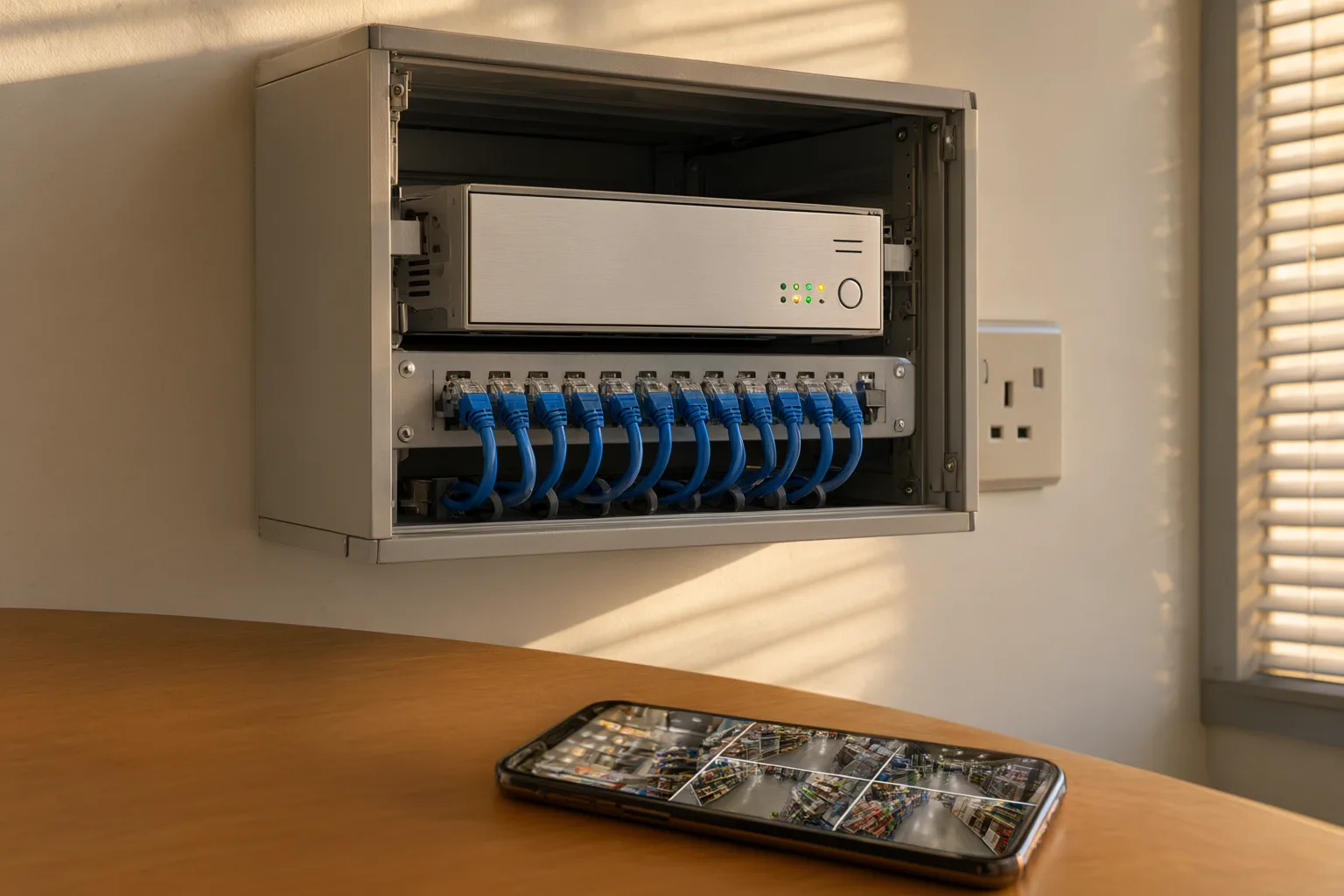
Local storage places a network video recorder (NVR) inside your premises, fitted with surveillance-grade hard drives such as WD Purple or Seagate SkyHawk. Cameras connect to the recorder over PoE cabling, so footage travels across your internal network without ever touching the internet.
Cloud storage sends footage — either continuously or only when motion or AI events are detected — to remote servers operated by the manufacturer or a subscription provider. You access recordings through an app or web portal rather than from a box in your comms room.
Hybrid storage combines both: the NVR records everything locally around the clock, while selected cameras simultaneously push event clips to the cloud. Platforms such as Hikvision Hik-Connect, Dahua DMSS and Uniview all support this dual approach on professional-grade hardware.
Why Is Local NVR Storage Still the Workhorse for Australian Businesses?
Local recording remains the backbone of the vast majority of professional commercial installations completed across Sydney and regional NSW. An on-site NVR sized for 30, 60 or 90 days of [[how-long-should-businesses-keep-cctv-footage-in-australia|retention]] gives you complete ownership of your footage with zero recurring charges.
- Pros: No ongoing subscription fees — you own the storage outright
- Pros: Records 24/7 at full resolution regardless of internet outages
- Pros: Fast local playback and export for police or insurance evidence
- Pros: Supports high camera counts (16, 32, 64+ channels) economically
- Cons: The recorder can be stolen, damaged by fire, or destroyed in a break-in
- Cons: Hard drives wear out and need replacement every 3–5 years
- Cons: Remote viewing still requires an internet connection at the site
What Does Cloud CCTV Storage Cost Australian Businesses Monthly?
Cloud storage appeals to small sites with a handful of cameras, franchise groups wanting centralised management across locations, and any business worried about an intruder walking off with the recorder. Because footage lives in a remote data centre, a burglary, flood or fire at your premises doesn't destroy your evidence.
- Pros: Footage survives even if the premises are burgled, flooded or burnt
- Pros: Access footage from anywhere without port forwarding or VPN setup
- Pros: Scales easily — add a camera, add a subscription
- Cons: Monthly fees per camera add up quickly across a large site
- Cons: Australian NBN upload speeds (often 20–50 Mbps) limit continuous cloud recording to a few cameras
- Cons: If the internet drops out, footage may be lost unless cameras have onboard SD card backup
- Cons: Subscription costs over 5 years often exceed the price of a quality NVR
Should You Compare Cloud vs Local CCTV Costs Over Five Years?
Upfront pricing tells only half the story. A local NVR with surveillance-rated drives typically costs between $800 and $2,500 depending on channel count and drive capacity, then nothing more until drives need replacing every three to five years. Cloud storage requires minimal hardware — sometimes under $300 — but subscriptions generally run $10 to $50+ per camera per month.
Scale that across an eight-camera site and the gap becomes dramatic. Local storage lands somewhere around $1,000 to $3,000 total over five years including drive replacement. Eight cloud subscriptions can total anywhere from $4,800 to well beyond $24,000 over the same period. A hybrid arrangement — cloud backup limited to two to four critical cameras — typically costs $1,600 to $4,300 over five years, keeping off-site protection affordable without surrendering your budget to subscriptions.
Retention length multiplies these figures further. Moving from 30-day to 90-day retention means tripling hard drive capacity locally, or stepping up several subscription tiers in the cloud, so it should be locked down before you price anything.
Can Your NBN Upload Speed Handle Continuous Cloud Recording?
Here's the catch that catches out many Australian businesses: cloud recording is limited by your upload speed, not your download speed. A single 4K camera recording continuously at a sensible bitrate needs around 4–8 Mbps of sustained upload. On a typical NBN 50/20 plan, that means two or three cameras maximum before your connection chokes — and your staff's email and cloud apps slow down with it.
This is why most [[how-to-choose-a-commercial-cctv-installer-in-australia-10-questions-to-ask|commercial]] cloud deployments use event-based recording (uploading clips only when AcuSense AI detects a person or vehicle) rather than continuous recording. For rural and construction sites on 4G, data allowances become the constraint instead. Local NVR storage sidesteps all of this — footage travels over your internal network cabling, never touching the internet until someone views it remotely.
Do NSW Businesses Have Legal Retention Requirements for CCTV Footage?
Storage sizing starts with a simple question: how long do you need to keep recordings? Most NSW businesses treat 30 days as a sensible baseline — long enough to discover and report an incident. Licensed venues, childcare centres and certain insurers push requirements toward 60 or 90 days.
Each additional month of retention demands proportionally more capacity. Locally, that means larger or additional surveillance drives; in the cloud, it means a higher subscription tier per camera. Getting this wrong in either direction is costly — too little retention and you lose evidence, too much and you're paying for footage nobody will ever review.
Is Your CCTV Evidence Safe If the Recorder Is Stolen?
Experienced burglars know exactly what an NVR looks like, and stealing or smashing it erases the very evidence that would identify them. With local-only storage, whatever was on that recorder is gone unless it's been backed up elsewhere.
Two defences work well together. First, physical security: mount the recorder in a locked comms cabinet or back room rather than in plain sight near the entry point. Second, cloud redundancy: configure your two to four most critical cameras to push event clips off-site automatically. Professional platforms from Hikvision, Dahua and Uniview handle this simultaneous local-plus-cloud workflow natively, so if the recorder disappears, your key evidence doesn't.
Are Hybrid Setups Right for Retail and Warehouse Sites in Newcastle?
Choose local storage if you have more than four or five cameras, need 30+ days of retention, or your internet upload speed is limited. Choose cloud if you have a small site, no secure place for an NVR, or multiple locations you want to manage centrally. Choose hybrid if evidence security matters — and for most retail, warehouse and commercial clients we work with, it does.
Not sure where your site fits? Aussie CCTV Cams is fully licensed and insured, and our free quote includes a storage plan sized to your cameras, retention needs and internet connection — backed by lifetime support.
Heat is another factor [[/newcastle|Newcastle]] and [[/adelaide|Adelaide]] business owners underestimate. A recorder tucked into a hot ceiling space or an unventilated comms cabinet during a 40°C South Australian summer can throttle drives and shorten their lifespan dramatically. We always specify surveillance-rated drives rated for continuous operation and mount recorders in ventilated, secure locations away from direct sun — a small detail that adds years to your investment.
For coastal sites around Newcastle, corrosion-resistant housings and weatherproof cabling matter just as much as the storage decision itself. Salt air degrades cheap connectors within months, and storm damage to roof-mounted cameras can take an entire recording channel offline without anyone noticing until footage is needed. Professional installation includes weather-rated equipment and regular maintenance checks that keep every channel recording when it counts.
Finally, don't forget [[cctv-requirements-for-licensed-premises-a-state-by-state-overview|compliance]] obligations beyond retention periods. Under the Privacy Act and state surveillance legislation, signage must notify staff and customers where cameras operate, and footage containing personal information must be handled lawfully. Businesses covered by the Fair Work system should also be aware that workplace surveillance laws in NSW and South Australia restrict covert monitoring of employees. A licensed installer will design your system so storage, retention and signage all line up with these obligations from day one.
Cloud vs local vs hybrid CCTV storage for Australian businesses (2025)
| Storage Option | Typical Cost (AUD) | Best Suited To |
|---|---|---|
| Local NVR only | $800–$2,500 upfront + drives | 4+ camera shops, warehouses, farms needing 30+ days retention |
| Cloud only | $10–$30 per camera/month | 1–4 camera offices and franchises wanting centralised access |
| Hybrid NVR + cloud | $1,500–$3,500 setup + selective cloud fees | Retail, multi-site franchises and high-theft-risk premises |
| SD card / edge storage | $50–$150 per camera | Single-camera entrances and temporary construction sites |