
Key Takeaways
- Fixed retail CCTV is the always-on backbone; body-worn cameras are an on-demand response tool for incidents.
- A typical 8–16 camera retail CCTV installation in Newcastle or Adelaide costs roughly $3,500–$9,000 AUD including NVR and labour.
- Body-worn cameras cost about $600–$2,000 per unit plus storage subscriptions, ideal for loss prevention officers.
- Both systems must comply with the Privacy Act 1988, NSW Workplace Surveillance Act 2005 and South Australian surveillance laws.
- Audio recording is the biggest legal trap — signage and staff notification are mandatory in most cases.
What Is the Difference Between Body-Worn Cameras and Fixed Retail CCTV?
The short answer: body-worn cameras and fixed retail CCTV solve different problems, and most Australian retailers need both. Fixed retail security cameras Australia-wide watch entrances, aisles and tills around the clock, while body-worn units record confrontations as they happen. A typical 8–16 camera installation costs $3,500–$9,000 AUD in Newcastle or Adelaide, with body-worn units adding $600–$2,000 each.
Retailers who rely on fixed cameras alone often discover that wide-angle footage from a ceiling-mounted unit three metres up can't capture what was said during an incident, or the moment a suspect made an admission. Retailers who rely on body-worn cameras alone have no protection outside the moments their officers choose to hit record. The strongest loss prevention programs layer both technologies together, cross-referencing footage so nothing is missed.
How Much Does a Retail CCTV Installation Cost in Newcastle and Adelaide?
A professionally designed fixed CCTV network places cameras over every critical zone in your premises: sales floor aisles, checkout points, emergency exits, stockrooms, loading docks and external areas such as car parks. Modern IP cameras from brands like Hikvision and Dahua offer features purpose-built for retail. ColorVu technology records full-colour images even in near-darkness, which matters for dim stockrooms and after-hours car parks. AcuSense analytics filter out false triggers such as shadows, insects or stray animals, so your team only responds to genuine human or vehicle movement.
Beyond recording, visible cameras change behaviour. Would-be shoplifters who spot obvious surveillance — especially when reinforced by clear signage — frequently abandon their plans before touching any stock. This deterrent effect operates twenty-four hours a day, including overnight when no staff member is present. Fixed systems also enable remote viewing, letting owners or contracted monitoring providers check multiple sites from a phone or central station, which is invaluable for multi-store operators.
Why Do Australian Retailers Need Both Security Systems?
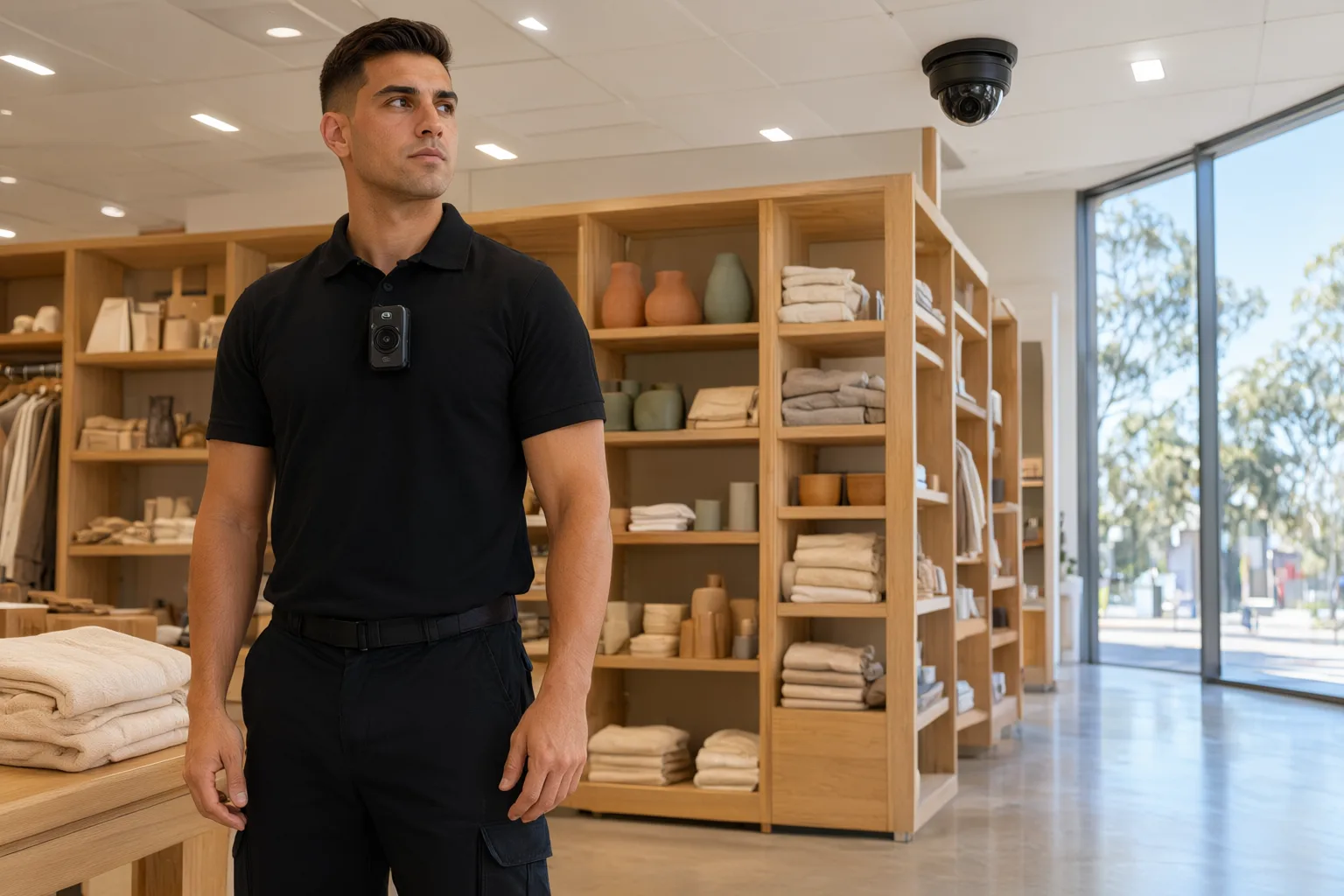
Body-worn cameras are compact recorders clipped to a [[solar-powered-vs-hardwired-cameras-for-construction-sites-which-wins|security]] officer's uniform or chest mount. They switch on when something happens: a suspected shoplifter is approached, service is refused to an intoxicated customer, or a confrontation escalates. Because the camera sits at eye level, it captures facial expressions, gestures, spoken admissions and any threats directed at your staff — detail no ceiling-mounted camera can provide.
That close-up evidence carries real weight. Police statements, court proceedings and internal reviews all benefit from footage showing exactly how an interaction unfolded from the officer's perspective. Body-worn cameras also protect officers themselves: false accusations of assault or heavy-handed conduct can be disproved quickly when the encounter was recorded. For loss [[the-true-cost-of-shoplifting-in-australia-and-how-cameras-fight-back|prevention]] teams working late-night convenience stores, bottle shops or high-theft categories like electronics and cosmetics, this protection alone often justifies the investment.
There's a training dividend too. Reviewing real recorded incidents shows new staff how experienced officers de-escalate conflict, follow procedure and document events correctly — far more effective than classroom theory.
Can Body-Worn Camera Footage Be Used as Evidence in Australia?
The core difference between the two systems comes down to when and where they watch. Fixed CCTV covers everything within its field of view, all the time, whether anyone is watching the monitor or not. It captures the suspect entering the store, browsing, concealing items and leaving — the full sequence. Its weakness is distance: mounted high on a wall, it records the theft but not the conversation.
Body-worn cameras invert that trade-off. They capture exceptional detail but only while activated, and only what the wearer sees. A camera switched on mid-confrontation misses how the suspect entered the building or where they stashed stolen goods elsewhere in the store. Deterrence follows the same pattern: fixed cameras discourage offending before it starts, while a body-worn device only becomes noticeable once an officer has already engaged someone.
Is Recording Audio Legal Under NSW Surveillance Laws?
Budgeting differs sharply between the two systems. A typical small-to-medium retail [[how-much-does-professional-cctv-installation-cost-in-australia|CCTV installation]] — eight to sixteen cameras, a network video recorder (NVR), PoE switches, cabling and professional labour — generally lands between $5,000 and $15,000 depending on camera count, resolution and features. After installation, running costs are modest: occasional lens cleaning, firmware updates and hard drive replacement every few years. The system works continuously without anyone managing it daily.
Body-worn cameras are cheaper per unit — expect roughly $300 to $800 per device — but carry heavier management overhead. Batteries must be charged between shifts. Footage needs downloading, tagging and secure storage, usually via proprietary docking stations and software licences. Outfitting three security officers might total $2,000 to $3,000 including software, yet those devices only function while staff are on shift and actively recording. Factor in training time and policy administration when comparing true cost of ownership.
Should You Choose Fixed CCTV for After-Hours Store Protection?
Both technologies operate under the Privacy Act 1988 and state-based surveillance legislation. In New South Wales, the Workplace Surveillance Act 2005 requires employers to give staff written notice before installing workplace cameras, and signage must tell customers that CCTV is operating. Fixed cameras in public retail areas are broadly accepted, but recording in change rooms, toilets or staff break rooms is off limits.
Body-worn cameras raise the compliance bar because they capture audio and film people at close range. In NSW, recordings must also respect the Surveillance Devices Act 2007. Best practice is a written policy specifying when activation is permitted — typically during incidents, confrontations or when an officer feels unsafe — rather than continuous shift-long recording, which is difficult to justify under privacy principles. Officers should inform individuals that recording is taking place wherever practicable.
Staff attitudes matter as well. Many employees welcome body-worn cameras as protection against false complaints; others worry about micromanagement. Consult your team before rollout, restrict footage access to legitimate security, training or legal purposes, and be transparent about retention and deletion. A system that stands up to scrutiny protects you if footage is ever challenged in court or by a privacy complaint.
Are There Privacy Rules for Retail Security Cameras in Australia?
Fixed CCTV should be your default if you need round-the-clock monitoring, want visible deterrence, or must cover periods when no security staff are present — after-hours break-ins, car park incidents, blind spots behind shelving. It's also the foundation for remote multi-site monitoring through a security provider.
Add body-worn cameras when your team regularly confronts offenders, refuses service, or works higher-risk environments such as late-trading convenience stores, bottle shops or jewellery outlets. They're most valuable for loss prevention officers who actively approach suspects, since the recording shields both the individual officer and the business from disputed accounts.
For most mid-sized and larger retailers, the hybrid model wins. Build a robust fixed network covering entries, tills and high-value stock zones, then equip response staff with body-worn devices. Integrate the two so footage can be cross-referenced: a body-worn clip of a theft pairs with fixed-camera tracking showing where the suspect entered, what else they touched and how they exited. That layered approach maximises prevention, prosecution prospects and staff safety simultaneously.
Which Camera Mix Suits Your Store Type Best?
Whichever path you take, preparation determines success. Start with a site assessment mapping entry points, till positions, high-value displays and existing blind spots. For fixed CCTV, confirm cabling routes, NVR storage capacity sized to your retention period, and whether cloud backup suits your budget. For body-worn cameras, establish charging stations, docking workflows and naming conventions for footage files before the first device ships.
Next, put governance in writing: a privacy policy covering both systems, defined retention periods (30 to 90 days is common among Australian retailers), access controls with logged viewing, and deletion schedules applied consistently. Brief your staff, display compliant signage, and schedule refresher training at least annually. Finally, test integration — verify that body-worn clips can be matched against fixed-camera timelines quickly, because speed matters when police request evidence after an incident.
For [[/newcastle|Newcastle]] retailers along Hunter Street or in Westfield Kotara, fixed cameras mounted under eaves and soffits handle the coastal humidity and salt air that corrode cheap hardware within two years. Marine-grade housings and IP66 weather ratings matter just as much here as they do for beachside [[/adelaide|Adelaide]] stores at Glenelg or Harbour Town, where summer heat above 40°C can degrade budget sensors and warp plastic mounts fixed to brick or Colorbond walls.
Placement strategy differs between the two technologies. Fixed cameras belong at choke points: every entrance, the checkout counter, high-value display cabinets, stockroom doors and loading docks. Body-worn cameras belong on people — loss prevention officers, weekend supervisors and security guards who walk the floor during peak trading. One covers geography; the other covers escalation. A shoplifter who avoids camera sightlines can still be recorded the moment a staff member engages them.
On pricing, expect these 2024–2025 Australian ranges. A four-camera starter package for a small boutique runs $1,800–$3,200 installed. An eight-to-sixteen camera system with a 16-channel NVR, 4MP dome cameras over aisles, a varifocal unit at the entry and licence-plate capture at the car park typically lands between $3,500 and $9,000 depending on cabling complexity — brick walls and double-brick heritage buildings in both cities add drilling and conduit time. Body-worn cameras from brands like Motorola (formerly Avigilon) or Hytera range from $600 for basic recorders to $2,000+ for units with live streaming and automatic activation triggers.
Storage and retention are ongoing costs retailers often forget. Australian best practice — and many insurers — expect 30 to 90 days of retained footage. A 16-camera system recording continuously needs a 6–10TB surveillance drive, adding $300–$600 to the build. Body-worn footage usually uploads to a cloud dock overnight, with subscription plans running $15–$40 per device monthly. Factor both into your three-year total cost of ownership before comparing quotes.
The legal framework deserves careful attention because penalties are real. Under the Privacy Act 1988, if your business turns over more than $3 million annually, you must have a privacy policy covering collection of personal information via surveillance, and you generally cannot record private conversations without consent. In New South Wales, the Workplace Surveillance Act 2005 requires 14 days' written notice before monitoring employees, and covert workplace surveillance needs a court order. South Australia's Surveillance Devices Act 2016 restricts listening devices similarly — recording a private conversation without consent carries criminal exposure, not just civil risk.
Signage is your cheapest compliance tool. Clear notices at every entrance stating 'CCTV in operation' and 'Audio may be recorded' satisfy notice requirements in both states and strengthen the evidentiary value of footage. For body-worn cameras worn by guards licensed under NSW Security Industry Act 1997 or SA's Security and Investigation Agents Act, activation policies should be documented: when to record, how to announce it, and where footage is stored and who can access it.
After-hours protection is where fixed CCTV pulls decisively ahead. Motion-triggered recording, infrared night vision covering dim stockrooms, and integration with alarm monitoring mean your property stays watched at 3am when no one wears a body cam. Many Newcastle and Adelaide retailers pair this with monitored back-to-base response — typically $35–$60 per month — so a triggered camera generates a patrol dispatch rather than just a stored clip.
Retail type should drive your mix. A small Adelaide bakery might need six fixed cameras and no body-worn units at all. A large electronics retailer in Newcastle with dedicated loss prevention staff benefits enormously from chest-mounted recorders during apprehensions, which deter false claims and protect staff. Warehouses and farm supply stores need long-range bullet cameras across yards plus thermal options for bushfire-prone fringe areas. Get a quote tailored to your floor plan rather than buying a generic kit online — professional design is what separates footage that solves crime from footage that shows nothing useful.
Fixed CCTV vs Body-Worn Cameras for Australian Retail Stores
| Option | Typical Cost (AUD) | Best Suited To |
|---|---|---|
| Fixed CCTV (4 cameras) | $1,800 – $3,200 installed | Small boutiques and cafés needing baseline coverage |
| Fixed CCTV (8–16 cameras + NVR) | $3,500 – $9,000 installed | Supermarkets, electronics and clothing retailers |
| Body-worn camera (per unit) | $600 – $2,000 + $15–$40/month cloud | Loss prevention officers and floor security staff |
| Hybrid fixed + body-worn | $5,000 – $12,000 combined | High-theft categories like liquor and jewellery |