
Key Takeaways
- Thermal cameras detect human heat signatures at 250–350 metres even in total darkness, fog or drizzle on NSW sites.
- Hikvision ColorVu and Starlight-class sensors record full-colour identification footage after sunset for gates and docks.
- Standard IR cameras only reach 30–60 metres, leaving long fence lines exposed on two-hectare industrial yards.
- Low-light cameras installed with PoE cabling cost $450–$900 per point across NSW commercial properties.
- Thermal units installed range $2,500–$8,000+ each depending on lens, range and bi-spectrum capability.
- A hybrid system of four thermal plus eight to twelve ColorVu cameras typically costs $25,000–$55,000 installed.
What Is the Difference Between Thermal and Low-Light CCTV?
Thermal imaging cameras detect people and vehicles at 250 metres or more on dark commercial perimeters, while low-light ColorVu cameras identify exactly who triggered an alarm in full colour after sunset. For large outdoor commercial sites in NSW, layering both technologies delivers the strongest security outcome.
Why Do Conventional Cameras Leave Large NSW Sites Exposed After Dark?
Walk any two-hectare industrial yard at night and the problem becomes obvious. Standard infrared (IR) cameras typically throw usable illumination only 30 to 60 metres, and beyond that the picture degrades into grainy black-and-white noise. Faces become smudges, vehicle colours disappear, and number plates turn to mush. On sprawling sites with long fence lines, that leaves vast stretches of darkness between camera points where an intruder can move undetected.
Floodlighting looks like the cheap fix, but it rarely works out. Lighting an entire perimeter demands significant installation cost and ongoing power bills, and every pole casts deep shadows that experienced intruders use as cover. Bright spill also draws complaints from neighbours and can clash with local council light-spill rules in some areas. Add the reality of Australian sites — bush boundaries, unlit rear fences, wildlife everywhere — and it's clear why conventional approaches fall short. Thermal imaging and modern low-light sensors were engineered precisely to close this gap.
How Does Thermal Imaging See What Light Cannot?
Thermal cameras ignore visible light entirely. Instead, they read infrared radiation — the heat that every person, vehicle engine and animal naturally emits — and translate those temperature differences into a sharp image. A human body glows bright against cool soil, gravel or grass regardless of whether it's midnight, overcast, foggy or lightly raining. Dark clothing, camouflage and shadows offer no protection whatsoever, because heat cannot be hidden the way reflected light can.
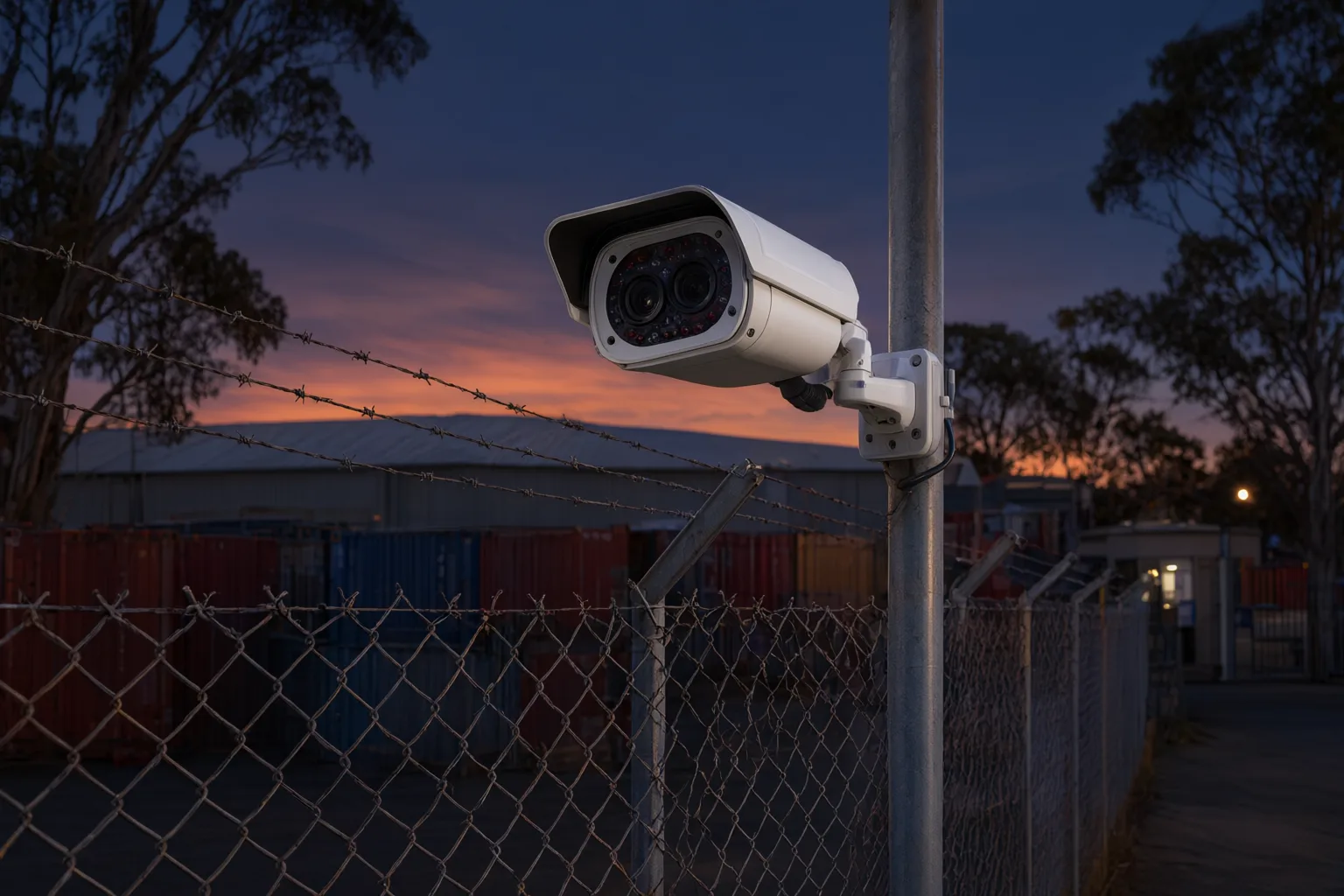
The detection numbers are what make thermal compelling for [[how-much-does-commercial-cctv-cost-in-australia-a-2025-pricing-guide|commercial]] perimeters. A mid-range thermal bullet camera fitted with a 35mm lens can detect a person at roughly 250 to 350 metres and register vehicles well past 500 metres. In practical terms, a handful of thermal units can supervise a fence line that would otherwise demand dozens of standard cameras and kilometres of floodlighting. Many professional models — including the Hikvision and Dahua thermal ranges commonly installed across NSW — combine a thermal sensor and a conventional optical lens in a single bi-spectrum housing, so operators get instant visual confirmation alongside the heat alert.
False alarms drop dramatically too. When paired with onboard analytics or an AcuSense-enabled NVR, the system distinguishes a human heat signature from a kangaroo hopping the boundary, a swaying gum tree or a plastic bag tumbling across the yard. For rural and semi-rural NSW properties where cheap motion detection fires all night on wildlife, this filtering alone transforms the value of the system.
Which Low-Light Technologies Deliver Full-Colour Night Vision?
Where thermal answers 'something is there', low-light cameras answer 'who and what'. The current generation of low-light sensors has rewritten expectations for after-dark footage. Hikvision ColorVu cameras pair F1.0 super-aperture lenses with large sensors and a gentle warm supplemental light, delivering genuine full-colour recording around the clock. That means you can see an intruder wore a red hi-vis shirt and arrived in a white ute — not just a grey silhouette. Dahua's Full-Colour range and Uniview's ColorHunter line achieve comparable results.
Starlight (or starvis-class) sensors take a different route, amplifying whatever ambient light exists so effectively that a moonlit yard records in colour with no added lighting at all. Where a site already has some illumination — street frontages, gatehouses, staff car parks — starlight cameras deliver excellent detail at a fraction of thermal's price, and the resulting footage holds up far better as identification evidence.
A simple design rule ties the two technologies together: let thermal watch the open perimeter and flag approaching movement, while ColorVu or starlight cameras cover entry points, loading docks and asset zones where faces, plates and colour detail matter. Layered this way, nothing slips through.
Should You Choose Thermal or Low-Light Cameras for Your Site Layout?
For most large commercial operations the honest answer is both — but the balance depends on layout, risk profile and budget. Open perimeters, bush boundaries, unlit yards and lengthy fence lines strongly favour thermal detection. Gates, docks, fuel storage areas, offices and anywhere identification matters favour low-light colour cameras. The comparison table further down this page breaks down detection ranges, weather performance, false-alarm behaviour and installed costs side by side so you can match technology to each zone of your property rather than guessing.
Are Thermal Perimeter Designs Suited to Australian Conditions?
Hardware alone never wins — design determines whether the system actually performs. Mounting height is critical for thermal: too low and you sacrifice detection range; too high and the field of view narrows until gaps appear. Professional installers typically position thermal heads at 6 to 9 metres, angled to create overlapping detection zones along the fence line, with low-light cameras covering every gate, dock and blind corner.
Australian conditions impose their own requirements. Summer heat trapped inside a housing mounted on a western-facing Colorbond wall can exceed 60°C, which is why quality systems specify cameras rated IP67 or better with wide operating temperature ranges. Coastal installations near Wollongong, Newcastle or Port Kembla need corrosion-resistant housings to survive salt air. Properties in bushfire-prone regions gain a bonus: thermal sensors can spot abnormal fire heat early, and some rural clients run the same camera fleet for [[solar-powered-vs-hardwired-cameras-for-construction-sites-which-wins|security]] and fire watch simultaneously. Remote compounds without dependable NBN coverage get designed around 4G connectivity and solar power so surveillance never drops offline.
Every camera should feed a correctly sized NVR holding 30 to 90 days of footage — the retention window insurers and police generally expect for commercial claims. A structured process of consultation, design, installation, configuration and handover training ensures your team can review footage, export evidence and manage alerts confidently from day one.
Can You Afford Thermal and Low-Light Installation Costs in NSW?
Budget usually decides the project, so realistic installed figures help. A premium ColorVu or starlight camera, professionally installed with PoE cabling and configuration, typically lands between $450 and $900 per point. Thermal represents a larger investment: expect $2,500 to $8,000+ per unit installed, depending on lens selection, detection range and whether the model is bi-spectrum (thermal plus optical).
As a worked example, a mid-size industrial yard might deploy four thermal cameras along the perimeter and eight to twelve ColorVu cameras across buildings and entries — a complete project in the $25,000 to $55,000 range including NVR, storage, networking and commissioning. That is serious money, but weigh it against a single theft of copper, fuel or machinery, an insurance excess, or months of paying someone to man a gate overnight. Most clients find payback measured in months rather than years. Reputable installers provide free itemised quotes showing exactly where every dollar goes, backed by lifetime support on the installation.
Is Thermal Footprint Evidence Reliable and Integratable?
Two practical questions decide long-term satisfaction. First, evidence: thermal footage alone rarely identifies a person, which is why professional designs always pair thermal detection with colour identification cameras. A system installed by a licensed NSW installer — correct timestamps, secure storage, unbroken chain of custody — produces material police and courts accept. Second, integration: modern Hikvision, Dahua and Uniview thermal and ColorVu cameras connect over standard PoE networks, so they can often be added to existing NVR-based systems. Older [[ip-cameras-vs-analogue-what-australian-businesses-should-choose-today|analogue]] DVR setups usually need an upgrade, which a free site inspection will assess.
Maintenance needs are modest but real. Annual checks of housings, seals and connectors — especially on coastal sites where salt air corrodes fittings — plus lens cleaning and firmware updates keep detection ranges and image quality at specification year-round. Choosing a licensed installer with lifetime support means problems get fixed before they become blind spots.
Thermal vs Low-Light Cameras for Commercial Sites
| Factor | Thermal Imaging | Low-Light (ColorVu / Starlight) |
|---|---|---|
| Detection in total darkness | Excellent — needs no light at all | Excellent with ambient or built-in warm light |
| Performance in fog, smoke, rain | Strong — sees heat through obscurants | Reduced — like the human eye |
| Person detection range | 250–350m+ (mid-range lens) | 30–60m for identification |
| Face / clothing / plate identification | No — silhouette and heat shape only | Yes — full colour, court-usable detail |
| False alarms (wildlife, weather) | Very low with analytics | Low with AcuSense human/vehicle filtering |
| Installed cost per camera (NSW) | $2,500–$8,000+ | $450–$900 |
| Best use case | Perimeters, open yards, bush boundaries | Gates, docks, entries, asset zones |