
Key Takeaways
- NSW employers must give written notice at least 14 days before any workplace CCTV goes live under the Workplace Surveillance Act 2005.
- Section 10 of the Act bans cameras outright in toilets, showers and change rooms with no signage workaround available.
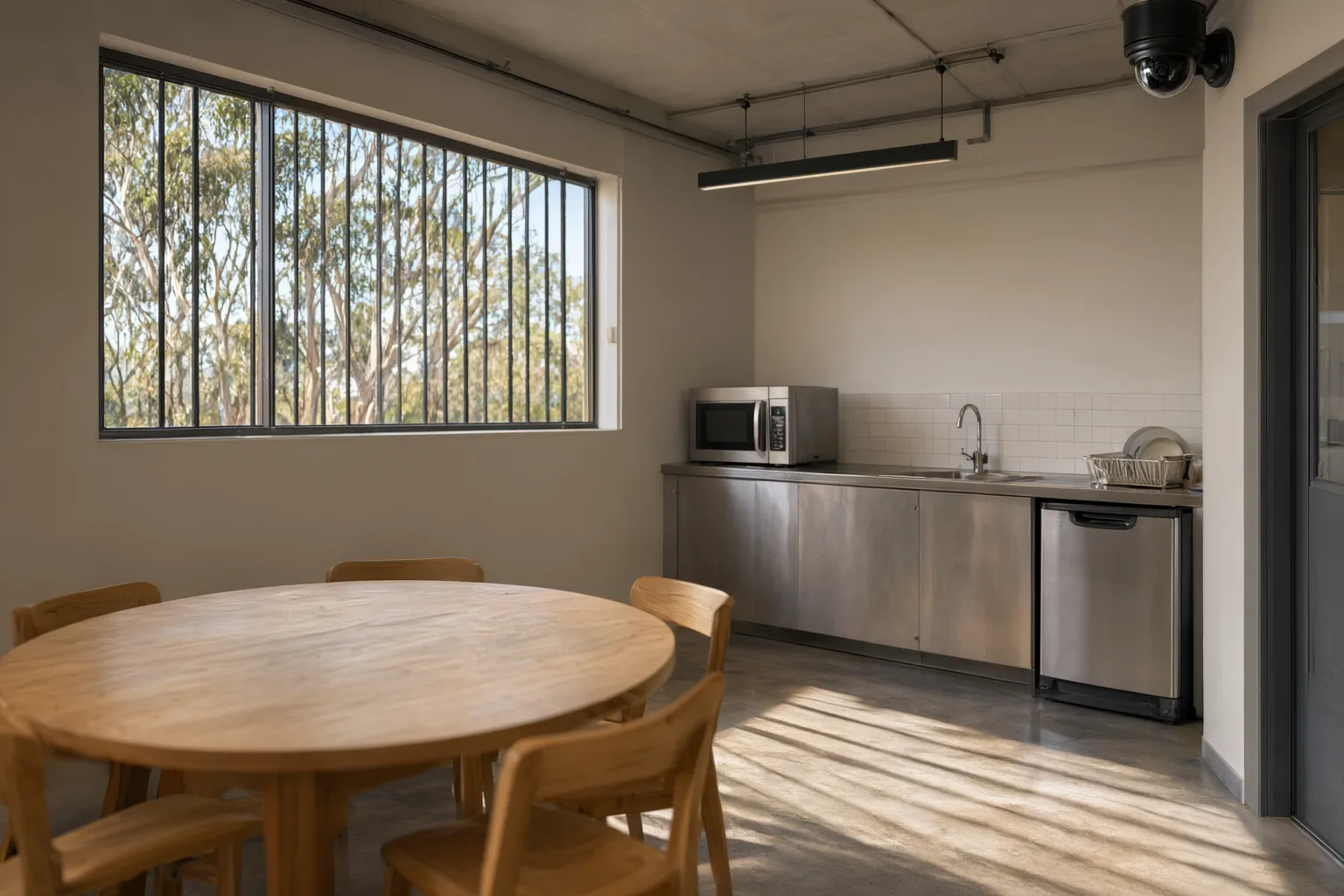
- Lunchroom CCTV in Newcastle workplaces is lawful but should mask seating zones to protect staff trust and privacy.
- Locker areas beside change rooms are prohibited zones; corridor lockers can be filmed with proper notice and framing.
- Corporations face fines up to $11,000 and individuals $5,500 for breaching employee surveillance laws in NSW.
- Businesses turning over more than $3 million must also meet Privacy Act 1988 obligations for footage handling.
Can You Legally Put Cameras in Staff-Only Areas in NSW?
Yes — NSW employers may lawfully install CCTV in staff-only areas such as lunchrooms and open locker corridors, provided they comply with the Workplace Surveillance Act 2005 (NSW). That means giving every affected employee written notice at least 14 days beforehand, displaying visible signage at each entrance, and never filming spaces where staff reasonably expect privacy. Comply and staff-area surveillance is legal; get it wrong and penalties reach $11,000 for corporations.
How the Workplace Surveillance Act 2005 Governs Employee Monitoring
The [[workplace-surveillance-laws-in-australia-what-employers-must-know|Workplace Surveillance]] Act 2005 (NSW) is the central piece of legislation controlling how employers monitor their workforce through cameras. It applies to any surveillance of employees while they are at work, including footage captured in break rooms, locker areas and other back-of-house spaces that customers never see. The Act distinguishes between overt surveillance — which is permitted with proper notice and signage — and covert surveillance, which generally requires a court order and is far more restricted.
Before overt CCTV begins, section 12 of the Act requires employers to notify employees in writing at least 14 days in advance. The notice must spell out the kind of surveillance being installed, how it will be carried out, when it will operate, and whether it will be continuous or intermittent. Any new employee joining the business must receive this notification before they start work, so your induction process needs to include the surveillance notice as standard paperwork.
Signage obligations sit alongside the notice requirement. Every entrance to an area under camera coverage must carry signs that are clearly visible and legible, telling anyone entering that CCTV is operating. A sign hidden behind a door or printed too small to read does not satisfy the legislation, so placement and size matter as much as wording.
Where Are Cameras Completely Banned Under Section 10?
Some locations are simply off limits regardless of how strong your security case is. Section 10 of the Workplace Surveillance Act prohibits cameras in toilets, showers, change rooms and any other area where employees would reasonably expect complete privacy. There is no notice process, no signage workaround and no business justification that overrides this prohibition.
The practical difficulty for many workplaces is that these prohibited spaces sit directly next to areas you may legitimately want to monitor. A change room often opens onto a locker corridor; a shower block adjoins a equipment storage room. Your camera design must guarantee that no lens captures the interior of a prohibited space, even partially, even when doors swing open. This is why professional site assessment matters — sightlines that look harmless on a floor plan can breach the law in practice.
Quiet rooms, prayer rooms and first-aid spaces also fall into high-risk territory. While not named explicitly in section 10, the reasonable-expectation-of-privacy test makes internal cameras in these spaces legally dangerous. Access control systems offer a safer alternative, logging who enters without recording what happens inside. [[/newcastle|Newcastle]]'s coastal salt winds and [[/adelaide|Adelaide]]'s intense summer heat mean camera eaves-mounting and UV-stable cable sheaths are essential for longevity.
Is Lunchroom CCTV Lawful but Culturally Sensitive?
Lunchrooms occupy awkward middle ground. Legally, they are workspaces, so CCTV is permissible with proper notice and signage. Culturally, they are where staff make personal phone calls, discuss private matters and decompress — behaviour no one expects to be filmed. Installing a camera over the lunch table is technically compliant but almost guaranteed to erode trust if handled clumsily.
A smarter design targets risk points rather than people. Doorways, servery counters, shared appliances such as microwaves and fridges, and storerooms attached to the lunchroom capture the activity most relevant to theft prevention and safety investigations. Seating areas can be excluded entirely using privacy masking, a feature available on modern platforms such as Hikvision AcuSense that digitally blurs designated zones within the camera's field of view.
Ask first whether video is even necessary. Swipe-card access control tells you who entered the lunchroom and when, which resolves most after-hours access concerns without recording anyone's conversations. Motion-activated recording limited to outside business hours is another middle path for businesses worried about overnight incidents rather than daytime behaviour.
What Makes Locker Areas the Most Ambiguous Zone?
Lockers create the sharpest legal ambiguity of any staff-only space. If lockers stand inside or immediately beside a change room where employees undress, cameras are prohibited outright under section 10. But lockers positioned in open hallways, corridors or general storage areas can be surveilled lawfully, provided notice has been given and the camera framing excludes change room interiors.
Physical layout decides everything. Warehouses, construction sites and industrial facilities commonly protect tool storage and personal belongings with corridor-mounted cameras covering locker banks. To stay compliant, angle lenses to capture faces approaching lockers rather than the contents of open lockers, and confirm that no part of an adjoining change room falls within view. Dahua Starlight cameras perform well in dimly lit locker corridors, delivering identifiable footage without the harsh lighting that makes break spaces feel hostile.
If your facility combines lockers with change facilities, engineer separation into the design. Place lockers in a monitored corridor outside the change room entrance, verify sightlines with a physical walk-through, and post 'No cameras beyond this point' signage at the change room threshold alongside your standard CCTV notices. Documenting these decisions demonstrates good faith if a privacy complaint ever arises.
Which Technology Makes Compliant Placement Easier?
Modern IP camera platforms include features purpose-built for sensitive environments. Hikvision ColorVu captures full-colour footage in near darkness without bright white illuminators, keeping break areas comfortable while maintaining image quality. Uniview's LightHunter technology serves a similar role in low-light locker corridors. Axis cameras offer built-in privacy masking plus audio detection that can trigger alerts based on sound levels without actually recording conversations — an important distinction, because capturing audio triggers additional consent requirements under NSW law.
Your recording infrastructure matters just as much as the cameras. Network video recorders with role-based access control restrict staff-area footage to authorised managers only, supporting your Privacy Act obligations. Set retention periods deliberately: 30 to 90 days covers most incident investigation windows, after which footage should overwrite automatically unless a specific incident justifies longer storage. Publish the retention period in your surveillance notice so employees know exactly how long recordings exist.
Are There Privacy Act Obligations Beyond State Law?
State surveillance law is only half the [[cash-handling-areas-camera-rules-every-australian-business-should-follow|compliance]] picture. Businesses with annual turnover above $3 million fall under the federal Privacy Act 1988 and its Australian Privacy Principles. Footage identifying individuals counts as personal information, which means it must be collected for purposes that are reasonably necessary to your operations, stored securely, and disclosed only to personnel with a genuine need to access it.
In practice this translates into concrete controls: password-protected NVR access with individual logins, documented policies on who may review footage and why, secure disposal once the retention window closes, and a process for employees to raise privacy concerns. Breaches can attract complaints to the Office of the Australian Information Commissioner, investigation, and civil penalties — exposure that stacks on top of state-level fines under the Workplace Surveillance Act.
Should Notice, Signage and Policy Come Before Installation?
Cameras alone do not make surveillance lawful — documentation does. Before installation, issue a written notice to every affected employee covering camera locations, the purpose of monitoring, operating hours, who can access footage and how long it will be retained. Collect written acknowledgements and build the same notice into new-starter inductions so coverage never lapses.
Pair the notice with visible signage at every entry point to monitored areas, worded clearly enough to read before someone steps inside. Reinforcing signs inside lunchrooms and locker corridors costs little and strengthens your transparency position considerably.
Finally, write a workplace surveillance policy that explains why monitoring exists, how footage may be used, who holds access rights and how complaints are handled. Include it in the employee handbook and review it annually. When staff understand the legitimate security rationale and trust the safeguards around misuse, acceptance of [[do-you-need-to-tell-staff-theyre-on-camera-australian-notice-requirements-explai|workplace CCTV]] rises sharply — and your legal position strengthens with it.
Why Get Professional Help Before You Install?
Grey-zone questions are fact-specific, and the cheapest time to resolve them is before a camera goes on the wall. If you are uncertain about a particular location, a short consultation with an employment lawyer costs far less than the penalties for non-compliant surveillance — up to $11,000 for corporations and $5,500 for individuals under the Workplace Surveillance Act 2005.
Experienced commercial installers add a second layer of protection. Aussie CCTV Cams' licensed and insured NSW installers have designed compliant systems for hundreds of businesses across Sydney, from small retail staff rooms to large warehouse locker facilities. Our five-step process begins with a detailed consultation covering your objectives, layout and legal obligations, followed by a site assessment that maps privacy-sensitive zones before any hardware is specified.
We build systems on professional-grade Hikvision, Dahua, Uniview and Axis equipment configured with privacy masks and role-based access controls, then train your team on compliant footage handling at handover. Lifetime support and free quotes make it straightforward to achieve security that respects both the law and your staff.
NSW Staff-Area CCTV: What Is Allowed Where
| Area Type | CCTV Legal? | Notice Required | Key Restrictions | Recommended Approach |
|---|---|---|---|---|
| Staff lunchroom | Yes, with conditions | 14 days written notice | Avoid filming seating and private conversations | Cover doorways and servery; apply AcuSense privacy masks |
| Open locker corridor | Yes, with conditions | 14 days written notice | Must exclude change room interiors and open locker contents | Frame for face identification; use Starlight low-light cameras |
| Change room | No | N/A – prohibited | Banned under section 10, Workplace Surveillance Act 2005 | Monitor the external corridor only |
| Toilets and showers | No | N/A – prohibited | Banned under section 10, Workplace Surveillance Act 2005 | No internal cameras; external corridor coverage only |
| Quiet/prayer room | Generally no | N/A – high privacy expectation | Reasonable expectation of privacy creates serious legal risk | Use swipe-card access control instead of cameras |
| Staff kitchen/servery | Yes, with conditions | 14 days written notice | Keep seating areas out of frame | Target shared equipment and entry points with privacy masking |