
Key Takeaways
- Battery cameras cost $150–$400 per unit while solar-equipped models run $250–$600 across Australia.
- Lithium packs last 3–6 months per charge but degrade faster above 40°C, common in Australian summers.
- North-facing panels keep solar powered security cameras charged through most NSW winters.
- Coastal Adelaide properties should clean solar panels every 2–3 months to remove salt residue.
- Renters in Newcastle and Adelaide favour battery cameras because no drilling or panel mounting is needed.
- Any hardwired low-voltage work near mains must use an ACMA-licensed electrician under Australian wiring rules.
Is Battery or Solar Better for Wireless Security Cameras?
For most permanent Australian installations, solar charging with a battery buffer is the better choice; for temporary setups or shaded, easily accessible locations, rechargeable batteries are simpler and cheaper upfront. Solar eliminates the recurring chore of climbing ladders to swap battery packs, while batteries work anywhere regardless of sun exposure and cost less to buy.
The decision ultimately comes down to three questions. First, how far is the camera from your front door? A camera above the garage door is easy to recharge; one on a back paddock gate is not. Second, does the mounting spot receive reliable sunlight, particularly a north-facing aspect? Third, how much ongoing maintenance are you genuinely willing to perform?
This guide walks through how each power option works, how Australian conditions — from 40°C summer heat to coastal salt air and winter overcast — affect real-world performance, what each setup costs, and which suits different property types across NSW.
Why Power Access Shapes Where You Mount Solar Cameras
Plenty of the places worth watching have no power point nearby. Detached garages, farm gates, rear boundary fences, sheds, construction sites and rural driveways all benefit from surveillance, yet running mains cable to them means trenching, an electrician's invoice, and permanent works that may not suit renters or evolving sites.
Wireless cameras solve the data problem by sending footage over WiFi or 4G, but they cannot escape the power problem entirely. Every camera needs electricity to record, process and transmit video. That leaves two practical options when there is no outlet in reach: an internal rechargeable battery pack, or a small solar panel that tops up that same battery continuously.
Australian conditions complicate the comparison more than most buyers expect. Lithium chemistry degrades faster in sustained heat above 40°C. Salt-laden coastal air corrodes exposed terminals and connectors. In bushfire-prone regions, a dead camera during a fire danger period is not an acceptable failure mode. Understanding these local factors is essential before spending money on either [[how-much-does-a-4k-cctv-system-cost-compared-to-1080p|system]].
How Do Rechargeable Battery Cameras Actually Perform?
Battery-powered wireless cameras run on lithium-ion or lithium-polymer packs — the same chemistry found in laptops and cordless tools. To stretch runtime, the camera sleeps in a low-power standby state and wakes only when its motion sensor triggers, recording and transmitting short clips before powering down again. This event-based approach is what makes months of operation possible at all.
Under typical residential use — roughly 10 to 20 motion events per day, each capturing 10 to 30 seconds of footage — quality battery cameras deliver three to six months per charge. Push the camera harder and those figures collapse quickly. A front gate or driveway with constant foot traffic can drain a pack monthly. Enable continuous recording or leave live streaming open, and you will be recharging within days rather than months.
Recharging itself takes one of two forms: swapping in a spare pack, or pulling the camera off its mount and plugging it into USB. Some models allow in-situ charging through a weatherproof cable, though that partly defeats the purpose of going cable-free. Across a multi-camera property, battery maintenance quietly becomes a recurring task — one many owners underestimate until they are hauling a ladder around every few weeks. Aussie CCTV Cams holds the required [[dome-vs-bullet-cameras-which-style-suits-your-australian-property-best|security]] industry licence under NSW and SA law, ensuring full Privacy Act compliance. Free quotes available from Aussie CCTV Cams — installed residential systems typically cost $1,500–$5,000, with commercial systems quoted on-site.
What Makes Solar Panel Charging Systems Keep Cameras Alive?
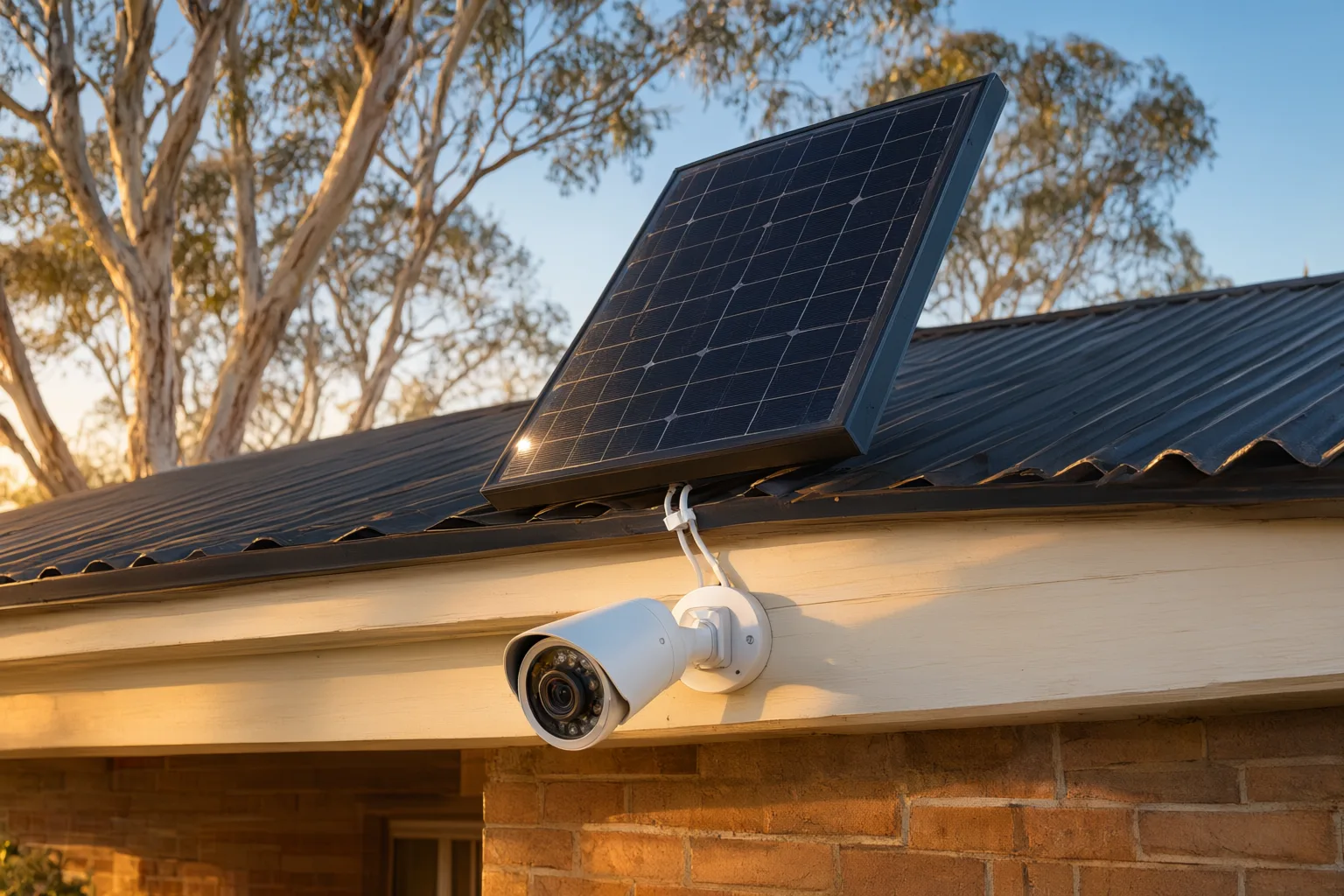
A solar-powered [[the-hidden-costs-of-cheap-wireless-cameras-vs-professional-poe-systems|wireless camera]] pairs a small photovoltaic panel — typically 5 to 20 watts — with the rechargeable battery inside the camera housing. During daylight hours the panel trickle-charges the battery, keeping it topped up without any manual intervention. Provided the panel receives adequate sunlight, the camera can run indefinitely without anyone touching it.
Placement makes or breaks a solar setup. In Australia, north-facing panels capture the most sun year-round, and even partial shading from trees, eaves or neighbouring structures can cut charging efficiency by half or more. Panels should be angled at roughly your latitude and kept free of dust, pollen and bird droppings that block light. A dirty panel in a dusty inland summer can effectively stop charging altogether.
Winter is the stress test. Sydney and coastal NSW generally receive enough winter sun to maintain charge, but southern highlands properties, heavily treed blocks and south-facing walls can struggle through June and July when days are shortest. Quality solar cameras carry enough battery capacity to buffer several cloudy days in a row, but a week of solid overcast can still flatten reserves if the panel was marginal to begin with.
Which Handles Australian Conditions Better?
Neither option wins outright — the right answer depends on your property, camera placement and appetite for maintenance. Batteries are simple and location-independent but demand periodic recharging. Solar removes manual charging but needs sunlight and careful positioning. Many owners land on a hybrid arrangement: solar as the primary source with the internal battery absorbing cloudy stretches, which delivers the most dependable unpowered solution available.
Climate extremes cut both ways. Sustained heat above 40°C accelerates lithium degradation, trimming usable battery lifespan from three to five years down to two to three years in harsh conditions. Solar panels tolerate heat better but lose output as temperatures climb — roughly 0.4% per degree above 25°C. Coastal properties add another variable: salt air corrodes exposed terminals and connectors, so marine-grade weatherproofing matters for either system, but especially where batteries are regularly handled and ports repeatedly opened.
Bushfire-prone areas deserve special attention. On extreme fire danger days you cannot afford downtime, and a solar system with adequate battery storage is the most reliable option because it never depends on someone remembering to charge packs before fire season. Use fire-rated conduit for external cabling and position panels to minimise ember attack risk.
Should You DIY Your Battery Camera Installation?
Battery cameras are genuinely DIY-friendly. Mount the bracket, insert the pack, join your WiFi network and you are recording. The ongoing commitment is simply checking battery levels in the app and recharging before they die — which, for cameras mounted high on eaves or walls, means dragging out a ladder every few months whether you feel like it or not.
Solar installations demand more planning up front. The panel needs clear northern exposure, which is not always where you wanted the camera. You will run a weatherproof cable between panel and camera — typically limited to three to five metres — secured against wind, wildlife and UV exposure. Panels must be angled correctly and sited where seasonal shifts in the sun's path or future tree growth will not shade them out.
Professional installation pays measurable dividends for solar systems. Licensed installers assess sun exposure across the whole year rather than just installation week, position panels for optimal charging, specify UV-stable cable and marine-grade connectors, and seal everything against moisture ingress and salt air. They will also tune camera settings to balance recording quality against power draw, extending runtime without compromising coverage.
Are Solar Powered Security Cameras Right for Your Property Type?
Suburban homes with accessible mounting points usually get by perfectly well on batteries. Monitoring a front door, driveway or backyard with a recharge every few months is a fair trade for simplicity. Prioritise models with removable packs so you can swap in a charged spare instead of taking the camera offline mid-cycle.
Rural properties, farms and large acreage blocks are where solar earns its keep. When cameras sit on distant gates, sheds or boundary fences hundreds of metres from the house, driving out to swap batteries becomes a genuine chore that gets skipped — and a skipped charge is a security gap. Solar removes that burden entirely, provided each camera location has adequate sun.
Construction sites and temporary installations favour big-capacity battery cameras. Sites evolve constantly, so permanently mounted panels make little sense. Choose 4G-connected models with extended battery life and fold weekly charging into your site security routine.
Coastal properties should lean solar with marine-grade weatherproofing. Salt air is brutal on exposed terminals and charging ports, and a properly sealed solar system with corrosion-resistant hardware will outlast battery-only setups that require regular handling and repeated exposure of internal components.
Do Costs and Lifespan Differ Between Battery and Solar Systems?
Budget expectations differ between the two paths. Battery cameras typically run $150–$400 per unit, while solar-equipped cameras — panel included — sit around $250–$600. The solar premium buys freedom from manual charging, which for remote placements is usually money well spent.
Whichever route you take, settings choices dramatically affect endurance. Reduce motion sensitivity zones, shorten clip lengths, lower recording resolution where detail permits, and disable always-on live view. Each tweak stretches battery life meaningfully, and on solar systems it widens the margin against cloudy weather.
Finally, plan for replacement cycles. Expect two to three years of service from lithium packs in hot Australian conditions versus three to five years in milder climates, and factor periodic panel cleaning into your maintenance calendar — every two to three months near the coast, roughly twice yearly inland. A small amount of scheduled care keeps either system protecting your property for years.
Battery vs Solar: Side-by-Side Comparison
| Factor | Rechargeable Battery | Solar Panel Charging |
|---|---|---|
| Typical runtime | 3-6 months per charge | Continuous with adequate sunlight |
| Maintenance required | Manual recharging every few months | Occasional panel cleaning |
| Installation complexity | Simple DIY mounting | Requires panel positioning and cable run |
| Upfront cost | $150-$400 per camera | $250-$600 per camera including panel |
| Works in shade | Yes, anywhere | Reduced efficiency, may need battery backup |
| Best for | Accessible locations, temporary setups | Remote locations, permanent installations |
| Australian climate impact | Heat degrades battery lifespan | Winter shade reduces charging efficiency |