
Key Takeaways
- CCTV cabling typically costs $15–$35 per metre installed across Australia, before camera and recorder hardware.
- Cable route complexity — eaves, ceiling cavities, double-storey walls and trenching — matters more than straight-line distance.
- PoE runs cap at 100 metres; longer farm or acreage runs near Adelaide need extenders, fibre or point-to-point wireless links.
- Always insist on an on-site measurement before accepting a fixed-price CCTV quote in Newcastle NSW or Adelaide SA.
- Check your installer holds a current security licence and complies with the Privacy Act 1988 and state surveillance laws.
How Far Can CCTV Cable Actually Run Before You Need Extenders?
The short answer: CCTV installation quotes in Australia are driven primarily by cable length, which typically costs between $15 and $35 per metre installed. A standard four-camera home system in Newcastle NSW might need 80–120 metres of cabling, pushing labour and materials alone past $1,500 before hardware. Understanding how installers measure, route and price cable runs lets you compare quotes accurately and avoid surprise variations once work begins on your property.
This article breaks down exactly why. If you understand cable length limits, property construction and installation methods before you request a quote, you'll be able to read one intelligently, spot vague pricing, and budget without surprises.
What Does Your CCTV Quote Really Pay For?
Every cable technology has a distance ceiling, and crossing it changes your [[how-much-does-a-4-camera-cctv-system-cost-in-australia|system]] design.
For modern IP systems running Cat6 Ethernet with Power over Ethernet (PoE), the practical limit is around 90 metres of horizontal cable before signal degradation and voltage drop become problems. Past that point, cameras may drop offline intermittently or fail to power up at all.
Older-style analogue systems using coaxial cable fare slightly better: HD-TVI and HD-CVI signals typically hold up to roughly 150 metres. Beyond that, you're into video baluns, amplifiers or a redesign of where your recorder sits.
These aren't marketing numbers — they're engineering constraints. Any installer who quotes a 150-metre Cat6 run without mentioning extenders or fibre is either inexperienced or planning a callback.
Why Does Block Size Change Your CCTV Cabling Costs?
Property size drives cable length almost linearly. A compact three-bedroom brick veneer on a suburban Sydney block might need around 80 metres of total cable for a four-camera system. The same four-camera kit on a sprawling single-storey home sitting on 1,000 square metres could easily need three times that.
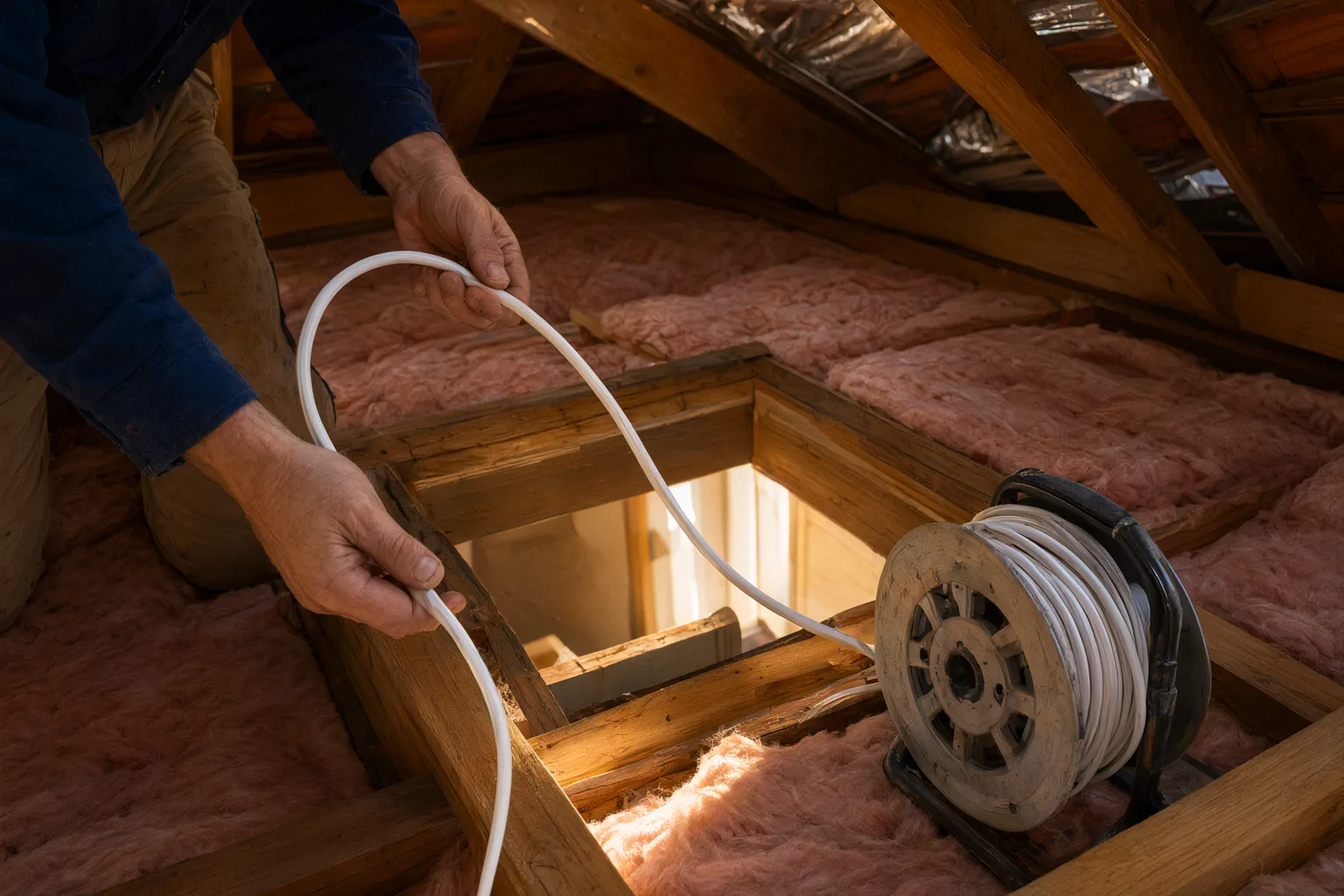
Longer runs mean more than just extra cable. Each additional metre adds conduit, clips, junction points and — most expensively — installer hours. A technician can push 20 metres of cable through an accessible single-storey roof cavity in under an hour. Running 60 metres across a large Colorbond roof, down a wall cavity and under a subfloor can consume half a day for a single camera.
That's why two 'four-camera installs' are rarely comparable. The hardware is the same; the labour is not.
Do Rural Properties Need Trenching for CCTV Cameras?
Farms and acreage properties take this to the extreme. A camera watching a front gate 200 metres from the house isn't a cable run — it's a civil works project. You're looking at trenching, underground-rated conduit, warning tape, weatherproof enclosures, and possibly solar power if there's no mains electricity anywhere near the gate.
Across rural NSW installations, cabling has accounted for as much as 60% of total project cost — more than the cameras and recorder combined. If you're budgeting for farm security, plan for the infrastructure first and choose camera locations partly based on where power and trenching routes already exist. A shed with existing power can halve your cabling bill by acting as a mid-point hub.
Which Installation Method Costs the Most Per Metre?
The route a cable takes matters as much as its length. From cheapest to most involved:
Internal wall cavity runs are the fastest and cheapest option where cavities exist and are accessible.
Roof cavity [[what-affects-cctv-installation-prices-10-factors-australian-quotes-are-based-on|installation]] is the workhorse of Australian residential installs — moderate labour, very common in single-storey homes.
Surface-mounted conduit is quick but visually obvious; it's standard in commercial settings and sometimes unavoidable in homes with solid walls.
Underground conduit requires excavation, PVC conduit, warning tape and backfilling, adding roughly $50–$150 per metre depending on soil type and site access.
Fibre optic cable becomes necessary for long runs over about 100 metres. It's significantly dearer per metre but effectively future-proofs the link.
Cable specification also shifts cost. Standard indoor Cat6 is inexpensive; outdoor direct-burial rated cable costs more per metre. In coastal areas, salt air corrodes cheap connectors quickly, so UV-stabilised conduit and marine-grade fittings are worth the small premium upfront.
Is a Double-Storey Home More Expensive to Cable?
Storey count is one of the most underrated cost drivers in residential quotes. A second storey turns a simple eave-to-recorder run into a multi-floor navigation exercise: threading wall cavities, avoiding existing electrical wiring, and often drilling through floors.
Access gets harder too. Many double-storey installs require removing roof tiles or working in ceiling spaces with minimal headroom. A camera that takes 90 minutes on a single-storey home can take three hours on a two-storey property — and that difference shows up directly in your quote.
Split-level homes, cathedral ceilings and exposed-beam construction create similar headaches. With no usable wall cavity, the options are surface-mounted conduit (which some owners dislike aesthetically) or creative routing through wardrobes and cupboards. Expect your installer to discuss these trade-offs during inspection rather than after.
Can PoE Extenders and Fibre Fix Long Camera Runs?
PoE is elegant — one cable carries both power and data — but it has a hard ceiling of 100 metres including patch leads at each end, leaving about 90 metres of actual run. Exceed it and voltage drop causes dropouts.
If a camera sits 120 metres from your recorder, you have three realistic fixes:
Install a PoE extender at roughly the 90-metre mark — typically $150–$300 per unit.
Place a network switch closer to the camera cluster — but that location needs mains power.
Run fibre optic cable with media converters at both ends — pricier, but bulletproof over long distances.
On large rural blocks, the smart play is often a weatherproof enclosure housing a PoE switch in a central shed or garage, with individual shorter camera runs radiating outward. Six separate 150-metre runs back to the house will always cost more than one trunk line plus short spurs.
Should Installers Measure Real Cable Routes Before Quoting?
Here's a detail that separates professional quotes from guesswork: cable length is never the straight-line distance. A camera might sit 15 metres from the NVR as the crow flies, but the actual route — up into the roof, across the ceiling space, down a wall cavity, across a subfloor — could measure 35 metres.
A proper site inspection walks every route, measures it, checks access, identifies conduit needs and flags any extra hardware like junction boxes or extenders. Only then can an honest fixed price be given.
Treat any per-camera flat rate quoted sight-unseen as a red flag. Cable [[how-much-does-professional-cctv-installation-cost-in-australia|installation]] is the single biggest variable between properties, so a quote issued without a site visit is either padded to cover unknowns or destined to grow once work begins.
Are You Checking Everything Before Accepting a CCTV Quote?
Armed with the above, here's how to approach quoting: walk your property and note rough distances from each intended camera position back to where your recorder would live; identify obstacles like double brick walls, slab floors, detached buildings and garden beds that would need trenching; and mention all of this when you book your inspection.
A licensed installer should then provide a fixed-price quote covering cable type, route lengths, conduit, labour and any extenders or switches — with nothing left as 'to be confirmed'. If coastal corrosion, rural distances or multi-storey access apply to your place, make sure they're explicitly priced rather than assumed away. Transparency at this stage is what prevents surprise charges later.
What Should You Check Before Accepting a CCTV Quote?
Beyond the headline per-metre rate, quality installers itemise consumables that cheaper operators skip. Cat6 cable rated for Australian UV exposure, conduit for external runs along brick walls, weatherproof grommets where cables penetrate eaves, and patch leads at both ends can add $200–$400 to a typical residential job. In coastal suburbs like Merewether or Glenelg, salt-laden air degrades cheap cable jackets within a few years, so specifying UV-stabilised, water-resistant cable is not upselling — it is essential for durability in humid Australian conditions.
Licensing also affects what you pay. In New South Wales, CCTV installers must hold a security industry licence issued under the Security Industry Act 1997, while South Australia requires registration under the Security and Investigation Agents Act 1995. Licensed operators carry insurance and follow AS 4806 standards for closed-circuit television, which is why their quotes may run 10–15% higher than unlicensed handymen advertising on social media. That premium buys compliance, warranty support and protection under Australian Consumer Law if the installation fails prematurely.
For business owners, workplace surveillance adds another layer. If cameras monitor staff areas in a retail shop, warehouse or office, the Workplace Surveillance Act 2005 (NSW) and equivalent South Australian provisions require signage and, in some cases, notification protocols. A professional installer quoting a commercial fit-out in [[/newcastle|Newcastle]]'s CBD or [[/adelaide|Adelaide]]'s Tonsley precinct should factor compliant camera placement into the cable plan — mounting positions that avoid change rooms and break areas often lengthen runs slightly, and your quote should reflect that honestly rather than discovering it mid-installation.
Finally, timing affects pricing. Demand for security installations spikes after break-ins hit local news and before Christmas, and some Adelaide and Newcastle installers charge call-out premiums for urgent jobs. Booking a site inspection during quieter periods, bundling multiple properties such as a home plus investment unit, or scheduling trenching alongside other landscaping works can shave hundreds off the final invoice without compromising cable quality or camera coverage.
Cable Options Compared for Australian CCTV Installations
| Option | Cost per Metre (AUD) | Best For |
|---|---|---|
| Cat6 PoE (internal) | $15–$25 | Homes and small retail under 90 m runs |
| Cat6 in external conduit | $25–$35 | Brick walls, eaves, coastal homes in Newcastle/Adelaide |
| Fibre optic | $40–$70 | Long commercial warehouse and campus runs over 100 m |
| Trenched underground conduit | $80–$150 | Farm gates, sheds and acreage driveway cameras |