
Key Takeaways
- A four-camera 1080p system installed in Australia costs $1,500–$3,500; the same setup in 4K costs $2,500–$6,000.
- Four 4K cameras fill 4–8TB per month versus 1–2TB for 1080p, so surveillance drives add $150–$400 to a 4K build.
- 4K-capable NVRs from Hikvision or Dahua cost $400–$900 more than 1080p units due to higher decoding demands.
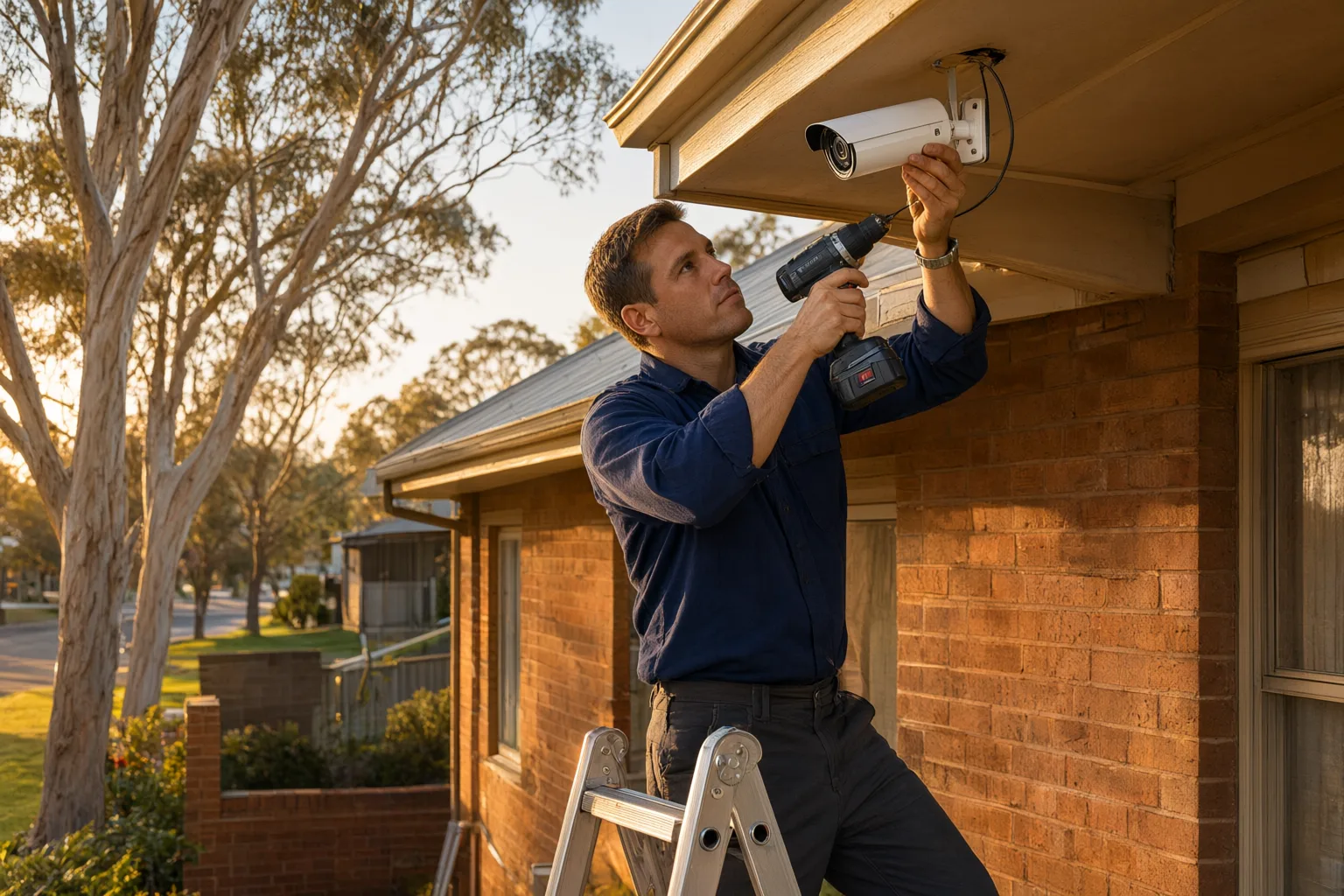
- Installation labour of $400–$900 barely changes between resolutions because both run on the same Cat5e/Cat6 PoE cabling.
- Under Australian Consumer Law, professional installs must carry warranties that DIY Bunnings kits typically don't match.
- Hybrid setups mixing 4K at entrances with 1080p in secondary zones save Newcastle and Adelaide homeowners $800–$1,500.
How Much Does 4K CCTV Cost Compared to 1080p in Australia?
For a typical Australian home or small business, a professionally installed four-camera 1080p CCTV system costs between $1,500 and $3,500, while an equivalent 4K system costs between $2,500 and $6,000. That gap of roughly $1,000 to $2,500 isn't just about better cameras — it flows through every part of the build, including the network video recorder (NVR), surveillance-grade hard drives, cabling and configuration time.
The reason is simple: a 4K camera captures around 8 megapixels per frame compared with roughly 2 megapixels for 1080p. Four times the detail means four times the data, and that data has to be processed, transmitted and stored somewhere.
In this guide we break down exactly where that money goes — camera by camera, terabyte by terabyte — so you can decide whether 4K is worth it for your property, whether 1080p will do the job fine, or whether a hybrid mix gives you the best of both.
Why Resolution Matters: What Are You Really Paying For?
Resolution determines how much usable detail your footage contains when something goes wrong. With 1080p, you can generally identify a person at close range — say within 5 to 8 metres — but beyond that, faces soften into blur. Number plate readability at distance is similarly limited.
With 4K, you can digitally zoom into recorded footage and still make out facial features or read a number plate at 15 to 20 metres. For Australian properties with wide frontages, long driveways, generous backyards or street-facing car parks, that extra reach is often the entire reason for installing [[dome-vs-bullet-cameras-which-style-suits-your-australian-property-best|cameras]] in the first place.
There's also a coverage argument. Because each 4K frame contains so much more information, one 4K camera can often watch an area that would need two or three 1080p [[wireless-camera-batteries-vs-solar-keeping-unpowered-cameras-running|cameras]] to cover at the same evidentiary quality. In some layouts, that means fewer cameras overall — which partially offsets the higher per-unit price.
What Do Quality 1080p and 4K Cameras Actually Cost?
Professional-grade equipment from brands like Hikvision, Dahua and Uniview sits well above consumer DIY kits sold at Bunnings or on Amazon. These cameras are built for Australian conditions — extreme summer heat, coastal salt air, dust storms and heavy rain — and carry proper IP66 or IP67 weather ratings with warranties that mean something.
At the 1080p end, a quality turret or bullet camera with infrared night vision typically runs $150 to $300 per unit. Move up to 4K with the same form factor and expect $250 to $500 per camera. Premium 4K models with ColorVu full-colour night vision or AcuSense AI-powered human and vehicle detection sit towards $400 to $600 each.
For a standard four-camera residential installation, camera hardware alone therefore totals $600 to $1,200 in 1080p versus $1,000 to $2,400 in 4K. Add-ons widen the gap further: motorised varifocal lenses, ANPR (automatic number plate recognition) capability and pan-tilt-zoom (PTZ) functionality all command a premium, particularly in 4K.
Do 4K Systems Need a More Powerful NVR?
The recorder is where many buyers get caught out. Every stream your NVR handles must be decoded in real time, and 8-megapixel streams demand significantly more processing grunt than 1080p ones.
A basic 4-channel NVR that comfortably handles 1080p streams costs around $200 to $350. A 4K-capable NVR with enough decoding horsepower to display and record multiple 8-megapixel channels simultaneously runs $350 to $700. If you want onboard intelligence such as AcuSense false-alarm filtering or facial recognition, budget towards the top of that range.
One practical tip: choose an NVR with spare channels and headroom. If you later want to add cameras or upgrade individual units from 1080p to 4K, a capable recorder saves you from replacing the whole system.
How Much Storage Does a 4K CCTV System Need?
This is the expense most people never see coming. Four 1080p cameras recording continuously at 15 frames per second with H.265 compression fill roughly 1 to 2TB per month. The same four cameras in 4K need 4 to 8TB over the same period.
Surveillance-grade drives — Western Digital Purple or Seagate SkyHawk are the industry standards — cost approximately $100 to $150 for 2TB, $180 to $250 for 4TB and $300 to $400 for 8TB. If you want 30 days of retention, which most insurers recommend, the storage line item alone can differ by several hundred dollars between resolutions.
The good news is that modern technology claws much of this back. H.265+ compression combined with smart recording — where cameras only capture footage on motion or AI-detected events rather than recording 24/7 — can reduce 4K storage needs by 50 to 70%. We configure this as standard on every installation, which often brings a 4K system's running storage down close to what a naive 1080p setup would use.
Does Resolution Change Installation Labour and Cabling Costs?
Interestingly, the physical installation cost barely changes between resolutions. Cabling, conduit, connectors and mounting hardware run $200 to $400 regardless of whether you're fitting 1080p or 4K cameras, because both typically ride on the same Cat5e or Cat6 cabling with Power over Ethernet (PoE).
Professional installation and setup labour ranges from $400 to $800 for a 1080p system and $500 to $900 for 4K — the slight premium reflecting additional configuration time for higher-resolution streams and smart features. Property complexity matters far more than resolution here: a single-storey brick veneer home is straightforward, while a two-storey house with a Colorbond roof, detached granny flat or long driveway requires more cable runs, possibly a PoE switch or [[the-hidden-costs-of-cheap-wireless-cameras-vs-professional-poe-systems|wireless]] bridge, and correspondingly more labour.
Commercial sites add further variables — high ceilings, long cable runs, after-hours installation windows and strata or landlord requirements all influence the final quote.
When Is 1080p Still the Smarter Buy?
We don't push 4K on every customer — that would be dishonest advice. For many properties, 1080p delivers everything needed at a meaningfully lower price point.
If your cameras cover small, defined areas — a front porch, back door, internal hallway or small retail counter — 1080p provides more than enough detail to identify a person at close range. Modern 1080p cameras with Starlight sensors also perform exceptionally in low light, sometimes matching or beating budget 4K models after dark because their larger pixels gather more light per pixel.
For rental properties, small offices or tight budgets, a well-designed 1080p system from Hikvision or Dahua will serve reliably for years. And because most modern NVRs support mixed resolutions, you can upgrade individual cameras to 4K down the track without replacing the whole system.
Are There Times When 4K Is Worth Every Extra Dollar?
There are situations where 4K isn't a luxury — it's the only option that genuinely does the job.
Wide open areas are the clearest case. A single 4K camera can cover a driveway, front yard or car park that would need two or three 1080p cameras for equivalent detail. Measured per square metre of usable coverage, 4K can actually work out cheaper.
Commercial and industrial sites benefit enormously. Warehouses, construction sites, retail floors and strata common areas all involve monitoring large spaces where incidents happen at distance. Zooming into crisp 4K footage to see exactly what occurred — rather than squinting at pixelated mush — is the difference between useful evidence and wasted time.
If you're investing in ANPR for number plate capture at a gate or entrance, 4K is essentially mandatory for reliable results beyond about 8 metres. Rural properties and farms benefit too: cameras positioned far from sheds, gates and stock yards need the reach that only 4K paired with a varifocal lens can provide.
Which Hybrid Setup Offers the Best Value in Australia?
For most Australian homes, the best value lies in the middle. Put 4K cameras where detail matters most — the driveway, front entrance and rear yard — and use 1080p for secondary zones like side passages, internal hallways and garages.
A typical hybrid six-camera system might combine three 4K ColorVu cameras on the perimeter with three 1080p Starlight cameras elsewhere, all feeding a single 4K-capable NVR. Total installed cost usually lands between $3,000 and $4,500 — less than a full 4K build, but with every critical approach covered in full 8-megapixel detail.
Whichever route you take, every system we install includes remote viewing on your phone, motion-activated push notifications and a full walkthrough at handover. The goal is always the same: footage that's actually usable when you need it most.
Installed Cost Comparison: 4-Camera 1080p vs 4K CCTV System
| Component | 1080p System | 4K System |
|---|---|---|
| 4 x Cameras (turret/bullet) | $600 – $1,200 | $1,000 – $2,400 |
| NVR (4–8 channel) | $200 – $350 | $350 – $700 |
| Surveillance HDD (30-day retention) | $100 – $150 (2TB) | $250 – $400 (6–8TB) |
| Cabling, conduit & connectors | $200 – $400 | $200 – $400 |
| Professional installation & setup | $400 – $800 | $500 – $900 |
| Total installed cost | $1,500 – $3,500 | $2,500 – $6,000 |