
Key Takeaways
- Businesses with employees in NSW must give written notice of camera surveillance at least 14 days before it begins.
- The Workplace Surveillance Act 2005 bans cameras outright in toilets, change rooms and showers regardless of signage.
- Signs must be placed before people enter a monitored area — inside placement is the most common compliance failure.
- Licensed venues in NSW often have mandatory CCTV signage conditions written into their liquor licence.
- A compliant CCTV warning sign costs around $30 yet delivers measurable deterrence against opportunistic theft.
- Audio recording requires consent under the Surveillance Devices Act 2007 (NSW); signage alone does not make it lawful.
How Do CCTV Warning Signs Work for NSW Businesses?
Yes. If your business operates CCTV in New South Wales, you should display clear CCTV warning signs at every entrance before people enter the monitored area — and for businesses with employees, notification is a legal requirement under the Workplace Surveillance Act 2005 (NSW), not an optional courtesy.
There is no single 'CCTV signage law' in Australia. Instead, three pieces of legislation combine to create your obligations: the Workplace Surveillance Act 2005 (NSW) governs cameras watching employees, the Privacy Act 1988 (Cth) governs the collection of personal information such as identifiable footage of customers, and the Surveillance Devices Act 2007 (NSW) imposes strict consent rules on audio recording.
This guide explains exactly what each law demands, where signs must go, what they should say, and how proper signage protects both your compliance position and the evidentiary value of your footage.
Which Three Laws Govern CCTV Signage Requirements in NSW?
Understanding which law applies to which situation is the first step to compliant surveillance. The [[workplace-surveillance-laws-in-australia-what-employers-must-know|Workplace Surveillance]] Act 2005 (NSW) catches most business owners off guard: it applies to you if you employ staff in NSW, regardless of business size, whenever cameras record areas where employees work.
For customer-facing spaces, the Australian Privacy Principles within the Privacy Act 1988 require organisations covered by the Act — generally those with annual turnover above $3 million — to take reasonable steps to notify people that personal information is being collected. Because video footage showing identifiable faces counts as personal information, a visible sign at the point of entry is the accepted method of meeting that obligation. Even if your turnover falls below the threshold, following the same practice is widely regarded as best practice and costs almost nothing.
Finally, the Surveillance Devices Act 2007 (NSW) restricts the recording of private conversations. If your system captures audio as well as video, signage alone will not make that recording lawful — separate consent requirements apply.
What Does Employee Notification Under the Workplace Surveillance Act Require?
The Workplace Surveillance Act draws a hard line between overt surveillance, where people know cameras are operating, and covert surveillance, where they do not. Overt camera surveillance of employees is lawful provided each affected worker receives written notice at least 14 days before surveillance begins — or, for new hires, before they commence work.
That written notice must spell out the kind of surveillance used, how it will be carried out, and when it will operate. Entrance signage does not replace this written notice, but it reinforces it and extends coverage to contractors, visitors and customers who fall outside the employee [[do-you-need-to-tell-staff-theyre-on-camera-australian-notice-requirements-explai|notification]] process.
Covert surveillance of employees is prohibited unless you obtain a covert surveillance authority from a magistrate, typically granted only to investigate serious wrongdoing such as theft. Installing a hidden camera in the stockroom because you suspect pilfering — without that authority — can result in prosecution and renders any footage inadmissible. Roof and eave mounting angles protect lenses from direct sun glare — critical in [[/adelaide|Adelaide]]'s harsh summers and [[/newcastle|Newcastle]]'s wet coastal winters.
Where Are Cameras Absolutely Banned Despite Warning Signs?
Some locations are off-limits entirely. Cameras must never be installed in toilets, change rooms, showers or other areas where people have a reasonable expectation of complete privacy. No amount of signage can legalise a camera in these spaces; the prohibition is absolute.
Staff break rooms sit in a grey area. Employee privacy expectations are high, and covert placement anywhere in a workplace is unlawful without magistrate's authority. Before installing any camera in a break room, lunch area or similar space, seek specific advice tailored to your premises.
Getting this wrong carries consequences well beyond embarrassment: non-compliant footage can be thrown out entirely, and penalties can dwarf whatever incident prompted the installation in the first place.
Should CCTV Signs Be Placed Before or Inside Monitored Areas?
Neither the legislation nor regulators prescribe exact dimensions or wording for CCTV signs. The practical test applied by courts and regulators is whether a reasonable person would have understood they were entering a recorded area — which gives installers clear guidance on placement.
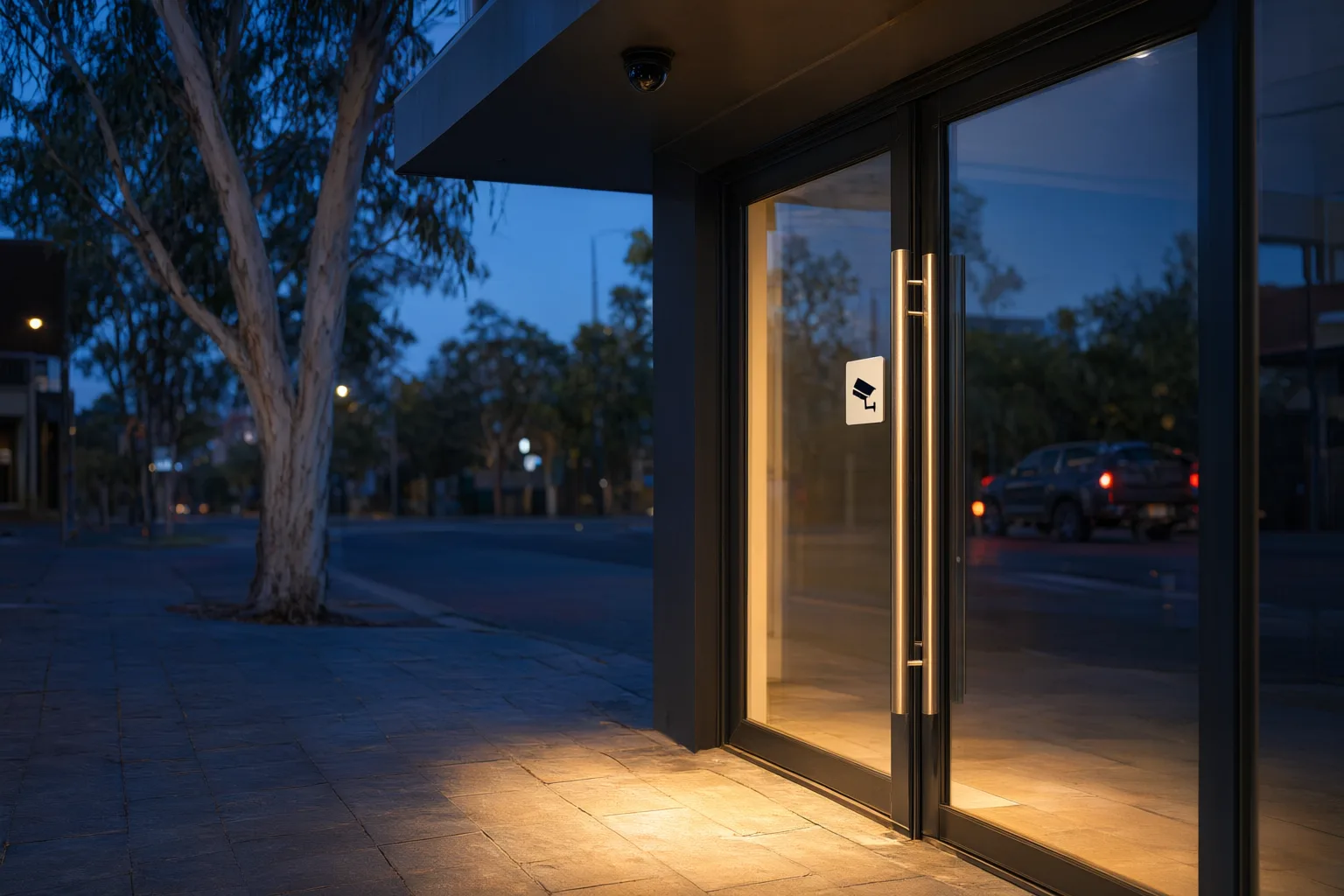
Position signs at every public entrance before people cross into the monitored zone. A sign inside the shop that customers only read after being filmed defeats the purpose entirely. Eye-level mounting, roughly 1.5 to 1.7 metres on the door or adjacent wall, delivers the best visibility.
Larger sites need broader coverage. Warehouses, construction sites and car parks should carry signage at vehicle entry points and repeated throughout the premises, not just at the front gate. Outdoor signs must use weatherproof materials to remain legible year-round.
Can Any Wording Make a CCTV Sign Compliant in Australia?
Effective wording is deliberately simple. A sign stating 'These premises are protected by 24-hour CCTV surveillance. Images are recorded for security purposes' satisfies the core requirement that a reasonable person understands recording is occurring and why.
Adding your business name and a contact point for privacy enquiries strengthens your Privacy Act [[cash-handling-areas-camera-rules-every-australian-business-should-follow|compliance]], particularly for larger organisations handling significant volumes of personal information.
One critical caveat: if your system records audio — which most professionally installed commercial systems deliberately avoid — far stricter consent requirements apply under the Surveillance Devices Act 2007 (NSW). Signage alone will not cover audio capture of private conversations.
Do Different Premises Types Need Different CCTV Signage?
Different business types face different practical requirements. Retail stores need door signage covering shop floors and point-of-sale camera zones. Licensed venues in NSW often have CCTV and signage conditions written directly into their liquor licence — particularly in declared precincts — so check your licence conditions carefully, as they can specify camera placement, retention periods and mandatory signage.
Construction sites and warehouses should sign all perimeter entry points, especially where ANPR cameras capture number plates at gates. Offices using access control and intercom systems at the front door should incorporate CCTV notices into that entry point, since visitors are typically recorded from the moment they approach.
Strata and mixed-use buildings add another layer again: cameras in common areas require owners corporation approval, and signage must cover shared lobbies, car parks and lifts.
Is Good Signage Enough to Deter Crime and Secure Evidence?
Beyond ticking legal boxes, visible warnings make your entire security investment work harder. Offenders who know they are being recorded overwhelmingly move on to softer targets — effective deterrence from a sign costing around $30.
Signage also protects the evidentiary value of your recordings. If you ever hand footage to NSW Police, use it in a workplace investigation or support an insurance claim, demonstrating that surveillance was overt and properly notified removes any argument that the material was obtained improperly. Footage from non-compliant covert cameras can be discarded altogether.
When designing a commercial CCTV system, signage placement belongs in the site design itself rather than as an afterthought. Mapping camera coverage and sign locations together during the consult ensures systems built on platforms like Hikvision or Dahua are legally defensible from day one, with retention settings, remote viewing permissions and user access logs configured to match privacy obligations.
Why Do NSW Businesses Keep Making CCTV Signage Mistakes?
The most frequent error is placing signs inside the monitored area rather than before it — customers have already been filmed by the time they see the notice. The second is relying on signage alone to satisfy employee notification duties, when the Workplace Surveillance Act requires separate written notice at least 14 days ahead.
Other common pitfalls include forgetting vehicle entry points on larger sites, letting outdoor signs fade until illegible, installing cameras in prohibited zones like change rooms, and enabling audio recording without understanding the stricter consent regime that applies.
Each mistake is cheap to fix now and expensive to fix after an incident. A short audit of your entrances, sign condition and system settings usually resolves every issue in a single visit.
NSW Business CCTV Signage Obligations at a Glance
| Legislation | Who It Covers | What It Requires | Signage Role |
|---|---|---|---|
| Workplace Surveillance Act 2005 (NSW) | All NSW employers | Written notice to employees 14 days before camera surveillance starts; covert cameras banned without magistrate's authority | Supports written notice; covers contractors and visitors on site |
| Privacy Act 1988 (Cth) | Businesses with turnover over $3 million (best practice for all) | Notify individuals that personal information (identifiable footage) is being collected and why | Entry signage is the accepted method of notification |
| Surveillance Devices Act 2007 (NSW) | Everyone in NSW | Restricts recording of private conversations; audio recording needs consent | Signage alone does NOT legalise audio recording |
| Liquor licence conditions (NSW) | Licensed venues in declared precincts | Specific camera coverage, retention and signage conditions | Mandatory signage often written into licence terms |