
Key Takeaways
- Annual CCTV maintenance cost averages $150–$600 for Australian homes and $500–$2,500+ for commercial sites in 2025.
- Only licensed security installers can legally service CCTV systems under state licensing laws in NSW and South Australia.
- Heat, coastal salt air, storms and humidity make annual servicing essential for outdoor cameras in Newcastle and Adelaide.
- Budget 5–10% of your original installation cost per year to cover maintenance and minor repairs.
- Skipping maintenance risks failed hard drives, voided insurance claims and blind spots exactly when footage matters most.
How Much Does CCTV Maintenance Cost Per Year in Australia?
The short answer: professional CCTV maintenance cost in Australia typically runs $150 to $600 per year for homes and $500 to $2,500+ for commercial premises in 2025. You can expect pricing to scale with the number of cameras, system complexity and whether you book a one-off service or an annual plan. For homeowners and businesses in Newcastle NSW and Adelaide SA, regular servicing keeps recordings reliable, extends equipment life and protects your insurance position.
For context, a standard four-to-eight camera family home usually lands in the $250–$450 range for a one-off professional service visit. Small businesses running eight to sixteen cameras generally budget $500–$1,200 annually, while larger warehouses, industrial sites or multi-location operations can expect to pay $1,500–$2,500 plus, particularly where compliance documentation is required.
These figures assume a professionally installed system from brands like Hikvision, Dahua, Uniview or Axis. Cheaper consumer DIY kits from electronics retailers cost less to service on paper, but they fail more often — and over a five-year horizon, the repair bills frequently outweigh any upfront savings. A single emergency call-out to diagnose a dead recorder or swap a failed hard drive typically costs $180–$350 before parts are even added, which is why preventative maintenance almost always beats reactive repairs on price.
What's Included in a Professional CCTV Service Visit?
A proper CCTV service is far more than someone wiping a lens and leaving an invoice. Licensed installers work through a structured checklist designed to catch small faults before they turn into expensive failures — a critical consideration when Australian heat, salt air and summer storms are constantly working against outdoor electronics.
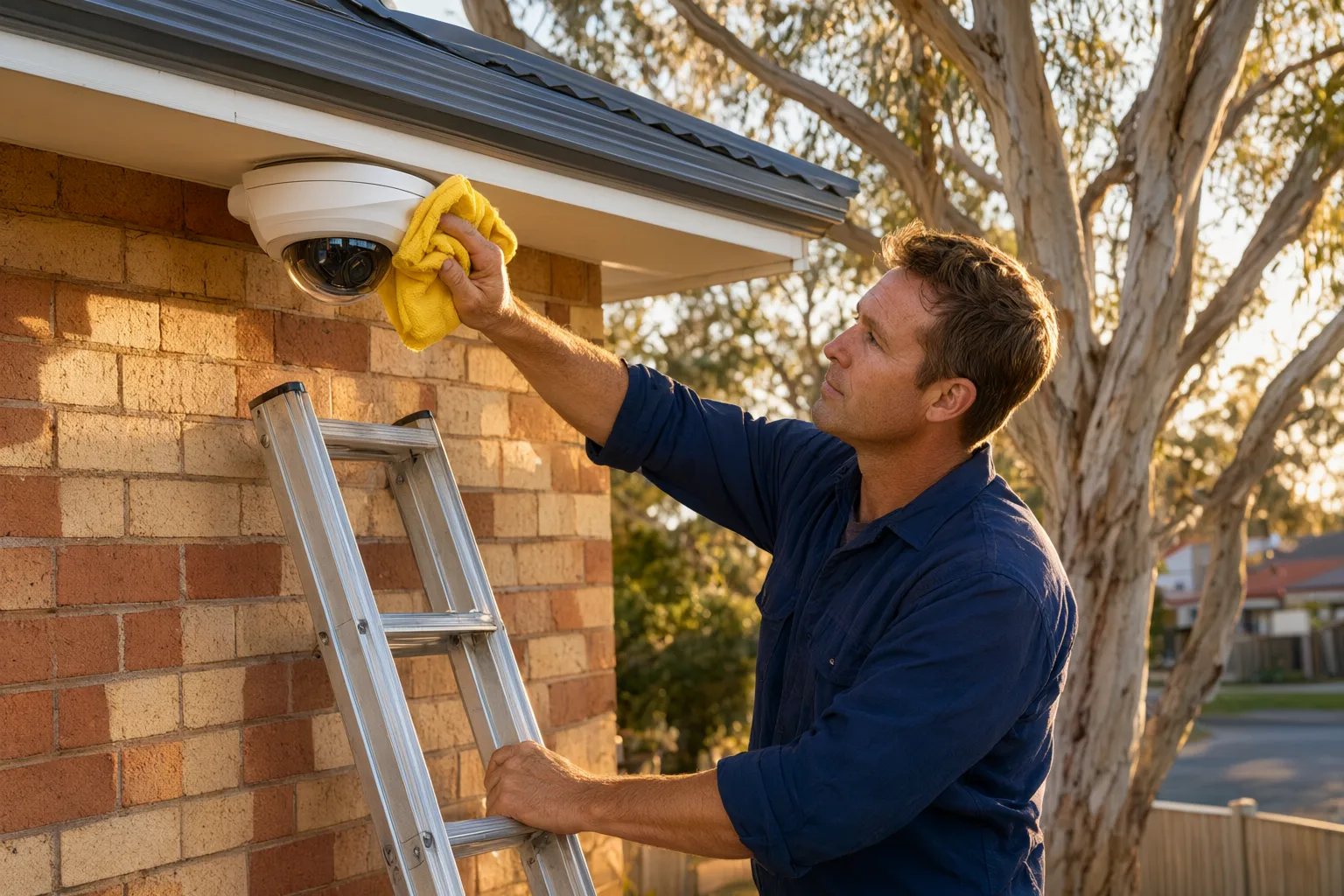
- Cleaning lenses, housings and infrared windows to restore full image clarity
- Re-aiming cameras that have shifted due to wind, vibration or building movement
- Testing hard drive health inside the NVR or DVR and confirming recording schedules still run correctly
- Updating firmware on cameras and recorders to patch known security vulnerabilities
- Inspecting cabling, connectors and PoE switches for corrosion, water ingress or heat damage
- Verifying remote viewing apps, motion detection zones and smart detection settings such as AcuSense
- Confirming time and date stamps are accurate — essential if footage is ever used as legal evidence
- Checking surge protection and earthing ahead of storm season
- Issuing a written condition report you can hand to your insurer
Are Annual CCTV Maintenance Costs Different by Property Type?
Pricing scales directly with system size and complexity. The table below reflects realistic 2025 rates for professional servicing by a licensed and insured technician across Australian capital cities and major regional centres — not DIY cleaning by the property owner.
Two factors push properties toward the upper end of each range: difficult access (cameras above two storeys, on masts, or requiring scissor lifts) and older systems where firmware migration, connector replacement or storage upgrades are needed during the visit.
Why Do Australian Conditions Make Annual Servicing Non-Negotiable?
Australia is genuinely one of the harshest environments on earth for outdoor electronics, and this is the single biggest reason maintenance here matters more than it does overseas. A camera mounted on a sun-facing western wall can hit internal temperatures above 70°C during a summer heatwave, accelerating capacitor ageing and drying out housing seals long before their rated lifespan.
Coastal suburbs cop salt-laden air that corrodes connectors, screws and mounting brackets within a couple of years if nobody inspects them. Inland, dust storms coat lenses in fine red film that degrades night vision performance. In bushfire-prone areas, ash and ember exposure can cloud housings in a single season.
Then there's storm season. Lightning strikes and grid power surges are among the most common causes of NVR and PoE switch failures seen across NSW and Queensland. A maintenance visit includes checking surge protection and earthing — cheap insurance against a $1,500-plus recorder replacement. Rural and remote properties running cameras over 4G links or solar power have it even tougher: a failed camera on a farm gate can sit dead for months before anyone notices without a scheduled check.
Should You Choose a Maintenance Plan or One-Off CCTV Service?
For most homeowners with a newer four-to-eight camera system, a one-off annual service is the sensible choice. You book a visit, the technician works through the full checklist, and you pay a flat fee. It's predictable, and there's no lock-in contract.
A maintenance plan earns its keep for businesses, strata properties and anyone who simply cannot afford downtime. Plans typically bundle one or two scheduled services per year, priority call-out response, discounted parts and labour on repairs, and remote health monitoring where the equipment supports it. Modern Hikvision and Dahua recorders can report hard drive errors, camera dropouts and storage warnings remotely, meaning many problems get fixed before you'd ever notice them yourself.
As a rule of thumb, plans cost 20–40% more than a single annual visit, but they usually pay for themselves the first time you need an urgent repair, because call-out fees and replacement parts are discounted or included. For a retail shop relying on footage for slip-and-fall claims and theft investigations, that guaranteed responsiveness is often worth the premium on its own.
Can Skipping CCTV Maintenance Really Cost You More?
The most expensive [[how-much-does-a-4-camera-cctv-system-cost-in-australia|CCTV system]] is the one that isn't recording when you actually need it. Installers regularly attend break-ins where the owner discovers the hard drive failed eight months earlier, or that a wind-shifted camera has been faithfully filming a brick wall instead of the driveway. In those moments, thousands of dollars of equipment has delivered precisely nothing.
Insurance is another major factor. Insurers increasingly ask for maintenance records when assessing theft and damage claims, and some commercial policies now require documented evidence of regular servicing before they'll pay out. A written report from a licensed installer after each service gives you exactly that documentation.
Image quality quietly erodes too. A camera with a dirty lens or degraded infrared cut filter will still show a picture — just not one clear enough to identify a face or number plate, which defeats the entire purpose of the investment. Feature-rich technologies like ColorVu low-light imaging and ANPR number plate recognition depend entirely on clean optics and correct configuration to deliver results.
Finally, outdated firmware is a genuine cybersecurity risk. Internet-connected recorders running old software with known vulnerabilities can be hijacked into botnets or used as a doorway into your broader home or business network — a growing problem as more systems come online.
Do Common CCTV Repairs in Australia Have Predictable Costs?
Understanding what goes wrong most often helps explain why preventative servicing is worth the money. Failed surveillance-grade hard drives top the list — continuous 24/7 recording is punishing work, and even quality WD Purple or Seagate SkyHawk drives typically last only three to five years under constant load. Budget $200–$450 for a replacement drive fitted and configured.
Storm and surge damage comes a close second. A lightning-hit or grid surge can kill cameras, cabling or the recorder outright, with repairs running $150–$400 per affected camera depending on model and access difficulty. Corroded connectors in coastal installations are another frequent call-out, along with cameras knocked out of alignment by wind, possums or nearby tree trimming.
Compare those numbers to a $250–$450 annual service and the maths becomes obvious: one avoided emergency repair generally covers several years of maintenance.
Is Your Installation Choice Affecting Long-Term CCTV Servicing Costs?
If you're installing a new system, several decisions made up front will lower your ongoing servicing bill. Specifying genuine IP66 or IP67-rated cameras with marine-grade mounting brackets dramatically slows corrosion in coastal areas. Choosing a recorder with enterprise or surveillance-rated drives rather than desktop drives extends storage lifespan considerably.
Camera placement matters as well. Mounting cameras under eaves or on shaded southern walls reduces thermal stress compared with sun-exposed western aspects. Properly rated surge protection at both the switchboard and the recorder adds modest upfront cost but prevents the single most expensive failure category.
Finally, insist on equipment from major brands with active Australian warranty support. Grey-imported cameras might look identical, but firmware updates arrive late or never, and a failed grey-import unit may be cheaper to replace than repair — a false economy that shows up within three to five years.
Which Budgeting Method Prevents Surprise CCTV Maintenance Bills?
A practical rule of thumb is to set aside 5–10% of your original [[dahua-cctv-cost-breakdown-from-entry-level-to-enterprise-in-australia|installation cost]] each year for maintenance and minor repairs. On a $3,000 home system, that's $150–$300 annually. On a $15,000 commercial installation, plan for $750–$1,500. Put it aside from day one and no invoice will ever catch you off guard.
When comparing quotes, ask specifically what's included, whether the technician holds the appropriate [[price-per-camera-explained-what-australian-homeowners-should-expect-to-pay|security]] or cabler's licence for your state, whether they carry insurance, and whether you'll receive a written report afterwards. Be wary of suspiciously cheap offers — a thorough service on an eight-camera system should take one to two hours, so anything priced like a ten-minute job almost certainly is one.
Most reputable installers will happily quote your existing system even if another company installed it, so it pays to gather two or three itemised quotes before committing to a plan.
In [[/newcastle|Newcastle]] NSW, coastal exposure is the biggest cost driver. Salt-laden air off the Hunter coastline corrodes housings, mounts and connectors far faster than inland conditions, so beachside properties from Stockton to Merewether should budget toward the upper end of the residential range — around $400 to $600 annually for a six-to-eight camera system. Inland suburbs like Cameron Park or Fletcher face less corrosion but more dust and summer heat, which degrades seals and stresses power supplies.
[[/adelaide|Adelaide]] SA presents its own profile. Long, dry summers push roofline and eave-mounted cameras through repeated thermal cycling, cracking gaskets and fading cable insulation, while winter storms test drainage and mounting brackets. Commercial sites across the CBD, Port Adelaide and northern industrial estates typically run 16 to 64 channels, where annual CCTV maintenance cost sits between $1,200 and $2,500+, often bundled into a contracted plan with priority response times.
Licensing matters when comparing quotes. In New South Wales, CCTV servicing must be performed by a technician holding a Master Security Licence issued under the Security Industry Act, while South Australia requires registration under the Security and Investigation Agents Act. Using an unlicensed operator may breach these laws, invalidate warranties and complicate insurance claims, so always verify licence numbers before booking a cheap service call.
Under the Privacy Act 1988 and state surveillance legislation, businesses must ensure cameras are functioning correctly if they rely on them for workplace surveillance or customer safety obligations. A system that silently fails could expose a retail store or warehouse owner to liability, making documented annual servicing both a compliance safeguard and evidence of due diligence. Keep service reports on file alongside your signage and notification records.
For farms and rural properties outside metro areas, travel time adds $80 to $150 per visit, so many owners opt for a combined plan covering two visits a year — one before summer heat peaks and one after storm season. This pre-summer check typically includes resealing weatherproof glands, cleaning lenses caked with dust, testing night vision performance and verifying remote access still works after router or NVR firmware updates.
Warranty terms also reward planned maintenance. Most reputable brands require proof of periodic professional servicing to honour warranty claims on recorders and cameras; a $250 annual service visit can preserve thousands of dollars of warranty coverage that would otherwise lapse. Ask your installer to log each visit against your serial numbers so claims are frictionless.
Finally, treat maintenance as part of total ownership cost, not an optional extra. A $3,000 home installation realistically costs $3,750 to $4,500 over five years once servicing is included — still dramatically cheaper than replacing a neglected system prematurely or losing irreplaceable footage after a break-in. Get a quote from a licensed local installer to lock in predictable annual pricing.
Estimated Annual CCTV Maintenance Cost by Property Type in Australia (2025)
| Property Type | Typical System Size | Annual Service Cost (AUD) |
|---|---|---|
| Home (metro) | 4–8 cameras | $150 – $600 |
| Home (coastal/rural) | 6–12 cameras | $300 – $800 incl. travel |
| Small business / retail | 8–16 cameras | $500 – $1,200 |
| Warehouse / commercial | 16–64 cameras | $1,200 – $2,500+ |