
Key Takeaways
- Analogue four-camera systems cost roughly $800–$1,200 fully installed; comparable PoE systems typically run $1,800–$3,500 in Australia.
- PoE uses one cable per camera for power and data, cutting labour time versus dual coax-plus-power runs.
- IP cameras deliver 4MP–8MP detail, colour night vision and reliable NBN/4G remote viewing that analogue DVR apps struggle to match.
- In NSW and SA, CCTV must comply with the Privacy Act 1988 and state surveillance laws — use a licensed installer.
- Coastal homes in Newcastle and hot Adelaide summers favour PoE hardware with better weather sealing and fewer corrosion-prone connectors.
What Is the Difference Between PoE and Analogue CCTV?
The short answer: PoE vs analogue CCTV Australia comes down to upfront price versus long-term value. Analogue systems are cheaper at the checkout, typically $800–$1,200 installed for four cameras, while a quality PoE IP camera system usually costs $1,800–$3,500. You can expect PoE to repay that gap through sharper footage, simpler cabling and lower maintenance over its lifespan.
PoE IP cameras deliver up to 4K resolution, full-colour night vision, intelligent human and vehicle detection, and smooth remote viewing over NBN or 4G. They also need only one cable per camera instead of two, which reduces labour costs and failure points. Analogue still suits buyers with existing coaxial wiring and very tight budgets, but most Australians who install analogue end up upgrading within a few years.
Is Analogue CCTV Really Cheaper Than PoE in Australia?
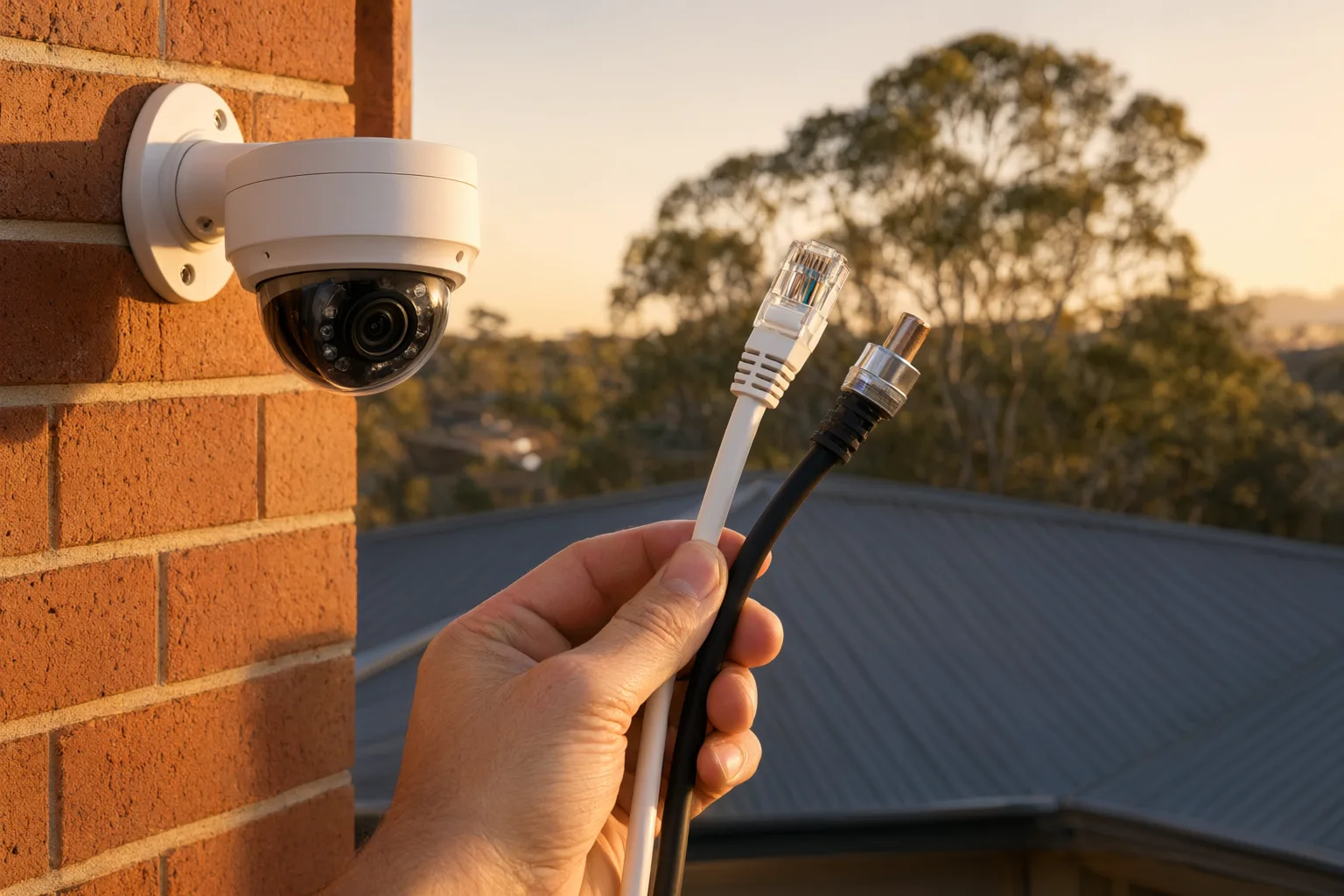
Analogue CCTV is the older technology. Cameras capture video and transmit it as an analogue signal along coaxial cable to a digital video recorder (DVR), which digitises and stores the footage. Each camera also needs its own separate power cable, so every camera position requires two cable runs. Resolution on modern HD-analogue formats such as TVI and CVI generally tops out around 1080p, and intelligent features like person detection or number plate recognition are rare or absent.
[[the-real-cost-of-a-4-camera-poe-system-installed-in-australia|PoE CCTV]] uses network (IP) cameras that receive both electrical power and data through a single Cat5e or Cat6 Ethernet cable, supplied by a network video recorder (NVR) or PoE switch. Because each camera is effectively a small computer on your network, it can process video locally and support resolutions of 4K and beyond. That processing headroom enables advanced features such as Hikvision ColorVu full-colour night vision, AcuSense human and vehicle classification that filters out false alarms from animals and weather, Starlight sensors for near-darkness footage, and ANPR (automatic number plate recognition) for driveways and car parks.
Why Does PoE Deliver Better Image Quality and Smart Features?
There is no denying analogue's price advantage. A basic four-camera analogue [[how-much-does-a-4-camera-cctv-system-cost-in-australia|system]] with DVR can start around $800 to $1,200 fully installed, making it attractive for landlords, sheds and basic monitoring where evidence quality is not critical.
A comparable PoE system with NVR typically ranges from $1,500 to $2,500 installed, depending on camera quality, lens selection and features such as ColourVu or ANPR. The premium reflects better sensors, better build quality and smarter software.
However, upfront price is only part of the equation. Analogue equipment tends to be replaced sooner because the technology plateaued years ago and components receive fewer firmware updates. PoE systems last longer, hold their value better and are far easier to expand — adding a fifth or sixth camera often means running one new cable rather than replacing the recorder. When you calculate cost per year of service across five to ten years, PoE frequently works out cheaper despite the higher starting price.
How Does Installation Differ for Australian Properties?
If you need to identify faces, read number plates or review activity in low light, PoE IP cameras are the clear winner. Technologies like ColorVu provide genuine full-colour video at night rather than grainy black-and-white infrared, while Starlight sensors deliver usable footage in near-darkness without harsh IR glare washing out the scene.
Smart analytics matter just as much as raw resolution. AcuSense-style detection distinguishes humans and vehicles from cats, birds, rain and moving branches, which means fewer 3am false alerts on your phone. ANPR can log every vehicle entering a property — invaluable for farms, depots and strata car parks.
Analogue cameras struggle in all these scenarios. Even HD analogue (TVI/CVI) maxes out around 1080p and lacks onboard processing power for intelligent detection, so you get more false alarms and less usable evidence. For Australian households wanting to check on pets or deliveries, and businesses needing evidence-grade footage for police or insurers, PoE delivers the clarity and reliability required.
Can PoE Systems Cut Maintenance and Ownership Costs?
Running two cables — coax plus power — to every camera adds labour time, wall penetrations and complexity. PoE simplifies this to a single cable run per camera, which is especially valuable in brick veneer homes, double-brick construction, Colorbond roof structures and warehouses with long cable distances. Fewer holes in weatherproof envelopes also matters in cyclone-prone and high-rainfall regions.
PoE hardware also copes better with Australian conditions. Ethernet cable is generally more resistant to heat degradation than coaxial cable in roof spaces that regularly exceed 60°C in summer, and professionally sealed IP66/IP67-rated camera housings handle coastal salt air and storm moisture far better than budget analogue units with BNC connectors that corrode.
For rural properties, construction sites and remote infrastructure using 4G remote viewing, PoE integrates seamlessly with solar power setups and wireless point-to-point bridges, letting you cover paddocks, gates and machinery sheds without trenching new conduit back to the house.
Do PoE Cameras Work Better With NBN and 4G Remote Viewing?
Analogue systems have more failure points by design: separate plug-pack power supplies for each camera, BNC connectors that corrode in humid coastal climates, and DVRs that often stop receiving firmware updates within a couple of years. A single damaged cable in an analogue run takes out both video and power simultaneously, and diagnosing which is at fault usually means a service call.
PoE systems centralise power delivery in the NVR or PoE switch, reducing the number of components that can fail. Firmware updates keep IP cameras secure against evolving cyber threats and add features over time — something analogue recorders rarely offer. Cable faults are easier to isolate with standard network testing tools.
Maintenance economics favour PoE too. Over a five-year horizon, fewer call-out fees, longer equipment [[how-long-should-a-cctv-system-last-lifespan-and-replacement-costs-explained|lifespan]] and no forced rewire typically bring the real total cost of ownership below analogue, even though the initial invoice was higher. Our comparison table below shows indicative five-year figures: roughly $1,400–$2,000 for analogue including higher maintenance, versus $1,800–$2,800 for PoE with lower ongoing costs and far greater capability.
Which System Suits Your Property Type Best?
One of the biggest practical differences shows up on your phone. Analogue DVR apps tend to stream low-resolution sub-streams that stutter and pixelate, especially on mobile data. PoE NVRs stream full HD or 4K sub-streams smoothly, push instant smart notifications when a person or vehicle is detected, and let you pull crisp clips straight from the timeline.
Because IP cameras are network devices, they slot naturally into the wider connected property: NBN fixed-line connections for city and suburban sites, 4G routers for farms and regional businesses, and even integration with intercoms, access control and alarm panels. If you plan to add smart features later — two-way audio, floodlight triggering, licence plate logging — only a PoE platform gives you that upgrade path without replacing the whole system.
Should You Choose PoE or Analogue in 2025?
Suburban family home: PoE is the sensible choice. You get driveway coverage with plate-level detail, backyard cameras that see colour at night, and reliable phone alerts when the kids arrive home. The extra upfront cost is modest against the decade of use.
Retail shop or office: Evidence-grade footage is essential for theft, liability and insurance claims. PoE's 4K detail and smart search (jump straight to events involving people) save hours of review time. Analogue's 1080p ceiling often leaves faces unidentifiable beyond a few metres.
Warehouse or industrial site: Long cable runs favour PoE's single-cable architecture, and ANPR at gates plus AcuSense perimeter detection dramatically cut false alarms from wind-blown debris and wildlife.
Farm or rural property: PoE pairs cleanly with solar power and 4G bridges for remote gates and machinery sheds, and ruggedised IP cameras withstand dust and heat better than consumer analogue kits.
Rental or tight-budget stopgap: Analogue can make sense if coax already exists in good condition and you need basic monitoring now — just accept you will likely upgrade within a few years.
Are You Ready to Compare Quotes From Licensed Installers?
Choose analogue only if you have existing coaxial infrastructure in good condition and a very tight budget. It works as a stopgap for basic monitoring, but treat it as temporary — the technology has plateaued and replacement parts are becoming scarcer.
Choose PoE for new installations, renovations, or whenever you need high-resolution evidence, smart alerts or dependable remote access. It aligns with modern NBN connectivity, scales camera-by-camera, and meets the expectations of insurers and police for usable footage. For homes, retail stores, warehouses and farms across Australia, PoE delivers better value, better performance and better peace of mind over the life of the system.
PoE vs Analogue CCTV: Installed Costs and Features in Australia (2025)
| Feature | PoE IP System | Analogue System |
|---|---|---|
| Installed cost (4 cameras) | $1,800 – $3,500 AUD | $800 – $1,200 AUD |
| Cabling required | Single Cat6 cable per camera | Coax + separate power per camera |
| Resolution & night vision | 4MP–8MP, colour night vision | Typically 1080p max, B&W infrared |
| Remote viewing via NBN/4G | Smooth high-res app streaming | Low-res sub-streams, frequent stutter |
| Best suited to | Homes, retail, farms wanting detail | Tight budgets with existing coax |