
Key Takeaways
- Axis cameras typically cost $800–$1,400 per unit in Australia before installation, roughly double comparable Hikvision or Dahua models.
- The premium buys superior low-light performance (Lightfinder 2.0), cybersecurity credentials, analytics licensing, and a 5-year warranty option.
- For most Australian homes, a professionally installed Hikvision or Dahua system delivers everything needed at half the hardware cost.
- High-risk sites — warehouses, retail chains, government-adjacent facilities in Newcastle NSW and Adelaide SA — justify the Axis spend.
- Total cost of ownership narrows the gap over 10 years thanks to Axis longevity, firmware support, and lower replacement rates.
Is Axis CCTV Worth the Premium in Australia?
The short answer: an Axis camera price in Australia typically sits between $800 and $1,400 per unit before installation, roughly double a comparable Hikvision or Dahua model. Whether that premium is worth paying depends entirely on your property, your risk profile, and how long you plan to own the system. For most homes in Newcastle and Adelaide, it isn't necessary. For high-risk commercial sites, it often is. This guide gives you real AUD numbers, honest comparisons, and a clear decision framework.
That's the honest answer most comparison articles dance around. Axis Communications isn't simply 'the expensive option'; it's a different tier of product built for different problems. A mid-range Axis dome retails around $800–$1,400, while a Hikvision camera with similar resolution sits at $250–$450. Whether that gap is money well spent depends entirely on what you're protecting, who needs access to the footage, and how long you expect the system to run.
This guide breaks down exactly where that extra money goes, which Australian sites genuinely benefit, and which buyers are better off investing the savings elsewhere.
- Axis suits commercial, government, and compliance-driven sites
- Hikvision and Dahua suit most homes and small businesses
- Installation quality matters as much as brand choice
What Should You Know About Axis Communications?
Axis Communications is a Swedish company headquartered in Lund, and it effectively created the category it now dominates: it released the world's first network camera in 1996. Nearly three decades later, that head start shows in the company's approach to engineering, firmware discipline, and long-term product support.
Unlike brands that compete primarily on price, Axis competes on architecture. Its devices are designed around an open-platform model, meaning they integrate with virtually any video management software (VMS) — Milestone, Genetec, Network Optix, and dozens of others. For a homeowner this barely registers; for a security manager running hundreds of [[solar-powered-cctv-cameras-upfront-costs-vs-long-term-savings-in-australia|cameras]] across multiple buildings, avoiding vendor lock-in is worth real money.
Axis also treats cybersecurity as a core product feature rather than an afterthought. Devices ship with signed firmware and secure boot, and the company publishes vulnerabilities transparently alongside regular patches. In a market where cheap IP cameras have repeatedly been conscripted into botnets, that rigour is a genuine differentiator.
- Invented the network camera in 1996
- Designed in Lund, Sweden
- Open-platform compatibility with major VMS platforms
- Signed firmware, secure boot, and transparent vulnerability disclosure
Which Features Does the Axis Price Premium Buy?
Let's put real numbers against the question. A mid-range Axis dome might retail for $800–$1,400. A Hikvision equivalent with similar resolution runs roughly $250–$450. That's a difference of several hundred dollars per camera before installation — so what changes when you pay it?
Build quality comes first. Axis housings use higher-grade materials, better thermal management, and more robust weather sealing. In Australian conditions — 40°C summer rooflines, coastal salt spray, hail and storm exposure — that engineering translates directly into fewer failures. Many Axis cameras are rated for 10+ years of continuous operation.
Image processing comes second. Axis designs its own ARTPEC system-on-chip and pairs it with premium lenses and sensors. Lightfinder 2.0 produces usable colour footage in near-darkness, while Forensic WDR handles brutal backlighting — think a person standing in a warehouse doorway at midday with full sun behind them. The output is footage that holds up as evidence rather than a silhouette.
Third is cybersecurity and compliance. Axis publishes a hardening guide, maintains a transparent disclosure process, and supports features like IEEE 802.1X network authentication and encrypted video streams. For healthcare facilities, financial institutions, and government tenants, these aren't luxuries — they're entry requirements.
- Swedish-designed ARTPEC chip for superior image processing
- Lightfinder 2.0 for colour imaging in extreme low light
- Forensic WDR for challenging backlit scenes
- Signed firmware, secure boot, and regular security patches
- Open-platform compatibility with major VMS platforms
- Typical product lifecycle of 7–10 years with ongoing firmware support
How Does Axis Compare With Hikvision and Dahua?
It's worth stating plainly: Hikvision and Dahua are not budget junk. Both manufacture professional-grade equipment we install regularly across NSW homes and businesses. Hikvision's ColorVu and Dahua's Full-Colour technologies deliver excellent night-time imaging, and their AI detection suites — AcuSense and WizSense/WizMind respectively — cut false alarms dramatically compared with older motion-only systems.
For the majority of residential and small-to-medium commercial installations, those brands represent outstanding value. The real question isn't whether Axis is 'better' in the abstract — it's whether Axis's specific advantages matter for your site. The comparison table below lays out the differences so you can judge for yourself.
- ColorVu and Full-Colour deliver strong night imaging at mid-range prices
- AcuSense and WizSense reduce false alarms effectively
- The right choice depends on your risk profile, not brand loyalty
Do High-Risk Sites Justify Paying More for Axis Cameras?
There are four situations where the Axis premium consistently pays for itself.
Critical infrastructure and government sites frequently mandate Axis or equivalent-tier brands because of cybersecurity compliance requirements. If your organisation must satisfy ISO 27001, the Essential Eight, or specific government procurement standards, specifying Axis removes a significant layer of audit friction.
Large commercial and industrial estates benefit from Axis's open platform. Once you're managing 50, 100, or 500 cameras across multiple buildings, native integration with enterprise VMS platforms and centralised management saves substantial operational cost year after year.
High-risk retail and banking environments depend on footage quality for fraud investigations, insurance claims, and legal proceedings. Forensic-grade imaging can be the difference between identifying an offender and filing unusable footage.
Harsh environments round out the list. Coastal installations, mining sites, and extreme heat zones chew through cheaper hardware. Replacing a failed $300 camera every three years — plus labour each time — often costs more across a decade than one Axis camera that simply keeps running.
- Government and critical infrastructure often mandate Axis-tier brands
- Enterprise-scale deployments benefit from open VMS integration
- Forensic imaging matters where footage feeds legal or insurance outcomes
- Harsh climates reward durable hardware over cheap replacements
Are Hikvision or Dahua the Smarter Choice for Australian Homes?
For most Australian homes, a professionally installed Hikvision or Dahua system covers everything you actually need. A four-camera ColorVu kit with AcuSense detection, a quality NVR, and phone-based remote viewing handles deterrence, entrance monitoring, and incident review — at roughly half the cost of an equivalent Axis build.
The same logic applies to small businesses. Cafes, offices, and standard retail shops monitoring entrances and stock don't need forensic WDR or defence-grade cybersecurity. Spending the difference on an additional camera, better lighting at key entry points, or a monitored alarm upgrade will almost always improve your overall [[reolink-buying-guide-for-australians-cameras-nvrs-and-real-prices|security]] posture more than upgrading the camera badge.
One caveat dominates everything else here: installation quality. A $400 Hikvision camera mounted by a licensed technician — correct positioning, proper cabling, tuned settings, secured network configuration — will outperform a $1,200 Axis camera slapped up badly, every single time. Brand choice never rescues a poor install.
- Residential needs are fully covered by mid-range brands
- Redirect savings toward coverage, lighting, or alarm monitoring
- Professional installation outweighs brand tier every time
Why Does the Axis Cost Gap Shrink Over Time?
Sticker price tells only part of the story. A CCTV system's true cost spans hardware, installation, maintenance, replacements, and the ongoing effort of managing it across its life.
Axis typically backs its cameras with a 5-year warranty (extendable), versus 3 years for most Hikvision and Dahua models. Axis also commits to longer firmware support cycles, so your cameras keep receiving [[price-per-camera-explained-what-australian-homeowners-should-expect-to-pay|security]] updates and feature improvements well into their service life. Stretch the comparison over ten years and the total-cost gap between Axis and mid-range brands often narrows to 30–50% — a fraction of the 100–200% upfront difference.
But there's a flip side worth respecting. If your budget is fixed and your security needs are ordinary, spending less upfront on a quality mid-range system and reinvesting the savings in wider coverage, better lighting, or monitored alarms usually delivers more total security per dollar than a smaller number of premium cameras.
- 5-year Axis warranty vs 3 years for Hikvision/Dahua
- Longer firmware support extends usable life
- 10-year cost gap narrows to 30–50%
- Fixed budgets often buy more security through coverage than brand upgrades
Should You Match Your Camera Brand to Your Risk Profile?
The fastest way to decide is to answer three questions honestly.
First, does anyone require compliance? If your insurer, regulator, head contractor, or procurement framework specifies certified cybersecurity standards, Axis moves from 'nice' to 'necessary'. Second, how long do you need this system to run without touch? If the answer is a decade in a harsh environment, Axis's build quality and warranty stack the maths in its favour. Third, will the footage ever need to survive legal scrutiny? If yes, forensic-grade imaging justifies itself the first time it identifies an offender.
If all three answers are no — which is true for most homes and small businesses — a mid-range system installed properly is the rational choice. And if you're genuinely on the fence, a hybrid design using ONVIF-compatible devices can blend both tiers, though single-brand systems remain simpler to maintain and update.
- Compliance requirements push you toward Axis
- Decade-long lifespans in harsh conditions favour Axis
- Legal-grade footage needs justify forensic imaging
- Otherwise, mid-range plus good installation wins
Can Aussie CCTV Cams Help You Choose in Newcastle or Adelaide?
At Aussie CCTV Cams, we install Axis, Hikvision, Dahua, Uniview, and other professional-grade brands — and we don't push any one of them. Our recommendations start with a free on-site consultation assessing your layout, lighting, entry points, and network infrastructure before a single camera is specified.
Every installation is completed by fully licensed and insured NSW technicians, and every system includes lifetime support. Whether the outcome is a $3,000 Hikvision setup or a $15,000 Axis deployment, you receive the same meticulous installation, thorough handover training, and ongoing backup from our team.
The best camera brand is the one correctly matched to your needs, installed properly, and maintained well. Request a free, no-obligation quote and we'll help you get it right the first time.
Before you compare brands, understand what drives the Axis camera price in Australia. Import costs, GST, distributor margins through authorised channels like Innomate or BGW Technologies, and the simple fact that Axis manufactures in Sweden rather than mass-producing in Asia all push the sticker price up. A single Axis P3268-LV dome might land at $1,100 ex-GST from an Australian distributor, while a visually similar Hikvision turret sells for around $450 installed-ready.
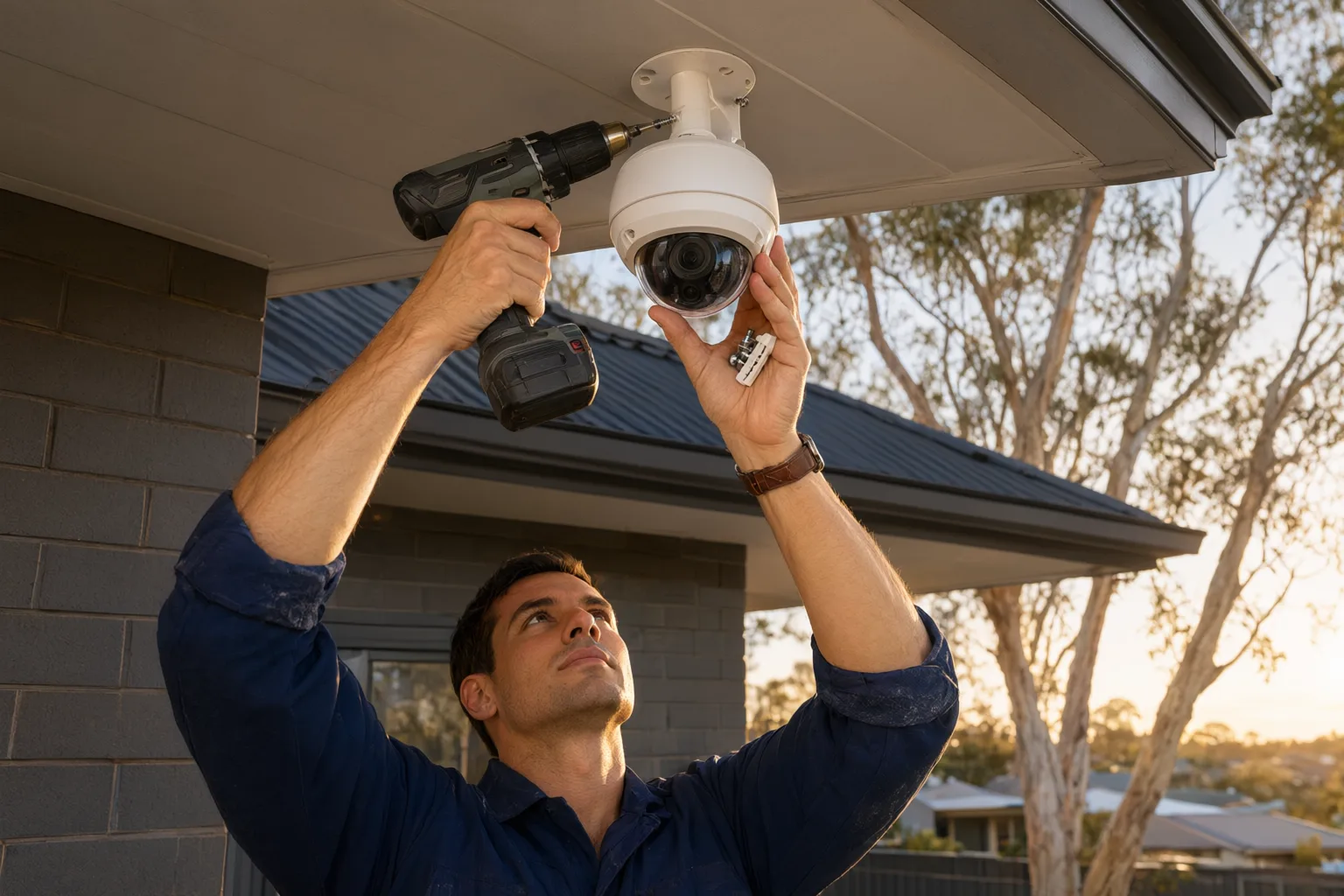
Installation labour is largely brand-agnostic. Whether we mount a camera under the eaves of a brick home in Adamstown or on a steel purlin inside a Wingfield warehouse, the cabling, bracketing, commissioning, and NVR configuration cost roughly the same. That means the Axis premium is almost purely a hardware decision — typically adding $1,500–$4,000 to a four-camera system compared with a Hikvision equivalent.
One often-overlooked factor is compliance. Under the Privacy Act 1988 and state surveillance legislation such as NSW's Workplace Surveillance Act, businesses recording staff or customers need reliable, tamper-resistant footage with dependable timestamps. Axis cameras ship with signed firmware, strong default security, and no history of the backdoor controversies that have affected some budget manufacturers — a genuine consideration for legal defensibility if footage ever matters in an insurance claim or dispute.
Australian conditions also matter more than most buyers expect. Coastal salt air in [[/newcastle|Newcastle]] corrodes cheap housings within three to five years, while [[/adelaide|Adelaide]] summers regularly exceed 40°C, cooking budget image sensors and causing colour shift and premature failure. Axis units carry IP66/IP67 ratings, operate to 55°C, and routinely run ten-plus years outdoors — which is why their residual value and warranty terms are stronger.
Finally, think about scalability. Axis uses an open platform (VAPIX and ONVIF support) that integrates with Milestone, Genetec, and most video management software, whereas budget brands increasingly lock you into proprietary ecosystems. If your business might grow from four cameras to forty, starting on Axis avoids a costly rip-and-replace later. If it won't, that flexibility is money spent for nothing.
- Free on-site assessment before any recommendation
- Licensed and insured NSW technicians
- Lifetime support regardless of brand chosen
Axis vs Hikvision vs Dahua: typical pricing and fit for Australian properties
| Brand & Tier | Typical Unit Cost (AUD) | Best Suited To |
|---|---|---|
| Axis (P-series/M-series) | $800–$1,400 + install | High-risk commercial sites, warehouses, government-adjacent facilities in Newcastle NSW and Adelaide SA |
| Hikvision (ColorVu/AcuSense) | $350–$700 + install | Most Australian homes and small businesses wanting strong night colour on a budget |
| Dahua (WizSense/Full-Colour) | $300–$650 + install | Cost-conscious residential installs and retail shops needing solid AI detection |
| Uniview (mid-tier) | $250–$550 + install | Multi-camera projects where value per channel matters most |