
Key Takeaways
- A scheduled commercial CCTV maintenance visit costs $250–$550 per year for a typical 8–16 camera Australian business system.
- Emergency CCTV call-outs triggered by neglect typically cost $350–$800 plus parts — often more than two years of planned servicing.
- Surveillance-grade hard drives last just three to five years of continuous writing, so drive health must be tested at every service visit.
- Many Australian commercial insurance policies require proof of maintenance; an unmaintained system can see claims reduced or denied entirely.
- Coastal, industrial and high-risk premises in Newcastle and Adelaide should move to six-monthly CCTV servicing under AS/NZS-aligned practice.
- A written condition report after each service creates the documented paper trail insurers and assessors value most.
How Much Does Commercial CCTV Maintenance Cost Compared to Neglect?
For a typical commercial CCTV system in NSW, a scheduled professional maintenance visit costs between $250 and $550 per year. Ignoring maintenance, by contrast, routinely ends in emergency call-outs of $350–$800 plus parts, uninsured losses that can exceed $50,000, and full system replacements of $8,000–$25,000 years earlier than necessary. The cheapest money you will ever spend on your security system is the money you spend keeping it working.
That gap exists because CCTV is the ultimate 'set and forget' purchase. It's installed once, the picture looks sharp on day one, and then it hangs on the wall doing its job invisibly for years. Unlike a broken air conditioner or a leaking roof, a degrading camera system gives you no warning at all. The cameras stay powered, the monitor still displays an image, and everything appears fine — right up until the day you actually need the footage and discover it was never there.
Why Does 'It Looks Fine' Put Your Business Security at Risk?
Across NSW we regularly attend [[cctv-maintenance-schedules-how-often-should-commercial-systems-be-serviced|commercial]] sites where the owner was convinced they were protected, only to uncover a recorder that stopped writing to disk eight months earlier, domes fogged with internal condensation, or lenses so coated in dust and pollen that number plates were unreadable beyond four metres. The system didn't fail loudly. It failed silently, and the business carried all of the risk without knowing it.
This is what makes CCTV unique among business equipment: its failure mode is invisible. A delivery van that won't start announces itself immediately. A camera recording a soft, hazy image at reduced frame rate onto a dying hard drive looks identical on screen to one performing perfectly. Without deliberate testing — playing back footage, checking drive health, verifying each camera's field of view — there is simply no way to know whether your system would perform in the moment that matters.
And the moment that matters is never convenient. It's the break-in at 3am, the ram raid through the roller door, the workplace incident, or the public liability claim from a customer who slipped on your floor. By then, the opportunity to prevent the failure has passed; all that remains is managing the loss.
What Are the Five Ways Neglect Drains Your Business Bank Account?
When we talk to business owners about [[how-much-does-cctv-maintenance-cost-per-year-in-australia|maintenance]], the conversation usually starts with price. A fairer question is: what does it cost when the system doesn't work? In our experience the damage arrives in five distinct forms.
First, lost evidence. If your recorder's drive failed months ago, there is no footage of the break-in, the theft by a contractor, or the fraudulent slip-and-fall claim. For a retailer or warehouse operator, a single uninsured stock loss or an undefended liability claim can run into tens of thousands of dollars — sometimes more than the entire original installation.
Second, insurance complications. Many commercial policies require security systems to be maintained in working order as a condition of cover. If an assessor finds your cameras were limping along at 2 frames per second onto a dead hard drive, you may face a reduced payout or a denied claim at precisely the worst moment. A documented service history from a licensed installer is often the difference between a paid claim and a protracted dispute.
Third, emergency repair premiums. Reactive call-outs always cost more than planned servicing — after-hours rates, urgent parts freighted in, and the downtime while your site sits unprotected waiting for a technician.
Fourth, wasted staff time. Every hour a manager spends rebooting recorders, googling error codes or squinting at blurry playback is an hour not spent running the business.
Fifth, premature replacement. A well-maintained Hikvision, Dahua or Axis system should deliver eight to ten years of reliable service. A neglected one — corroded connectors, cooked drives, water-damaged housings — can be uneconomical to repair within five. That's capital expenditure you brought on yourself.
- Lost or unusable footage after theft, vandalism or a workplace incident
- Reduced or denied insurance claims due to unmaintained equipment
- Emergency call-out fees and after-hours repair premiums
- Staff hours wasted troubleshooting instead of trading
- Full system replacement years ahead of schedule
Which Components Fail First: Lenses, Drives, Power or Firmware?
Australian conditions are genuinely hostile to outdoor electronics. Heat, UV, coastal salt air, red dust, storms and insects all take their toll — and every one of those threats is manageable, provided someone is actually looking.
Lenses and housings are the most common casualty. Dust, pollen, salt spray and spider webs accumulate gradually, and because the change is slow, nobody notices the image softening month by month. Spiders are drawn to the warmth of infrared LEDs, and a single web across a dome can turn night footage into a glowing blur. Cameras with Hikvision ColorVu or Starlight low-light technology deserve particular attention here — you paid a premium for that night performance, so you should actually receive it.
Recorders are the silent failure point. Surveillance-grade hard drives in an NVR or DVR typically last three to five years of continuous 24/7 writing. Without regular SMART health checks, the first sign of trouble is often total footage loss. Power supplies and PoE switches degrade in hot comms racks, UPS batteries die unnoticed, and cooling fans clog with dust until components cook.
Finally, software. Firmware updates patch security vulnerabilities and unlock genuine improvements — AcuSense AI updates, for example, sharpen human and vehicle detection and cut false alarms dramatically. An unmaintained system misses all of that, and an unpatched, internet-connected NVR is a live cyber security risk sitting on your business network.
Is Maintenance Cheaper Than Neglect When You Compare the Numbers?
Let's put realistic figures around this for a typical small-to-medium commercial site in NSW — say an 8 to 16 camera system with an NVR, professionally installed. The comparison below makes the economics difficult to argue with.
A scheduled visit once or twice a year keeps lenses clean, drives healthy, firmware current and every camera verified as recording and correctly aimed. Set that predictable cost against a single uninsured stock loss, one disputed liability claim, or replacing a corroded system at year five instead of year ten. Maintenance isn't an expense line — it's the cheapest insurance your insurance policy has.
Should Your Service Visit Include a Written Condition Report?
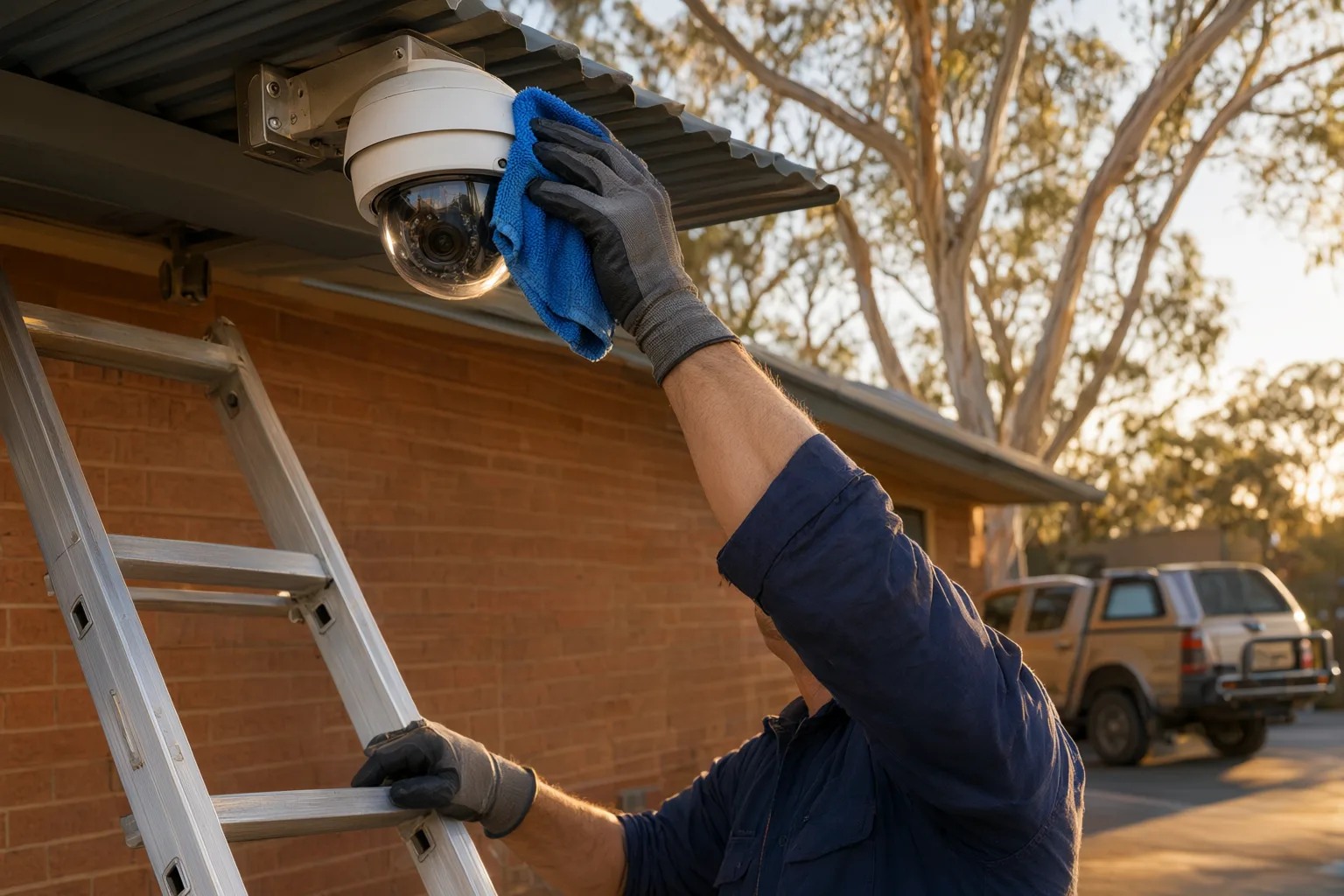
Not all maintenance is equal. A quick wipe of the lenses from a ladder is not a service. A proper commercial maintenance visit from a licensed installer should be systematic, documented, and finish with a written condition report you can file for your records and your insurer.
At Aussie CCTV Cams, our licensed and insured technicians follow a structured checklist on every visit, flagging small issues — a perishing cable gland, a drive showing early SMART errors — before they become failures. Because we install professional-grade Hikvision, Dahua, Uniview and Axis hardware daily, we know these systems inside out, and every maintenance customer receives lifetime support for advice between visits.
If your system is ageing, a maintenance visit is also the natural time to plan a staged [[the-real-cost-of-a-professional-cctv-system-upgrade-in-australia|upgrade]] — moving to AcuSense or ANPR cameras at key points, for instance — rather than being forced into a rushed, expensive replacement after a failure.
- Clean all lenses, housings and infrared windows; clear webs and vegetation
- Re-aim every camera and confirm field of view still matches your risk areas
- Test NVR/DVR drive health (SMART) and verify footage records and plays back
- Inspect cabling, connectors, junction boxes and seals for corrosion, UV damage and water ingress
- Update firmware; review cyber security settings and passwords
- Verify remote viewing apps, motion detection and AI analytics
- Test UPS/battery backup and PoE switch performance
- Deliver a written condition report with photos and recommendations
Do You Need Six-Monthly or Annual CCTV Servicing?
For most commercial premises, we recommend professional servicing every 12 months as a minimum, stepping up to every six months for harsher environments. Coastal businesses battling salt air, industrial sites with dust and vibration, food and hospitality venues with grease-laden air, and construction sites all benefit from six-monthly attention. High-risk premises — service stations, pharmacies and licensed venues — should treat six-monthly servicing as standard practice.
Between professional visits, a simple monthly habit makes a real difference: pull up live view and playback on every camera, confirm the recording date is current, and glance at picture quality after dark. Ten minutes a month means a failure never sits unnoticed for months. If anything looks off, get it checked promptly — small faults are always cheaper than the incident that exposes them.
Your CCTV system protects your stock, your staff, your premises and your liability position. It deserves the same routine care as your fire equipment or your vehicles. Book a maintenance visit with Aussie CCTV Cams for a clear, honest picture of your system's health — plus a free quote if anything needs attention.
Can You Turn Neglect Into a Documented Maintenance Plan?
If your system has gone unserviced for years, don't panic — but do act. The first step is a comprehensive health check: every camera tested, every drive assessed, firmware brought current and a written baseline report established. From there, a recurring annual or six-monthly plan keeps you protected and gives you the paper trail insurers value.
The businesses that fare best after an incident share one trait: documentation. Photos of clean lenses, dated drive health reports, firmware logs and signed condition reports turn an insurance dispute into a straightforward claim. Ask any prospective provider whether their visits include written reporting — if the answer is no, keep looking.
Are There Australian Standards for CCTV Maintenance Frequency?
CCTV Maintenance vs Neglect: Typical Costs for a NSW Business
| Scenario | Typical Cost | What You Get (or Lose) |
|---|---|---|
| Scheduled annual maintenance visit | $250 – $550 per visit | Full system check, cleaning, firmware updates, drive health test, written condition report |
| Six-monthly plan (harsh environments) | $450 – $900 per year | Two visits per year, priority support, early fault detection, insurer-ready documentation |
| Emergency call-out after failure | $350 – $800+ plus parts | After-hours rates, urgent diagnosis, site unprotected during downtime |
| Surveillance hard drive replacement (planned) | $250 – $450 installed | Proactive swap before failure; footage archive preserved |
| Lost footage after an incident | Potentially $5,000 – $50,000+ | No evidence for police, insurers or courts; disputed liability claims |
| Premature full system replacement | $8,000 – $25,000+ | Replacing at year 4–5 a system that should have lasted 8–10 years |