
Key Takeaways
- Dome cameras suit discreet indoor and covered outdoor areas; bullet cameras excel at long-range outdoor coverage.
- Bullet cameras act as a visible deterrent, while domes make it harder to tell where the lens is pointing.
- Vandal-resistant domes (IK10-rated) are best for accessible mounting heights and public-facing areas.
- Australian conditions matter: coastal salt air, heat and storms influence housing choice and IP ratings.
- Most professionally designed systems mix both styles for complete coverage.
- A licensed installer will match camera style, lens and technology like ColorVu or AcuSense to each location.
What Is the Difference Between Dome and Bullet Cameras?
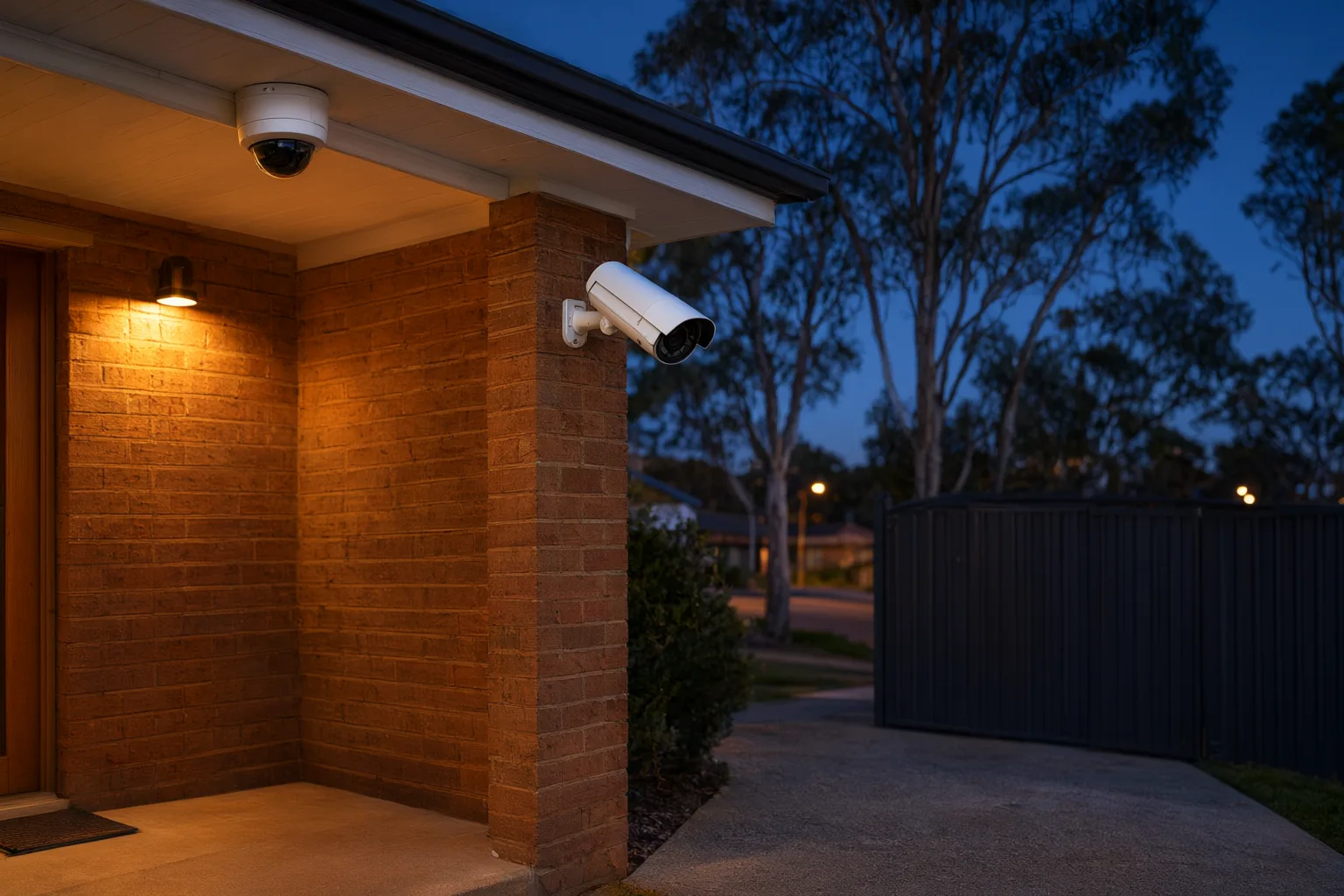
The names describe the housing shape. A dome camera sits inside a rounded, tinted dome enclosure, usually mounted flush to a ceiling or eave. A bullet camera has a cylindrical, protruding body that points visibly in one direction, typically wall-mounted under an eave or on a bracket.
Both styles are available across the professional brands we install, including Hikvision, Dahua, Uniview and Axis, and both can deliver identical image quality, resolution and smart features. The real difference is mechanical: how the camera mounts, how obvious it is, how it handles weather and tampering, and how far it can see. Choosing between them is less about which is 'better' and more about which suits each specific mounting point on your property.
Dome Cameras: Strengths and Weaknesses
Dome cameras are the discreet option. Because the lens sits behind a tinted dome, people on site cannot easily tell which direction it is facing, which makes them excellent for retail floors, offices, foyers and anywhere you want coverage without an obvious 'you are being watched that way' signal. Turret-style domes, a popular variation, remove the outer bubble to eliminate infrared reflection issues at night.
Their compact shape also makes them harder to grab, knock or redirect. Vandal-resistant models carry IK10 impact ratings, meaning the housing can withstand direct strikes, which is why domes are the standard choice at accessible mounting heights such as shopfronts, school corridors, apartment common areas and car parks.
On the downside, domes typically have shorter infrared night-vision ranges than bullets, the dome bubble can accumulate dust, spider webs and water spots that soften image clarity, and adjusting the viewing angle after installation takes a little more effort. In coastal suburbs, salt film on the dome needs periodic cleaning to keep footage sharp.
- Best for: indoor areas, eaves, shopfronts, offices, apartments and vandal-prone spots
- Typical IR night range: 20 to 40 metres
- Look for: IK10 vandal rating, IP66 or IP67 weather rating for outdoor use
- Watch out for: dome bubble maintenance in dusty or coastal locations
Bullet Cameras: Strengths and Weaknesses
Bullet cameras are built for distance and deterrence. The elongated body houses larger lenses and more powerful infrared LEDs, so bullets routinely deliver 40 to 80 metres of night vision, making them the natural pick for driveways, side passages, fence lines, yards, warehouses and rural properties. Their unmistakable shape is itself a security feature: intruders can see exactly what is being monitored, and that visible presence discourages opportunistic crime before it happens.
Bullets are also quicker to aim and re-aim, which matters on construction sites and commercial premises where coverage needs change. Because the lens is exposed rather than behind a bubble, there is no dome reflection to degrade infrared performance, and the built-in sun shield helps in harsh Australian afternoon sun.
The trade-offs: bullets are easier to grab, knock or spray-paint if mounted within reach, they are more visually prominent (some homeowners find them industrial-looking on a brick veneer facade), and spiders love building webs across the protruding body. At low mounting heights in public areas, a dome is usually the smarter call.
- Best for: driveways, perimeters, backyards, warehouses, farms and long sightlines
- Typical IR night range: 40 to 80 metres
- Look for: IP66/IP67 rating, motorised varifocal lens for flexible framing
- Watch out for: mounting within reach, spider webs, visual prominence
How Australian Conditions Affect Your Choice
Our climate is tougher on cameras than most. Along the NSW coast, salt-laden air corrodes cheap housings and fogs dome bubbles within a year or two, so we specify IP66 or IP67-rated housings with proper seals regardless of style. In western Sydney and regional areas, summer heat inside a roof cavity or on a sun-baked Colorbond wall can push consumer-grade cameras past their operating limits, which is one reason we only install professional-grade hardware rated to 60 degrees Celsius or higher.
Storm season brings driving rain at odd angles, so under-eave mounting suits domes, while exposed fence-line runs favour bullets with deep sun shields. In bushfire-prone zones, ember attack and radiant heat argue for metal housings mounted on non-combustible surfaces. And on rural properties running on 4G or solar power, bullet cameras with long-range Starlight or ColorVu sensors often win because they cover more ground per camera, reducing the total unit count and bandwidth load.
Matching Camera Style to Each Area of Your Property
In our design consultations, we walk the property and assign a style to each location rather than picking one style for the whole site. Front porches and entry doors suit compact domes or turrets paired with a video doorbell. Driveways and side gates get bullets with ANPR-capable or AcuSense sensors to capture vehicles and filter out false alarms from pets and swaying gum trees. Backyards and pool areas usually take a mix: a wide-angle turret near the house and a long-range bullet covering the rear fence.
Inside, domes dominate because they blend into ceilings and resist tampering. Retail stores run domes across the floor with a bullet watching the loading dock. Warehouses flip that ratio, with high-mounted bullets covering racking aisles and domes at pedestrian entries. Features like Hikvision ColorVu for full-colour night footage, AcuSense human and vehicle detection, and Power over Ethernet (PoE) for reliable single-cable installs are available in both form factors, so you never sacrifice capability for shape.
Why Professional Design and Installation Matters
The dome-versus-bullet question is really a system design question. Lens focal length, mounting height, angle of incidence, lighting, cabling runs and NVR configuration all interact, and a camera that is perfect on paper can underperform badly if it is mounted two metres too low or pointed into the setting sun. As licensed and insured NSW installers, we handle the full process: an on-site consult, a tailored design, professional installation, network and remote-viewing configuration, and a proper handover where we train you on the app.
Every system we install comes with lifetime support, and we back it with professional-grade Hikvision, Dahua, Uniview and Axis hardware rather than consumer DIY kits. If you are weighing up dome versus bullet cameras for your home or business, the fastest way to a confident answer is a free, no-obligation quote with a design that maps each camera style to the exact spot it will protect.
Dome vs Bullet Cameras at a Glance
| Feature | Dome Camera | Bullet Camera |
|---|---|---|
| Typical night vision range | 20-40 metres | 40-80 metres |
| Visual deterrence | Low – discreet, direction hidden | High – clearly visible and directional |
| Vandal resistance | Excellent (IK10-rated models) | Moderate – easier to grab or redirect |
| Best mounting locations | Ceilings, eaves, shopfronts, indoor areas | Walls, fence lines, driveways, perimeters |
| Maintenance needs | Dome bubble needs cleaning in dusty or coastal areas | Prone to spider webs across the housing |
| Aiming and adjustment | More effort once installed | Quick to aim and re-aim |
| Typical installed cost (AUD) | $350-$600 per camera | $350-$650 per camera |
| Ideal property uses | Retail, offices, apartments, entries, car parks | Driveways, yards, warehouses, farms, construction sites |