
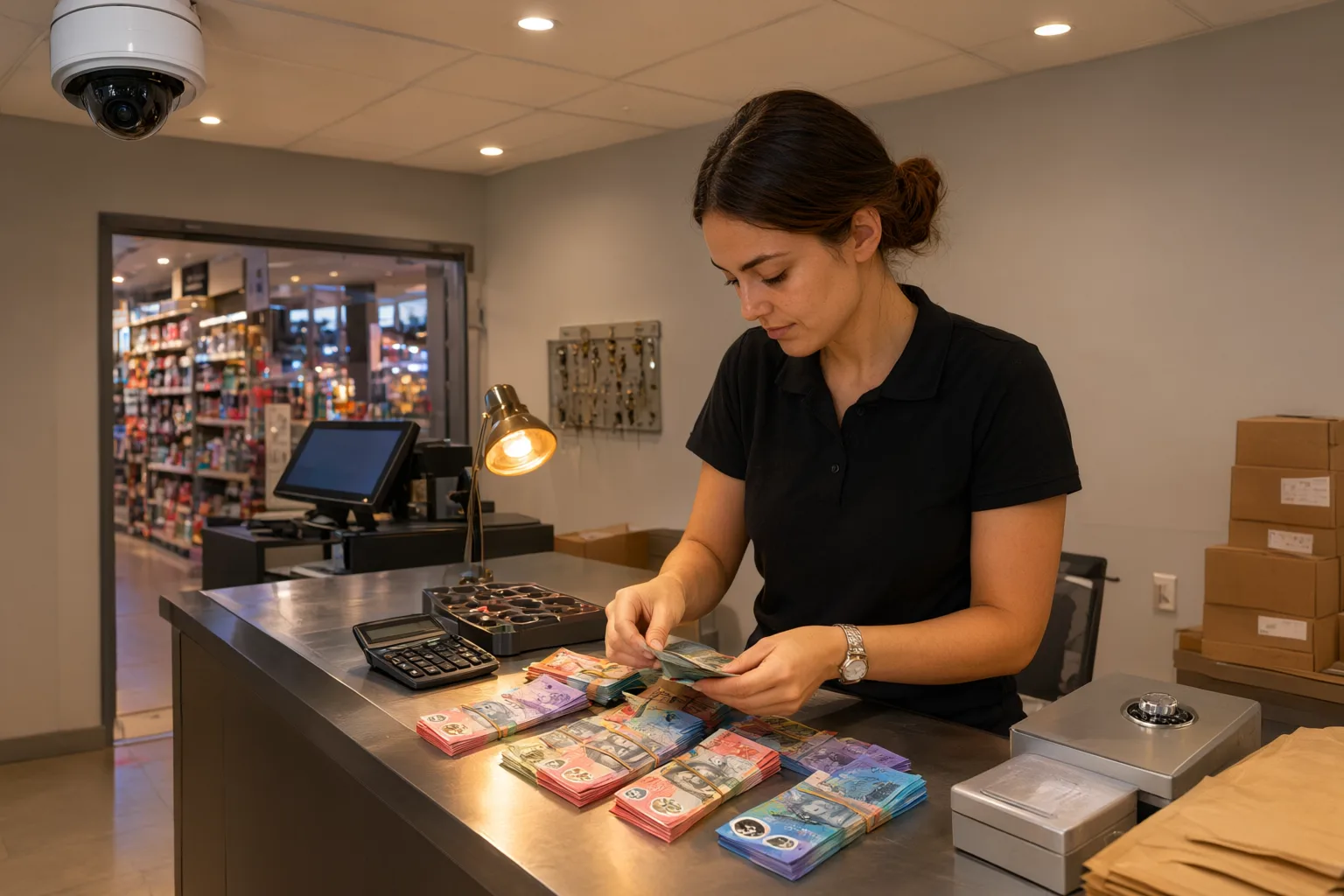
Key Takeaways
- Filming cash handling is legal Australia-wide only under workplace surveillance laws like the NSW Workplace Surveillance Act 2005 and SA's Surveillance Devices Act.
- Written notice to employees is mandatory before activating cash area cameras in NSW workplaces.
- Continuous recording beats motion detection for evidentiary value over tills and EFTPOS terminals.
- Clear signage at every entrance is required for commercial CCTV in Adelaide SA and Newcastle NSW.
- Restrict footage access to authorised managers and retain recordings 30–90 days.
Why Cash Handling Areas Demand Dedicated Camera Coverage
The short answer is that cash handling CCTV compliance in Australia is achievable for any business, but it hinges on three pillars: lawful installation under state workplace surveillance laws, clear employee notification, and footage controls that satisfy the Privacy Act 1988. Whether you run a retail store in Newcastle NSW or a hospitality venue in Adelaide SA, you can film your till, cash drawer and EFTPOS terminal legally — provided signage, written notice and access restrictions are in place before the first frame is recorded.
A properly designed CCTV system over these zones performs three distinct functions simultaneously. First, it deters — most opportunistic offenders will simply walk away when they can see they are being recorded. Second, it documents — when something does go wrong, high-quality footage provides evidence that is difficult to dispute. Third, it protects your honest employees, who are too often the first suspects when a till runs short without any recording to clear their name.
Insurers have taken note as well. Many commercial policies covering money on premises or cash-in-transit now make CCTV over tills and safes an explicit condition of cover. Fail to meet that condition and you may find a claim denied precisely when you need it most.
What Are the Legal Rules for Filming Cash Areas in Australia?
The direct answer: yes, you can legally film staff handling cash in Australia, but only if you comply with [[employee-monitoring-ethics-where-to-draw-the-line-with-workplace-cameras|workplace]] surveillance legislation — and in New South Wales that means giving employees written notice before any camera starts recording. The Workplace Surveillance Act 2005 requires that notice to explain what kind of surveillance will occur, how it will be carried out, and when it will commence. Cameras must remain clearly visible, and signage should appear at entrances and within the cash handling area itself.
Covert cameras change the picture entirely. Hidden units installed without staff knowledge are only lawful in NSW when a magistrate has issued a covert surveillance authority — typically sought where serious theft is already suspected and under active investigation. For routine compliance over everyday cash operations, overt, well-signposted cameras are the only safe route. Attempting to run undeclared cameras over a till exposes you to privacy complaints, potential penalties and footage that may be inadmissible when you need it.
Federal law adds another layer. The Privacy Act 1988 applies to businesses with annual turnover above $3 million, and to any footage capable of identifying individuals. In practice this means maintaining a clear written policy covering who may view cash area recordings, how they are stored securely, and when they are deleted. Even if your turnover sits below the threshold, adopting those same principles is wise — courts and insurers treat them as the benchmark for whether your surveillance was reasonable.
Should Cameras Over Tills Record Continuously or on Motion Detection?
Effective coverage begins with mapping the complete journey cash takes through your premises — from the moment a customer hands over notes at the counter to the moment a deposit bag leaves for the bank. Each stage of that journey deserves its own camera angle, because one wide shot of the front counter will never capture the fine detail that actually resolves a dispute.
Placement is always a balance between evidentiary value and reasonable privacy. Overhead cameras above each till should frame the cash drawer and the operator's hands, while a second camera mounted at face level records who is standing at the counter. Critically, no camera should ever aim at an EFTPOS PIN pad — capturing customer PINs breaches payment card industry [[do-you-need-to-tell-staff-theyre-on-camera-australian-notice-requirements-explai|requirements]] and is one of the most common failures identified during security audits. Angle your lenses so the keypad falls outside the frame.
- Point-of-sale tills: an overhead dome over the drawer plus a face-level camera covering the customer interaction
- Counting rooms and back offices: wide-angle coverage of the entire counting bench with no gaps hidden behind shelving
- Safes and strong rooms: a dedicated camera on the safe door recording anyone who opens it, around the clock
- Cash transit paths: corridor coverage along the route from tills to back office and from office to exit
- Staff entrances and exits: to record bags and discourage unauthorised cash leaving the building
- ATMs and self-serve kiosks: face capture or ANPR at the approach combined with a clear view of the machine
Can You Legally Film Staff Handling Cash Without Written Notice?
Cash area cameras should record continuously, not merely when motion triggers them. Motion-only recording creates deliberate gaps in your [[from-quote-to-commissioning-what-a-professional-cctv-installation-timeline-looks|timeline]] — gaps that sophisticated offenders learn to exploit and that defence lawyers will highlight in any proceedings. Continuous capture removes ambiguity entirely.
Cost is no longer a barrier. Modern Hikvision and Dahua network video recorders use efficient H.265+ compression, allowing a full month of multi-camera continuous footage to fit comfortably on standard surveillance-grade hard drives. What once required expensive enterprise storage now fits within a modest small-business budget.
Retention is the companion requirement. Thirty days is the practical minimum for most Australian businesses, but if your cash volumes are heavy or your insurer specifies longer, ninety days is the safer standard. Cash reconciliation discrepancies frequently surface weeks after the event — by which time motion-triggered footage stored for two weeks has already been overwritten, along with your only chance of understanding what happened.
Where Should Cameras Be Positioned Across Cash Handling Zones?
Recording footage correctly is only half the job; controlling who sees it completes the chain of custody. Recordings of cash handling areas should be viewable exclusively by authorised owners or managers, each operating under an individual login on the NVR. Shared passwords destroy accountability — when everyone uses the same credentials, nobody can prove who accessed what, or when.
Every viewing session should be logged automatically, producing an audit trail that demonstrates the footage has not been tampered with, edited or selectively deleted. That documented chain of custody is exactly what makes recordings stand up in court, in a police investigation, or in a contested insurance claim. Without it, even crystal-clear video can be challenged as unreliable.
This discipline also protects your staff. Employees have a legitimate interest in knowing that footage of them at work is not casually browsed by whoever happens to hold the remote. A restricted, logged access policy signals professionalism and reduces the risk of privacy complaints under the Privacy Act 1988.
Which Camera Technology Performs Best Over Cash Areas?
Resolution over cash is non-negotiable. To identify individual banknote denominations and track the movement of individual fingers, a minimum of 4 megapixels is required on till cameras, with 4K preferred for counting rooms where detail matters most. Professional-grade equipment from manufacturers such as Hikvision, Dahua, Uniview and Axis delivers this clarity consistently — consumer DIY kits compress away precisely the detail you are paying to capture.
Low-light performance matters just as much, because cash counting routinely happens before opening or after close, often in dim back offices. Starlight sensors and ColorVu-style technology maintain full-colour images in near darkness, keeping faces and denominations identifiable without flooding the room with harsh lighting that creates its own glare problems.
Intelligent features add a further protective layer. AcuSense-style analytics can raise instant alerts whenever someone enters the counting room outside scheduled hours, while tamper detection alarms the moment a camera is covered, sprayed or redirected — behaviour that is a classic precursor to internal theft. Pair the system with an uninterruptible power supply so your cash area cameras keep recording through blackouts and deliberate switch-offs alike.
How Long Should You Keep Footage of Cash Handling Areas?
Thirty days is the accepted floor for most businesses, and ninety days is the recommended standard wherever cash volumes are significant or an insurer's policy conditions demand longer retention. The reasoning is straightforward: discrepancies in cash reconciliation rarely appear on the day they occur. A pattern of shortfalls might only emerge during a monthly stocktake or an end-of-quarter audit, long after the relevant shifts have passed.
Footage that has been overwritten cannot be recovered — there is no second chance. Before settling on a retention period, check your insurance policy wording carefully, as many commercial policies specify minimum CCTV retention as a condition of money cover. Meeting or exceeding that specification protects both your claim and your premium.
Is Signage Required for Commercial CCTV in Adelaide SA and Nationwide?
The failure we encounter most often is the blind spot created by shelving, promotional signage or a poorly angled dome camera. Walk the cash path yourself and review the live feed from every position along it — if you can stand anywhere holding cash without being clearly visible on camera, so can a thief.
Second is relying on a single camera per critical zone. One angle can be blocked instantly by a standing body, a raised arm or a strategically placed box. Two overlapping angles per zone is the professional benchmark, ensuring that if one view is obstructed the other still captures the event.
Third is neglecting maintenance altogether. Dusty lenses, failed hard drives and cameras knocked out of alignment degrade coverage silently — everything looks fine until the moment you need the footage. A scheduled maintenance plan keeps your system court-ready, and it costs far less than discovering a dead camera after a $10,000 till shortage.
Do Access Controls on Cash Footage Really Matter for Compliance?
For most Australian small businesses, the practical cost of a compliant cash handling setup sits between $1,800 and $4,500 AUD installed, depending on how many tills need coverage and whether your premises already have cabling. A single 4MP dome camera above a café counter in [[/newcastle|Newcastle]] NSW typically lands near the lower end, while a multi-lane supermarket or warehouse with several cash zones in [[/adelaide|Adelaide]] SA will trend higher once licensing-grade storage and signage are included. Always get a quote tailored to your floor plan rather than relying on generic package pricing.
Heat and humidity matter more over cash areas than most owners expect. A camera mounted above an EFTPOS terminal near a sunny window in coastal Newcastle can suffer glare and sensor drift during summer, while Adelaide's dry heat pushes budget electronics past their rated temperature ceiling. Choose units rated to at least 50°C, mount under eaves where possible, and avoid positioning domes directly beneath air conditioning vents where condensation can fog the lens.
Under the Privacy Act 1988 and its Australian Privacy Principles, footage containing identifiable staff or customers must be handled as personal information. That means a documented purpose for collection, reasonable security around the recorder, and deletion once the retention window lapses. Businesses that sell or repurpose cash handling footage — for marketing, social media or disciplinary purposes beyond what was disclosed — risk penalties and erode the trust of both employees and customers.
Licensed venues face extra scrutiny. Pubs and clubs in NSW operating under liquor licence conditions are frequently audited on whether their surveillance covers cash registers, gaming areas and bottle shops continuously. In South Australia, Consumer and Business Services may request footage following disputes, so a well-documented chain of custody — who exported the clip, when, and why — protects you as much as it protects the investigation.
Finally, treat compliance as an annual review, not a one-off install. Staff turnover, refits that move shelving into camera sightlines, and firmware updates that reset retention settings are the three most common ways compliant systems quietly drift out of compliance. A yearly walk-through of your cash path, signage audit and retention check costs little and keeps your Newcastle or Adelaide business defensible if a dispute, robbery claim or Fair Work matter ever arises.
Camera options for compliant cash handling coverage
| Option | Best For | Compliance Notes |
|---|---|---|
| 4MP Dome (counter-mounted) | Cafés and single-till retail | Discreet; verify no shelving blocks sightline |
| 4K Bullet (eave-mounted) | Warehouses and drive-throughs | Wide coverage; rate to 50°C for Australian heat |
| Dual-lens Turret | Multi-lane supermarkets | One unit covers drawer plus EFTPOS terminal |
| PTZ Camera | Large cash offices and counting rooms | Must still record continuously; restrict PTZ presets |