
Key Takeaways
- Professional CCTV installation typically costs $1,800–$3,500 for a four-camera system in Newcastle or Adelaide, versus $350–$1,200 for DIY kits.
- Hidden DIY costs — false alerts, replacements, your own labour — often erase the upfront saving within five years.
- Paid installers in NSW must hold a Class 2C security licence; SA installers need licensing under the Security and Investigation Industry Act 1995.
- Coastal salt air in Newcastle and harsh summer heat in Adelaide both demand weather-rated, properly mounted equipment.
- DIY still suits renters, short-term projects and single indoor monitoring needs.
What Does Professional CCTV Installation Really Cost Over Five Years?
The short answer: professional CCTV installation in Australia typically costs $1,800–$3,500 for a quality four-camera system, while DIY kits run $350–$1,200 up front. Over five years, however, replacement cycles, false alerts and maintenance usually push the true DIY total past the professional figure. For most Newcastle and Adelaide properties, professional installation delivers better value per year of reliable footage.
That is the five-year maths in one paragraph. The sections below unpack each line item, identify where DIY is genuinely the smarter choice, and set out the licensing and legal obligations that apply to camera work in New South Wales.
Why Compare Cost Per Year, Not Price Tags, on CCTV Systems?
Most shoppers start the comparison at the wrong end. They spot a $350 four-camera kit online or on a retail shelf, glance at a $2,000 professional quote, and conclude the kit is the bargain. The fairer question is what each option costs per year of footage you can actually rely on.
The framing matters because the two product classes have wildly different lifespans. Consumer cameras sold through retail channels are engineered for mild climates and light duty. Australian summers regularly exceed 40°C, coastal salt air corrodes connectors, and storm seasons punish every bracket and seal. Under those stresses, DIY cameras commonly degrade or fail inside two to three years—image quality slips first, then housings crack, then electronics quit.
Professionally specified gear sits in another class. Cameras from Hikvision, Dahua, Uniview and Axis carry IP66/IP67 weather ratings, tolerate temperature extremes and ship with 3-year manufacturer warranties. Correctly installed, they routinely serve seven to ten years.
Set those lifespans side by side and the annualised gap narrows sharply—or vanishes. The kit looks cheap because the sticker price conceals the replacement cycle.
How Much Do DIY Kits and Professional CCTV Installation Cost Up Front?
DIY pricing spans three tiers. Entry-level four-camera kits run $200 to $600. Mid-range bundles with a network video recorder (NVR) sit around $600 to $1,200. Premium consumer kits advertising AI detection reach $1,200 to $1,800. Beyond the box price, budget for cabling, connectors, mounting hardware, tools and possibly ladder hire if you are working at height.
Professional [[dahua-cctv-cost-breakdown-from-entry-level-to-enterprise-in-australia|installation]] for a standard NSW home ranges from $1,200 to $4,500 depending on camera count, layout and features. That figure covers far more than labour: a site assessment, system design, commercial-grade hardware, licensed installation, network configuration and a handover walkthrough so you know how to operate everything.
Typical professional price points look like this: a basic four-camera install lands between $1,200 and $2,000; a six-to-eight camera system with number plate recognition (ANPR) runs roughly $2,500 to $3,500; premium commercial-grade setups start near $3,500 and climb past $4,500. Business systems range wider again—from $3,000 to beyond $15,000 depending on site size, camera count and integration needs.
- Entry DIY kit (4 cameras): $200-$600
- Mid-range DIY kit with NVR: $600-$1,200
- Premium DIY kit with AI features: $1,200-$1,800
- Basic professional 4-camera install: $1,200-$2,000
- 6-8 camera professional system with ANPR: $2,500-$3,500
- Premium commercial-grade system: $3,500-$4,500+
Which Hidden Costs Do Retail Security Camera Prices Never Mention?
Three categories of hidden expense quietly erode the DIY saving. First, false alerts. Consumer cameras often lack the processing grunt to separate genuine threats from swaying trees, shifting shadows and insects crossing the lens. Many owners eventually mute notifications altogether—which defeats the point of owning cameras. Professional systems use AcuSense-style analytics to distinguish people and vehicles from background movement, cutting false alarms by up to 90%.
Second, power and connectivity. Quality installs use PoE (Power over Ethernet) cabling, delivering stable power and data through a single cable. No batteries to swap, no Wi-Fi dropouts mid-recording, no extra power points needed at each camera position. Wireless consumer kits depend on your home network staying healthy plus batteries or solar chargers that need attention year-round.
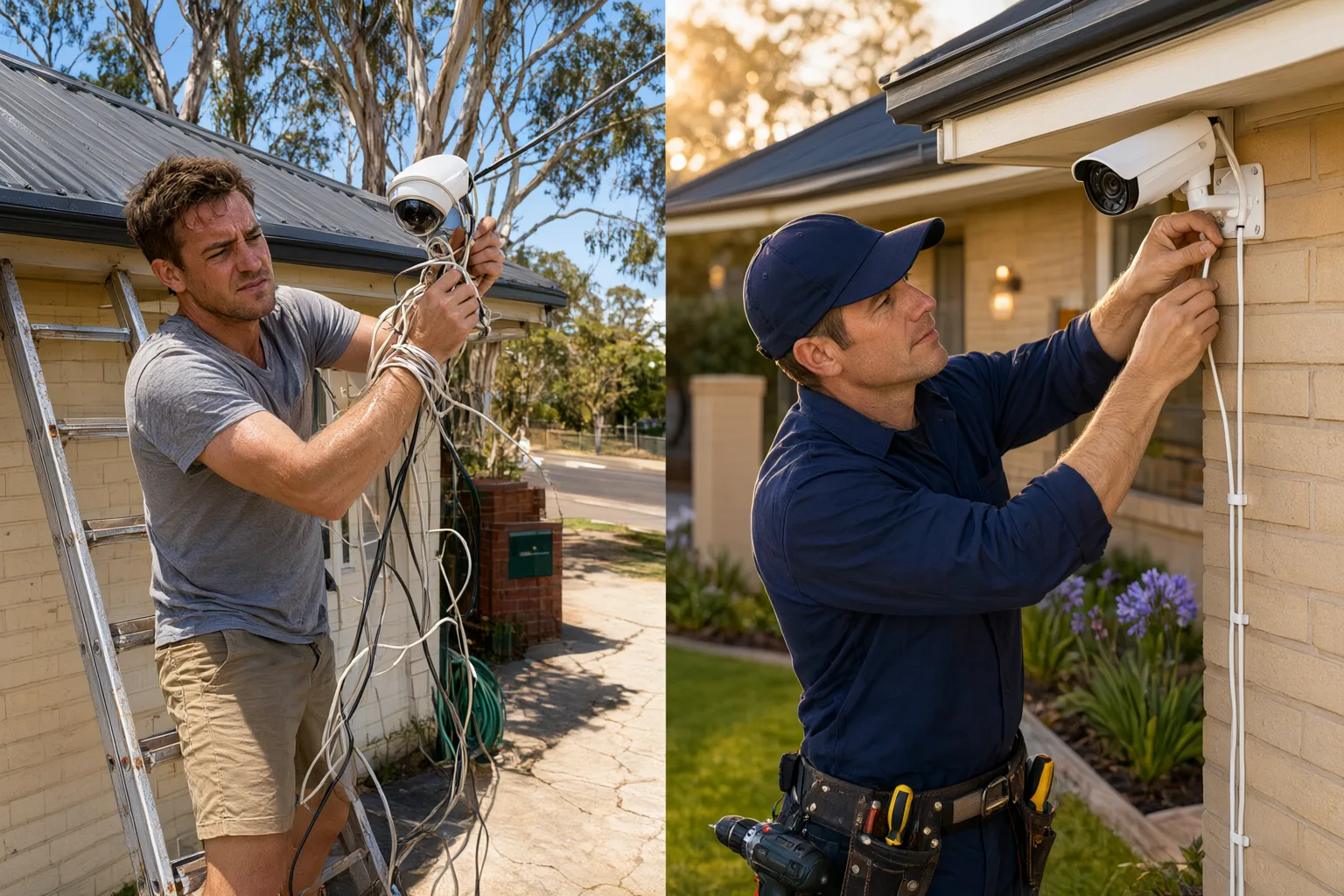
Third, your own hours. A first-time DIY install typically consumes eight to twelve hours once you tally research, cable routing, drilling, mounting, network setup and troubleshooting. Valued even conservatively at $50 an hour, that is $400 to $600 of your time—often matching or exceeding the professional premium you were trying to dodge. And if something fails mid-install, there is no one to call without paying twice.
Is the Five-Year CCTV Cost Ledger Different for Newcastle Homes?
Add up replacement cycles, maintenance and reliability, and the picture flips. A DIY owner may buy the same system twice inside five years. A professionally installed system carries warranty cover through its early years and keeps recording well beyond year seven.
Run a simple scenario. Suppose you buy a $700 mid-range DIY kit today and it needs replacing in year three for another $700 (prices rarely fall enough to offset inflation and shipping). That is $1,400 across five years, plus roughly $500 of your own time, plus incidental repairs, SD cards or battery swaps along the way—call it $1,900 to $2,100 all-in. Meanwhile the $2,000 professional system is still under or just past warranty, still recording, and has never cost you a weekend on a ladder.
Resale value tilts the same way. A documented, professionally installed [[how-much-does-a-4-camera-cctv-system-cost-in-australia|CCTV system]] adds appeal when selling a property. Visible cable runs, mismatched cameras and clunky consumer apps tend to detract from presentation instead. Real estate agents in competitive markets regularly list security systems among the features that help a home photograph and inspect well.
Insurance adds one more variable. Some insurers discount premiums for monitored security systems, but many require professional [[the-true-cost-of-cheap-cctv-why-bargain-systems-cost-australians-more-in-the-lon|installation]] certificates before applying the reduction—and DIY systems may not qualify at all. Footage from non-compliant setups can also face admissibility challenges in legal proceedings, which matters most precisely when an incident has occurred and the recording is worth the most.
Can DIY CCTV Genuinely Make Sense for Adelaide Properties?
Honesty requires admitting DIY is not always the wrong call. Renting somewhere you cannot drill? Need temporary monitoring during renovations? Want a supplementary indoor camera to check on pets? A decent consumer unit handles these jobs fine, and spending $2,000 would be overkill.
The mismatch occurs when DIY gear is asked to do a professional job. Primary home security, business protection, rural properties and any scenario where footage quality determines usefulness all favour installed systems. Australian environments sharpen the case further: coastal homes need corrosion-resistant housings, bushfire-prone areas demand ember-resistant mounting, and remote sites may need 4G connectivity or solar power options consumer kits simply do not offer.
If budget is tight but you want professional outcomes, ask about a staged approach. Cover critical entry points first, then expand over time. Every component integrates properly, warranty coverage stays intact, and the cost spreads across several years rather than arriving as one lump sum.
Do You Need a Class 2C Licence to Install CCTV in NSW or SA?
Two regulatory points shape the decision in NSW. First, anyone installing security equipment for payment must hold a Class 2C security licence. Installing cameras on your own property does not require one—but it does mean verifying any installer you hire is licensed and insured, which you can do through the NSW Police Force Security Licensing & Enforcement Directorate. Hiring an unlicensed operator risks voided warranties, non-compliant work and no recourse if the install goes wrong.
Second, camera placement carries legal obligations under the Surveillance Devices Act 2007. Cameras must not record audio without consent, must not point into neighbours' private areas, and signage is recommended. Licensed installers handle this compliance as part of the job, along with positioning cameras to capture genuinely evidentiary footage and integrating with alarms, intercoms and access control where relevant.
Strata properties add a further layer: anything mounted on common property usually requires body corporate approval, and strata managers increasingly expect licensed, insured installers before granting it.
Are CCTV Quotes Comparable Like For Like?
Whether you lean DIY or professional, compare options on identical criteria. Ask what weather rating the cameras carry, what warranty applies to both equipment and workmanship, whether cabling is PoE or wireless, how footage is stored and for how long, and whether analytics can filter out non-threat movement. Request exact camera models in writing—not just '4K cameras'—so you can verify specifications yourself.
A credible installer will walk your property, identify blind spots and entry points, explain trade-offs plainly and itemise the quote. Be wary of quotes lumping everything into a single figure with no hardware breakdown, or promising prices well below the market ranges above without explanation.
For DIY buyers, read the fine print on storage: many consumer kits push cloud subscriptions adding $50 to $300 per year—a recurring cost that never appears in the advertised box price and quietly erodes the saving over five years.
Should You Choose Based on Your Property or the Advert?
Strip away the marketing and the decision rests on three things: risk tolerance, technical confidence and time horizon. If you enjoy tech projects, have basic networking skills and accept the odds of replacing hardware within a few years, DIY suits low-stakes monitoring well.
For most homeowners and businesses wanting dependable security, professional installation wins on outcomes and long-run cost. Aussie CCTV Cams offers free, no-obligation quotes with transparent pricing—our licensed, insured team designs around your specific property, explains each option plainly and backs the work with lifetime support. Get in touch to talk through what your property needs, and we will show you exactly where every dollar goes before you commit to anything.
It is also worth factoring in Australian conditions that rarely appear in overseas reviews. Coastal suburbs like Merewether or Bar Beach expose camera housings to salt-laden air that corrodes cheap brackets within eighteen months, while [[/adelaide|Adelaide]]'s summer heat regularly pushes roofline and eave-mounted electronics past 50 degrees Celsius, degrading budget sensors and adhesives. Professionally specified systems use marine-grade fittings, IP66-or-better housings and brick-appropriate fixings that survive storms, humidity and bushfire-season smoke far longer than retail alternatives.
Finally, remember consumer law protections differ between channels. Equipment supplied and installed by a licensed Australian business carries statutory guarantees under Australian Consumer Law covering fitness for purpose, whereas a self-imported kit bought from an overseas marketplace may leave you with no practical recourse when it fails in year two. That legal safety net has real dollar value when you weigh the five-year ledger.
Five-year cost comparison: DIY kits vs professional CCTV installation in Newcastle & Adelaide
| Option | Upfront Cost (AUD) | Typical Lifespan | Warranty & Support | Best Suited To |
|---|---|---|---|---|
| Entry DIY kit (4 cams) | $200–$600 | 2–3 years | 12 months retailer only | Renters, temporary monitoring |
| Mid-range DIY + NVR | $600–$1,200 | 3–4 years | 1–2 years manufacturer | Confident tech hobbyists |
| Premium consumer kit | $1,200–$2,000 | 3–5 years | 2 years, limited support | Large DIY-friendly homes |
| Professional install (Newcastle) | $1,800–$3,500 | 5–7 years | 3+ years parts & workmanship | Coastal homes, businesses |
| Professional install (Adelaide) | $1,900–$3,800 | 5–7 years | 3+ years parts & workmanship | Heat-exposed sites, warehouses |