
Key Takeaways
- Layered car yard security cameras—ANPR, thermal and ColorVu—outperform any single-camera setup at Australian dealerships.
- ANPR cameras at entry points log every plate, giving police searchable evidence within minutes of a reported theft.
- Thermal perimeter cameras detect intruders in total darkness up to 30 metres out, cutting false alarms by up to 95%.
- Basic commercial systems for small yards start around $8,000–$15,000; large monitored setups run $25,000–$60,000+.
- Camera-alarm integration with professional monitoring enables verified response times often under 60 seconds after hours.
- DIY wireless kits fail Australian Standards AS/NZS 2201 expectations for retention, cabling and insurance-grade evidence.
What Is the Most Effective Security Setup for an Australian Car Yard?
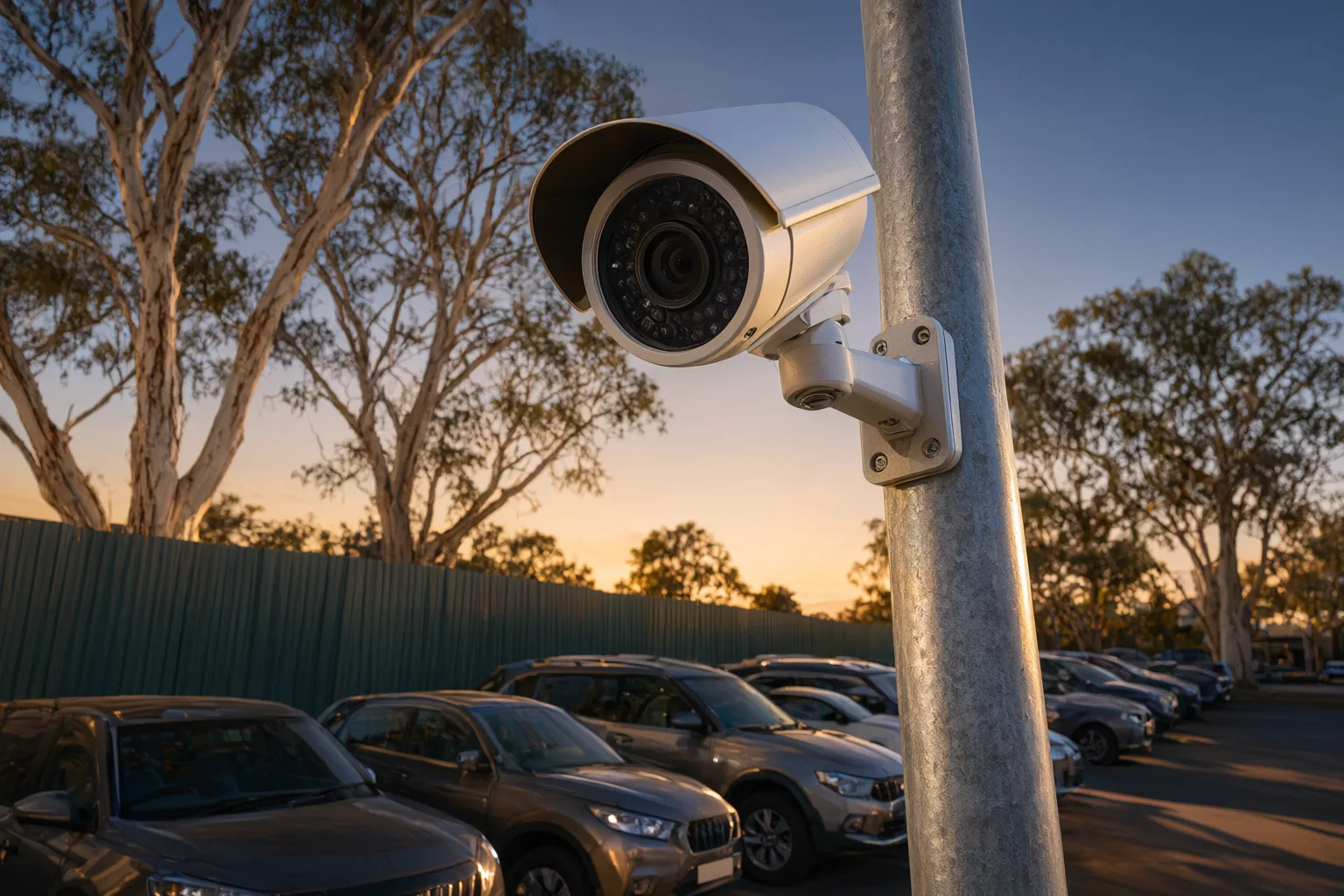
The most effective use of car yard security cameras is layered smart placement: ANPR cameras at every entry and exit, thermal or ColorVu units along the perimeter, and high-resolution fixed and PTZ cameras covering stock rows—all tied into alarm integration and professional monitoring. Because dealerships display high-value vehicles outdoors behind chain-link fencing, no single camera can do the job alone.
Why Are Car Yards Prime Targets for Thieves and Vandals in Australia?
Dealerships face a security problem few other businesses share: their most valuable assets sit outdoors, in plain view, behind fencing that is often little more than a deterrent. Unlike a warehouse with solid walls and controlled access, a car yard spans open ground where stock is visible from the street—an invitation to opportunistic thieves and organised crews alike.
The motivations vary. Some offenders take vehicles for joyriding; organised groups target specific models for export or dismantling. Parts theft is particularly damaging because it is fast—a catalytic converter can be cut out in minutes, wheels and airbags removed almost as quickly, often without triggering any conventional alarm until long after the offender has gone.
The physical layout compounds the risk. Rows of parked vehicles create visual corridors that block sightlines, giving intruders cover while they work between cars. Perimeter fencing is typically chain-link or palisade, which can be scaled or cut with basic tools. After hours, most yards are unmanned and rely on passive recording—footage that only proves useful once the damage has already been done.
Australian conditions add another layer of difficulty. Harsh summer heat degrades inferior camera housings, coastal yards battle salt-air corrosion, and storms or dust events reduce visibility. Regional yards may cover several acres, making comprehensive coverage impractical without professional design.
How Should You Map Your Yard So Car Yard Security Cameras Deliver the Most Value?
Effective placement begins with understanding traffic flow and vulnerability zones rather than simply mounting cameras at corners. Every entry and exit point needs a dedicated ANPR (Automatic Number Plate Recognition) camera positioned to capture plates clearly day and night. These units should be angled to avoid headlight glare and mounted high enough to resist tampering while still reading plates accurately.
Perimeter coverage demands a different approach. Thermal imaging cameras detect body heat in complete darkness, through light fog and behind partial obstructions such as vegetation. Unlike standard infrared cameras, thermal units need no ambient light and cannot be blinded by torches or headlights. Where yards already have adequate lighting, ColorVu technology delivers full-colour footage around the clock, preserving details like clothing colour and paintwork that black-and-white IR footage loses.
Inside the yard itself, placement must account for constant change. As stock rotates, blind spots shift, so coverage needs to be flexible. High-resolution PTZ (Pan-Tilt-Zoom) cameras with auto-tracking can follow movement across rows, while fixed cameras with wide dynamic range handle the contrast between shaded areas and harsh Australian sunlight. Mounting height matters enormously: too low invites tampering, too high makes facial identification impossible. Aussie CCTV Cams holds the required security industry licence under NSW and SA law, ensuring full Privacy Act compliance.
Are ANPR Cameras Essential at Every Car Yard Entry Point?
Modern car yard security depends on technologies purpose-built for outdoor, high-value asset protection. AcuSense-style deep learning analytics distinguish humans and vehicles from animals, falling leaves and shadows, dramatically cutting the false alarms that plague traditional motion detection and cause monitoring centres to ignore alerts.
For larger sites, radar-integrated cameras provide precise intrusion detection across wide areas, tracking multiple targets simultaneously and cueing PTZ cameras to zoom and follow automatically. Paired with strobe lights and audio warnings—a combination known as active deterrence—the system intervenes before a theft occurs instead of merely documenting one.
Storage and transmission planning is just as important as camera selection. Dozens of high-resolution cameras generate enormous data volumes, so NVR (Network Video Recorder) systems with RAID redundancy protect footage against hard drive failure. In regional Australia, where NBN outages are common, 4G failover keeps your system connected when fixed-line services drop.
Which Camera Technologies Work Best for Dealership Environments?
No single camera technology suits every zone of a dealership. The right mix depends on your layout, lighting conditions and risk profile. The comparison below summarises how the main options perform in typical Australian car yard conditions, from gatehouse plate capture to wide-open perimeter sweeps.
Do Integrated Alarms and Monitoring Make Car Yard Security Cameras More Effective?
Cameras on their own record crime—they rarely prevent it. Genuine protection comes from integrating cameras with alarms and professional monitoring. When a thermal camera detects an intruder at 2 AM, the system should simultaneously trigger strobe lights, broadcast a warning through speakers and alert a monitoring centre that can verify the event visually and dispatch security or police.
Video analytics make this intelligence possible. Line-crossing detection fires when someone enters restricted zones, while loitering detection flags suspicious behaviour—such as a person crouching between cars with tools—before a crime is committed. Analytics can also separate a customer browsing after hours from a genuine threat, reducing unnecessary callouts.
For dealerships with [[service-station-cctv-protecting-fuel-cash-and-night-shift-staff|service]] departments or parts storage, access control integration restricts entry to authorised personnel. When an alarm triggers, the system can lock gates automatically, flood the area with light and swing PTZ cameras onto the exact location, giving responders immediate visual verification of what is happening on site.
Is Professional Installation Better Than DIY for Car Yard Cameras?
Consumer-grade wireless cameras look like a bargain, but they routinely fail in commercial car yard environments. Wi-Fi signals struggle across large outdoor areas, battery-powered units degrade in summer heat, and consumer cloud storage rarely offers the retention periods required for insurance claims or police investigations.
Professional [[how-much-does-professional-cctv-installation-cost-in-australia|installation]] starts with a site survey that maps the vulnerability points specific to your layout. Licensed installers work to Australian Standards for security systems, protect cabling from weather and tampering, and configure networks to prioritise camera traffic—preventing the bandwidth congestion that causes footage gaps in DIY setups.
Ongoing maintenance matters just as much as installation. Spider webs, dust storms and salt buildup steadily degrade image quality. Professional systems include remote health monitoring that alerts technicians when cameras go offline or lenses need cleaning, ensuring your coverage holds up when you actually need it.
Can the Right Car Yard Security Cameras Cut Theft Costs and Insurance Premiums?
Vehicle theft, parts stripping and vandalism cost Australian dealerships millions of dollars annually through lost stock, higher insurance premiums and business disruption. A professionally designed camera system typically pays for itself through prevented losses and reduced premiums, while supplying the evidence needed for successful prosecution when incidents do occur.
Aussie CCTV Cams specialises in commercial security for automotive businesses across NSW. Our licensed and insured team designs systems using Hikvision, Dahua and Axis hardware engineered for Australian conditions, from initial consultation through to ongoing maintenance and lifetime support as your business grows.
Do not wait for a break-in to expose the gaps in your coverage. Contact us today for a free site assessment and quote—we will design a [[pub-and-bar-cctv-camera-placement-for-entries-bars-and-beer-gardens|camera placement]] strategy that eliminates blind spots, deters intruders and gives you complete visibility over your stock, day and night, in all weather.
Camera Technology Comparison for Car Yard Security
| Technology | Best Application | Lighting Requirement | Detection Range | Key Advantage |
|---|---|---|---|---|
| ANPR Cameras | Entry/exit gates | Requires IR or white light | 10-30 metres | Captures number plates for vehicle identification |
| Thermal Imaging | Perimeter fencing | None (heat-based) | Up to 500 metres | Detects intruders in total darkness and fog |
| ColorVu | Main display rows | Minimal ambient light | 20-40 metres | Full colour footage 24/7 for detail identification |
| AcuSense AI | Internal yard coverage | Standard IR | 30-50 metres | Reduces false alarms from animals and weather |
| PTZ Auto-Tracking | Open areas and corners | Varies by model | 100-200 metres | Follows intruders automatically across large areas |