
Key Takeaways
- No Australian law mandates childcare CCTV, but the National Regulations' Element 2.2.1 makes it best practice for supervision.
- Centres with turnover over $3 million must follow the Privacy Act 1988 when collecting and storing camera footage.
- NSW's Workplace Surveillance Act 2005 requires written staff notice at least 14 days before workplace camera monitoring begins.
- Most Australian childcare centres retain CCTV footage for 30 to 90 days, extending retention during any incident investigation.
- Professional IP systems from Hikvision or Dahua with PoE cabling suit childcare sites far better than consumer Wi-Fi cameras.
- Cameras are prohibited in bathrooms and change rooms, and signage must be displayed at every entrance under surveillance rules.
Do Australian Childcare Centres Have to Install CCTV?
No Australian law requires childcare centres to install CCTV, but most quality services now do. Cameras support National Quality Framework supervision duties, meet strong parent expectations, and help resolve incidents quickly — provided your system complies with the Privacy Act 1988 and state surveillance legislation.
That legal position, however, tells only half the story. The National Quality Framework obliges every service to provide a safe environment, maintain adequate supervision at all times, and manage incidents effectively. A professionally designed camera system directly supports each of those duties, which is why assessors, insurers and families increasingly treat footage capability as best practice rather than a luxury.
The practical reality in 2025 is that many metropolitan and regional centres have already installed systems, and high-profile incidents across the sector have accelerated that shift. Families touring your centre will often ask about cameras before they ask about curriculum. If you are weighing up installation, the question is less whether you are allowed to go without CCTV and more whether you can afford the reputational risk of doing so.
How the National Quality Framework Relates to Childcare Cameras
Quality Area 2 of the National Quality Standard deals with children's health and safety, and Element 2.2.1 specifically requires that children are adequately supervised at all times. Cameras never replace an educator's eyes, but they add a second layer of oversight in spaces where supervision is hardest: sleep rooms, outdoor play areas, and transition zones such as hallways between indoor and outdoor environments.
Element 2.2.3 asks services to manage incidents and emergencies effectively. Recorded footage transforms incident management. When a child is injured, when two families dispute an account of events, or when a regulator requests information following a complaint, an objective video record allows you to respond with facts rather than recollections.
It is worth being clear about how assessment works: a centre will not be marked down during assessment and rating simply because it lacks cameras. What providers with well-managed systems report is that demonstrating compliance becomes easier. Footage can evidence supervision practices, show how an incident was handled, and give authorised officers confidence in the service's overall safety culture.
What Parents Expect From Daycare Cameras Today
Parent expectations have moved quickly. Many families now raise CCTV during their first enrolment tour, and some will not enrol at a centre without visible cameras. The most commonly requested coverage includes every entry and exit point, main play rooms, outdoor play spaces, and sleep rooms where infants rest unobserved by parents for long stretches of the day.
Families also expect transparency around policy, not just hardware. They want to know who within the centre can view footage, how long recordings are kept, whether anyone outside the service can access them, and how privacy is protected. Centres that publish a written CCTV policy and train staff to answer these questions confidently consistently report stronger trust and fewer complaints.
Live parent viewing via secure apps exists in the market but remains controversial. Privacy advocates worry about children other than your own appearing in shared feeds, and managers note the workload created when parents demand reviews of everyday interactions. Most centres therefore offer recorded footage review for specific incidents rather than open live access, and communicate that choice clearly to families. Whether you own a home, rental property, or [[how-to-choose-a-commercial-cctv-installer-in-australia-10-questions-to-ask|commercial]] business premises, a correctly installed CCTV system deters opportunistic crime and protects your investment.
Is CCTV Legal in Childcare Centres Under Australian Privacy Laws?
Installing cameras creates legal obligations alongside their benefits. If your centre has an annual turnover over $3 million, the Privacy Act 1988 (Cth) governs how personal information captured on camera is collected, stored and disclosed. Smaller services should still follow its principles as good practice, since regulators and courts look favourably on services that do.
State surveillance laws matter most when staff are monitored. In New South Wales, the [[can-cctv-footage-be-used-in-an-australian-workplace-investigation|Workplace]] Surveillance Act 2005 requires employers to give employees written notice at least 14 days before camera surveillance begins, along with clear signage at all entrances stating that CCTV is operating and who to contact for further information. Other states have comparable workplace surveillance regimes, so check your local requirements before switching a system on.
Placement rules are non-negotiable. Cameras must never be positioned in bathrooms, change rooms or staff break areas. Aim lenses away from neighbouring properties and public footpaths beyond your boundary to avoid privacy complaints from the wider community. Finally, restrict footage access to authorised staff, store recordings securely, and adopt a written policy covering access, [[how-long-should-businesses-keep-cctv-footage-in-australia|retention]] and disclosure. Most centres retain footage for 30 to 90 days unless an incident requires longer storage.
Which Camera System Suits a Childcare Centre Best?
Professional-grade IP camera systems from manufacturers such as Hikvision, Dahua or Uniview are the standard choice for childcare. These platforms deliver high-resolution imaging, dependable Power over Ethernet (PoE) connectivity on a single cable per camera, and secure remote viewing so authorised managers can check premises from anywhere without exposing footage to the open internet.
Several features deserve priority in an early childhood setting. Colour night vision technologies such as Hikvision ColorVu keep outdoor areas usable as evidence after dark. Wide dynamic range handles play rooms with large bright windows where conventional cameras produce silhouettes. Audio recording can add context in common areas, but only install it where state law permits and say so in your signage.
Resist the temptation to use consumer Wi-Fi cameras. They drop connections, drain support time, and present genuine hacking risks that no childcare operator should carry. A typical centre needs 8 to 16 cameras covering entry points, hallways, play rooms, outdoor areas and car parks. An NVR with at least 4TB of storage retains roughly 30 days of continuous footage from 12 cameras recording at 4MP resolution.
Should Cameras Cover Every Area of a Childcare Centre?
Good coverage starts at the boundary. The main entry and exit needs a camera that captures every person arriving or leaving, ideally with colour night vision and wide dynamic range to handle backlighting from glass doors. Car parks and perimeter lines benefit from varifocal bullet cameras with motion detection, deterring unauthorised access and documenting arrivals and departures.
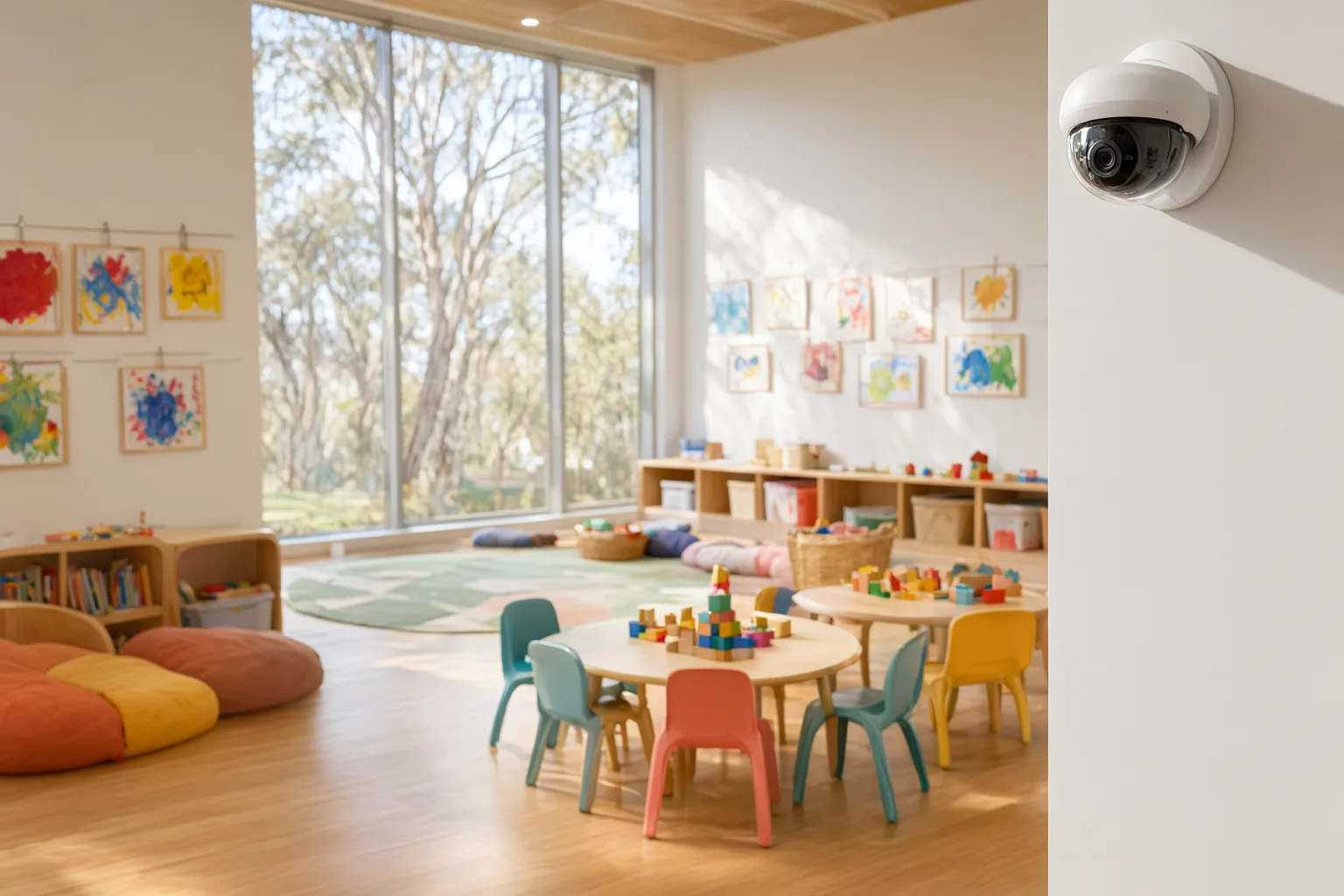
Inside, wide-angle dome cameras in play rooms provide general supervision support and reassure visiting parents. Sleep rooms call for domes with strong infrared performance and no visible LEDs, so rest periods are monitored without disturbing sleeping children. Outdoor play areas need weatherproof IP67-rated bullet cameras rated for full sun, rain and low light.
Staff and office areas deserve a thoughtful approach rather than blanket exclusion. Discreet domes with privacy masking protect sensitive spaces while respecting educator privacy, and they demonstrate to your team that the system is designed around fairness. The goal everywhere is the same: cover the spaces where incidents happen or disputes arise, and leave genuinely private spaces alone.
Can CCTV Protect Educators From False Allegations?
Educators work under intense scrutiny, and a single false allegation can end a career even when it is ultimately dismissed. Objective footage is one of the strongest protections available. When a misunderstanding arises, managers can review the record, resolve the matter in hours instead of weeks, and spare both the educator and the family prolonged stress.
When genuine incidents occur, footage lets leadership respond accurately: identify exactly what happened, support the affected child appropriately, brief families honestly, and hand regulators clear evidence if an authorised officer investigates. That transparency reduces escalation and demonstrates a culture of accountability that assessors notice.
Providers with well-run systems report fewer workers' compensation disputes, faster resolution of parent complaints, and measurably higher staff confidence. Few investments improve safety, compliance and reputation simultaneously, which explains why CCTV has become one of the most common capital upgrades in the sector.
Why Signage and Policy Build Parent Trust in Childcare Surveillance
Hardware alone does not build trust; communication does. Publish a plain-language CCTV policy covering camera locations, who may view footage, retention periods, and how parents can request a review after an incident. Display signage at every entrance stating that cameras operate on site and providing a contact for questions.
Train every educator to answer basic questions about the system confidently. When a parent asks why there is a camera in the sleep room or how long footage is kept, a consistent, informed answer prevents small concerns becoming formal complaints. Treat the system as part of your centre's openness story rather than a hidden security measure.
Finally, review the setup annually. Check that new play structures have not created blind spots, confirm storage still meets your retention window as enrolments grow, and update the policy whenever staffing or technology changes. A maintained system signals professionalism; a neglected one can undermine the very trust it was meant to build.
Recommended Camera Coverage for Childcare Centres
| Area | Camera Type | Key Features | Why It Matters |
|---|---|---|---|
| Main entry and exit | 4MP IP dome or bullet | Colour night vision, wide dynamic range | Captures every person entering or leaving; critical for incident review |
| Play rooms | 4MP IP dome | Wide-angle lens, audio (if permitted) | General supervision support and parent confidence |
| Sleep rooms | 4MP IP dome with infrared | Low-light performance, no visible LEDs | Monitors rest periods without disturbing children |
| Outdoor play areas | 4MP IP bullet | Weatherproof (IP67), ColorVu or Starlight | Covers large areas in all lighting and weather conditions |
| Car park and perimeter | 4MP IP bullet with varifocal lens | Long-range night vision, motion detection | Deters unauthorised access and monitors arrivals and departures |
| Office and staff areas | 4MP IP dome | Discreet design, privacy masking | Protects sensitive areas while respecting staff privacy |